I've been noticing how often privacy blockchains are discussed as if better cryptography automatically means less trust.
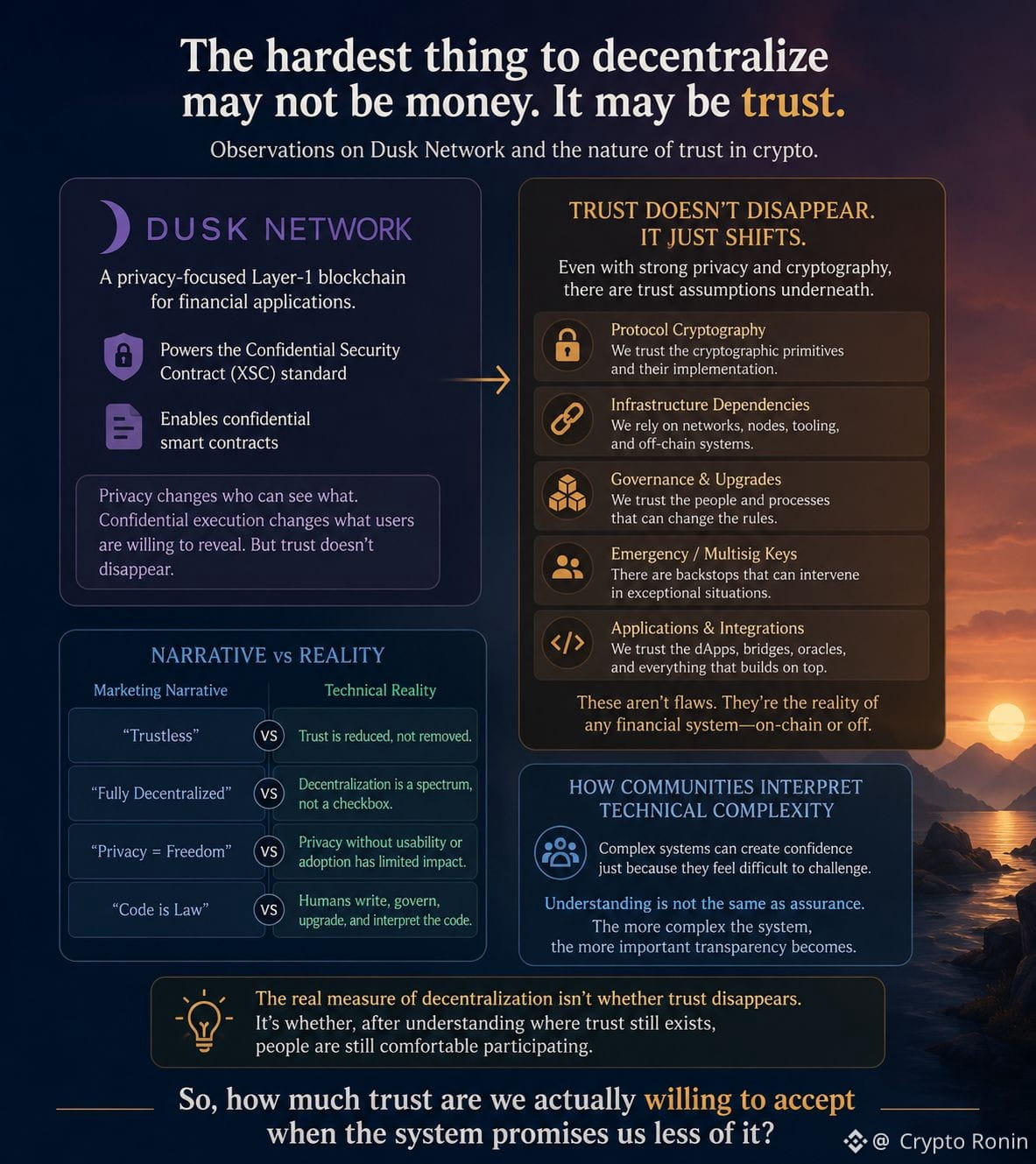
Dusk is an interesting case. It positions itself as a privacy-focused Layer-1 for financial applications, with confidential smart contracts and the XSC standard. But the more I watch narratives around projects like this, the more I wonder whether the technology is only half the story.
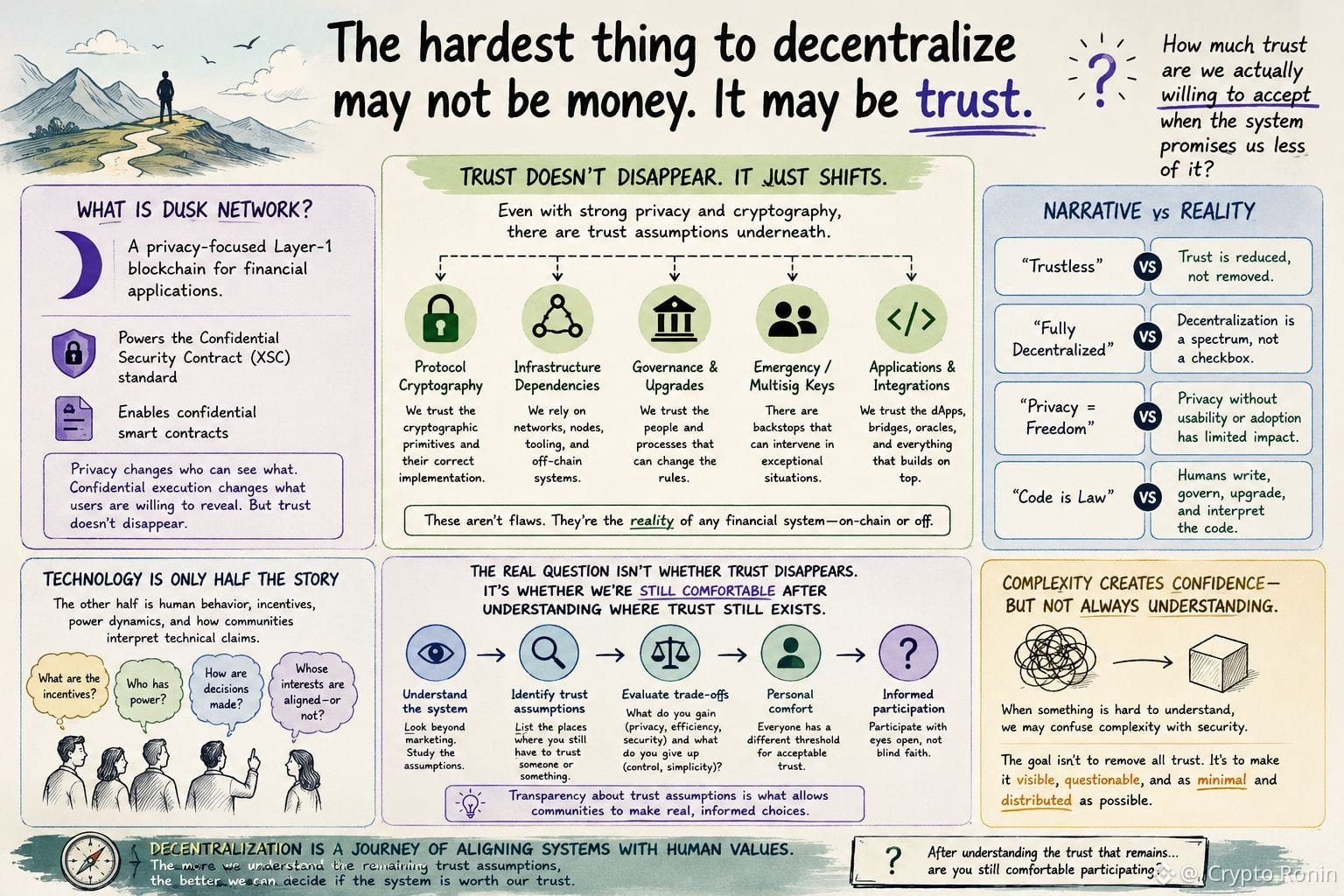
Privacy changes who can see what. Confidential execution changes what users are willing to reveal. But neither necessarily removes the need to trust systems, developers, governance, or the assumptions underneath the protocol.
There is a difference between a marketing narrative that says "trustless" and the technical reality of a system with cryptographic assumptions, protocol rules, implementation risks, and human decisions around upgrades and governance.
That doesn't make the system inherently flawed. Every financial infrastructure has trust assumptions. The more interesting question is whether those assumptions are visible, understandable, and distributed well enough that users can make informed judgments.
I've also been thinking about how communities interpret technical complexity. Sometimes complexity creates confidence simply because it feels difficult to challenge.
Maybe the real measure of decentralization isn't whether trust disappears.
Maybe it's whether, after understanding where trust still exists, people are still comfortable participating.
So I keep coming back to one question: how much trust are we actually willing to accept when the system promises us less of it?
@Dusk $DUSK #dusk
$ENA
$SOL
Dusk is an interesting case. It positions itself as a privacy-focused Layer-1 for financial applications, with confidential smart contracts and the XSC standard. But the more I watch narratives around projects like this, the more I wonder whether the technology is only half the story.
Privacy changes who can see what. Confidential execution changes what users are willing to reveal. But neither necessarily removes the need to trust systems, developers, governance, or the assumptions underneath the protocol.
There is a difference between a marketing narrative that says "trustless" and the technical reality of a system with cryptographic assumptions, protocol rules, implementation risks, and human decisions around upgrades and governance.
That doesn't make the system inherently flawed. Every financial infrastructure has trust assumptions. The more interesting question is whether those assumptions are visible, understandable, and distributed well enough that users can make informed judgments.
I've also been thinking about how communities interpret technical complexity. Sometimes complexity creates confidence simply because it feels difficult to challenge.
Maybe the real measure of decentralization isn't whether trust disappears.
Maybe it's whether, after understanding where trust still exists, people are still comfortable participating.
So I keep coming back to one question: how much trust are we actually willing to accept when the system promises us less of it?
@Dusk $DUSK #dusk
$ENA
$SOL