There’s a certain sameness across a lot of blockchain, AI, and Web3 projects. The terminology changes, the narratives get refreshed, but underneath it, many are still telling versions of the same story. What caught my attention with Dusk is that its focus feels less like a narrative and more like an answer to a practical constraint.
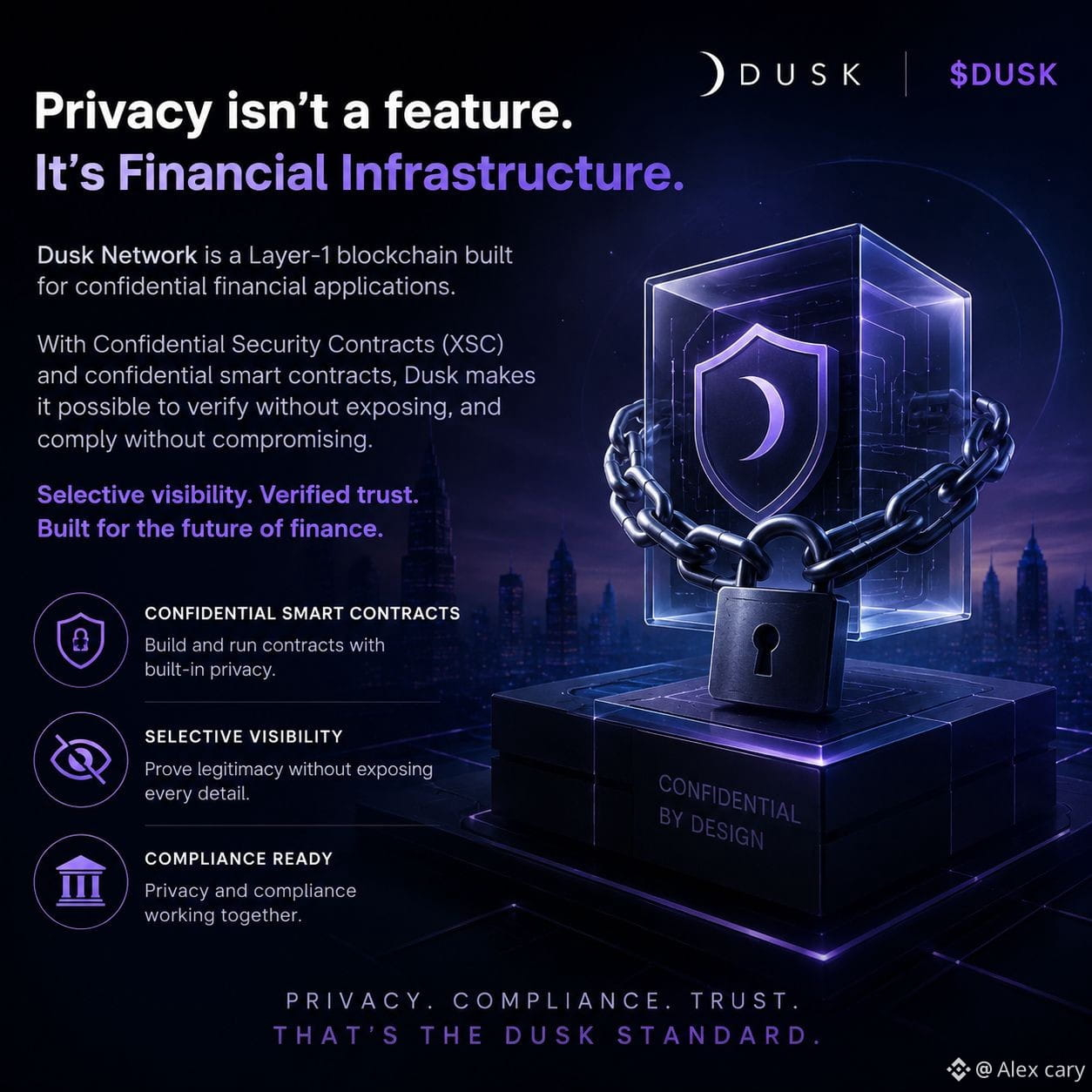
The core idea is privacy, but not privacy as a checkbox on a feature list. Dusk is building a Layer-1 aimed at financial applications, with confidential smart contracts and its Confidential Security Contract standard. For me, that distinction matters because financial information is often sensitive by default. Businesses may need to prove that an action or transaction is valid without putting every detail of their activity into public view.
That creates an interesting tension between confidentiality and verification. Too much transparency can expose information that should remain private, while too much privacy can make trust and compliance harder. If blockchain infrastructure is eventually used more seriously by institutions and businesses, finding a workable balance between those two sides could become increasingly important.
What I found interesting about Dusk is that the privacy thesis is tied to this broader infrastructure problem. Whether it succeeds will come down to execution, usability, adoption, and scale, not simply the technology itself.
From my perspective, that makes Dusk worth watching for a simple reason: it is working on a problem that could become more relevant as blockchain moves from experimentation toward practical financial use.
@Dusk $DUSK #dusk
The core idea is privacy, but not privacy as a checkbox on a feature list. Dusk is building a Layer-1 aimed at financial applications, with confidential smart contracts and its Confidential Security Contract standard. For me, that distinction matters because financial information is often sensitive by default. Businesses may need to prove that an action or transaction is valid without putting every detail of their activity into public view.
That creates an interesting tension between confidentiality and verification. Too much transparency can expose information that should remain private, while too much privacy can make trust and compliance harder. If blockchain infrastructure is eventually used more seriously by institutions and businesses, finding a workable balance between those two sides could become increasingly important.
What I found interesting about Dusk is that the privacy thesis is tied to this broader infrastructure problem. Whether it succeeds will come down to execution, usability, adoption, and scale, not simply the technology itself.
From my perspective, that makes Dusk worth watching for a simple reason: it is working on a problem that could become more relevant as blockchain moves from experimentation toward practical financial use.
@Dusk $DUSK #dusk