
@Dusk #dusk I’ve been looking at Dusk Network ($DUSK ) from a slightly different angle: what does it look like when I stop reading the marketing and start watching the chain?
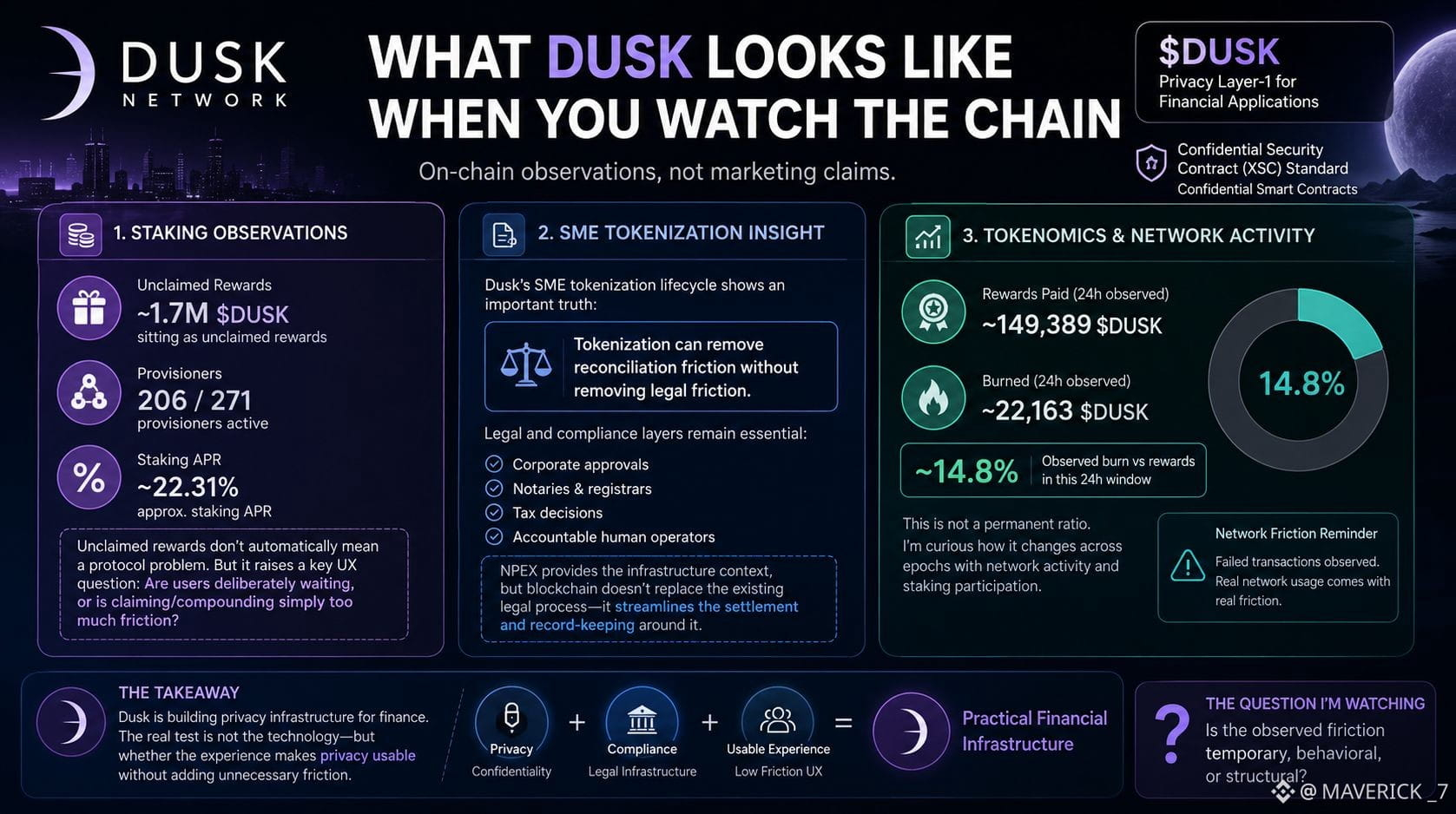
One thing that caught my attention is staking. Around 1.7M DUSK appeared as unclaimed rewards, while 206 of 271 provisioners were active, with staking APR around 22.31%. That doesn’t automatically signal a protocol problem. But it raises a useful UX question: are users deliberately waiting, or is claiming and compounding still more friction than expected?
Then there’s SME tokenization. Dusk’s lifecycle makes something clear: tokenization doesn’t erase legal infrastructure. Corporate approvals, notaries, tax decisions and accountable human operators can still matter. The interesting value may be reducing reconciliation friction without removing legal friction. The NPEX context is useful here, but blockchain shouldn’t be framed as replacing the entire legal process.
I also noticed roughly 149,389 DUSK in rewards against 22,163 burned in one observed 24h window about 14.8%. I wouldn’t treat that as permanent. I’m more curious how it changes across epochs, activity and staking participation. Failed transactions also remind me that real usage has friction.
So I’m watching one question closely: is this friction temporary, behavioral, or structural?
$DUSK
One thing that caught my attention is staking. Around 1.7M DUSK appeared as unclaimed rewards, while 206 of 271 provisioners were active, with staking APR around 22.31%. That doesn’t automatically signal a protocol problem. But it raises a useful UX question: are users deliberately waiting, or is claiming and compounding still more friction than expected?
Then there’s SME tokenization. Dusk’s lifecycle makes something clear: tokenization doesn’t erase legal infrastructure. Corporate approvals, notaries, tax decisions and accountable human operators can still matter. The interesting value may be reducing reconciliation friction without removing legal friction. The NPEX context is useful here, but blockchain shouldn’t be framed as replacing the entire legal process.
I also noticed roughly 149,389 DUSK in rewards against 22,163 burned in one observed 24h window about 14.8%. I wouldn’t treat that as permanent. I’m more curious how it changes across epochs, activity and staking participation. Failed transactions also remind me that real usage has friction.
So I’m watching one question closely: is this friction temporary, behavioral, or structural?
$DUSK