#dusk $DUSK @Dusk
@Dusk Earlier, I used to think a Layer 1 for finance mainly needed to be fast, cheap, and capable of handling tokenized assets.
But the more I looked into Dusk, the more I felt that view was too simple.
A tokenized bond or fund doesn’t automatically become a usable financial asset just because it’s onchain. You still need to answer who can buy it, who can hold it, what information should be disclosed, what should remain private, and how payments settle alongside the asset.
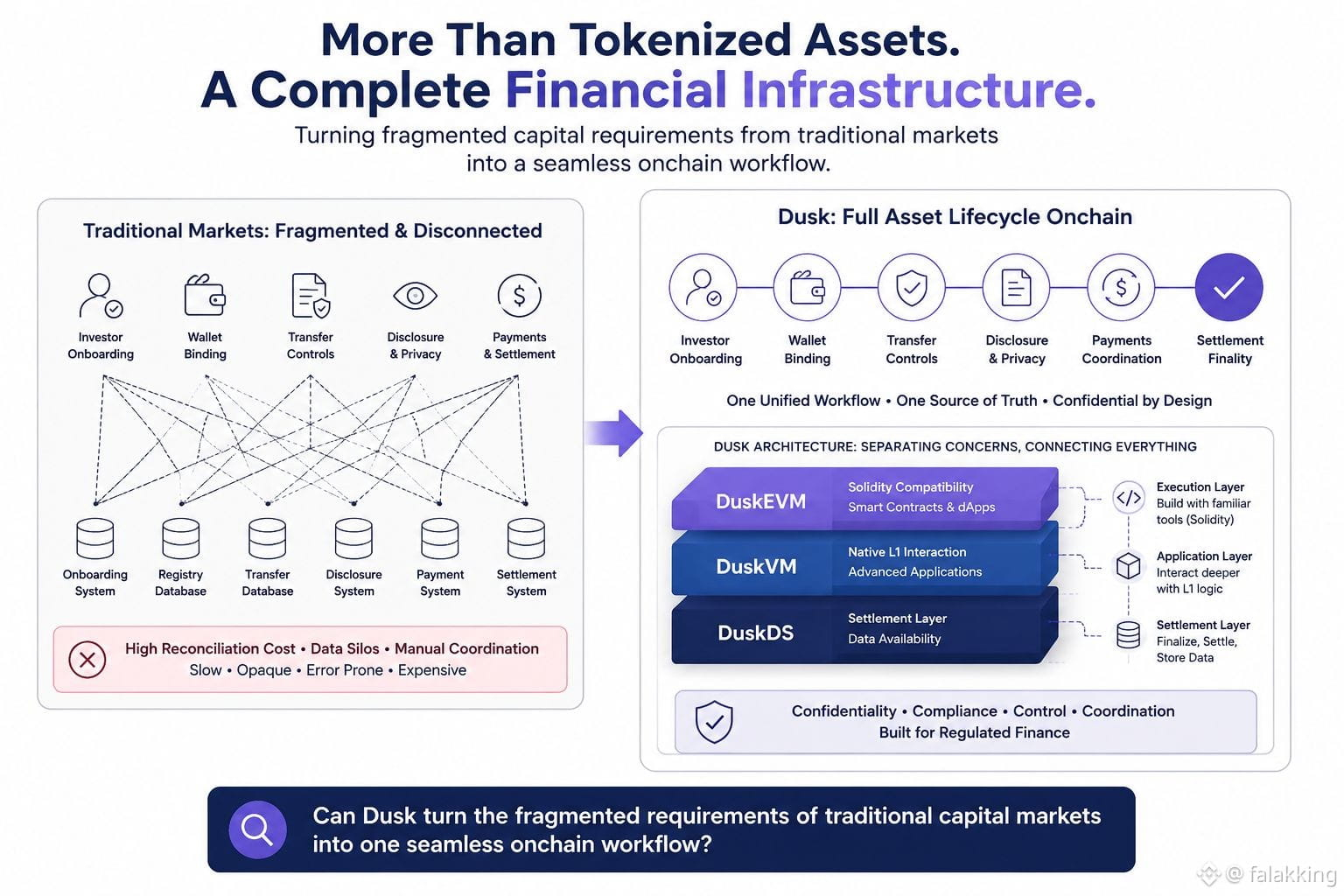
That’s where Dusk caught my attention. It seems to approach RWAs around the full asset lifecycle, including onboarding, wallet binding, transfer controls, disclosure, and payment coordination.
The architecture is interesting too: DuskEVM for Solidity-based applications, DuskVM for deeper L1 interaction, while DuskDS focuses on settlement and data availability.
I’m still not convinced that having more layers automatically makes Dusk better financial infrastructure. In fact, more components also mean more things that need to work reliably in practice.
But that’s exactly what I want to watch.
Can Dusk actually turn the fragmented requirements of traditional capital markets into one seamless onchain workflow?
That, to me, is the more important question.
@Dusk Earlier, I used to think a Layer 1 for finance mainly needed to be fast, cheap, and capable of handling tokenized assets.
But the more I looked into Dusk, the more I felt that view was too simple.
A tokenized bond or fund doesn’t automatically become a usable financial asset just because it’s onchain. You still need to answer who can buy it, who can hold it, what information should be disclosed, what should remain private, and how payments settle alongside the asset.
That’s where Dusk caught my attention. It seems to approach RWAs around the full asset lifecycle, including onboarding, wallet binding, transfer controls, disclosure, and payment coordination.
The architecture is interesting too: DuskEVM for Solidity-based applications, DuskVM for deeper L1 interaction, while DuskDS focuses on settlement and data availability.
I’m still not convinced that having more layers automatically makes Dusk better financial infrastructure. In fact, more components also mean more things that need to work reliably in practice.
But that’s exactly what I want to watch.
Can Dusk actually turn the fragmented requirements of traditional capital markets into one seamless onchain workflow?
That, to me, is the more important question.