$XRP
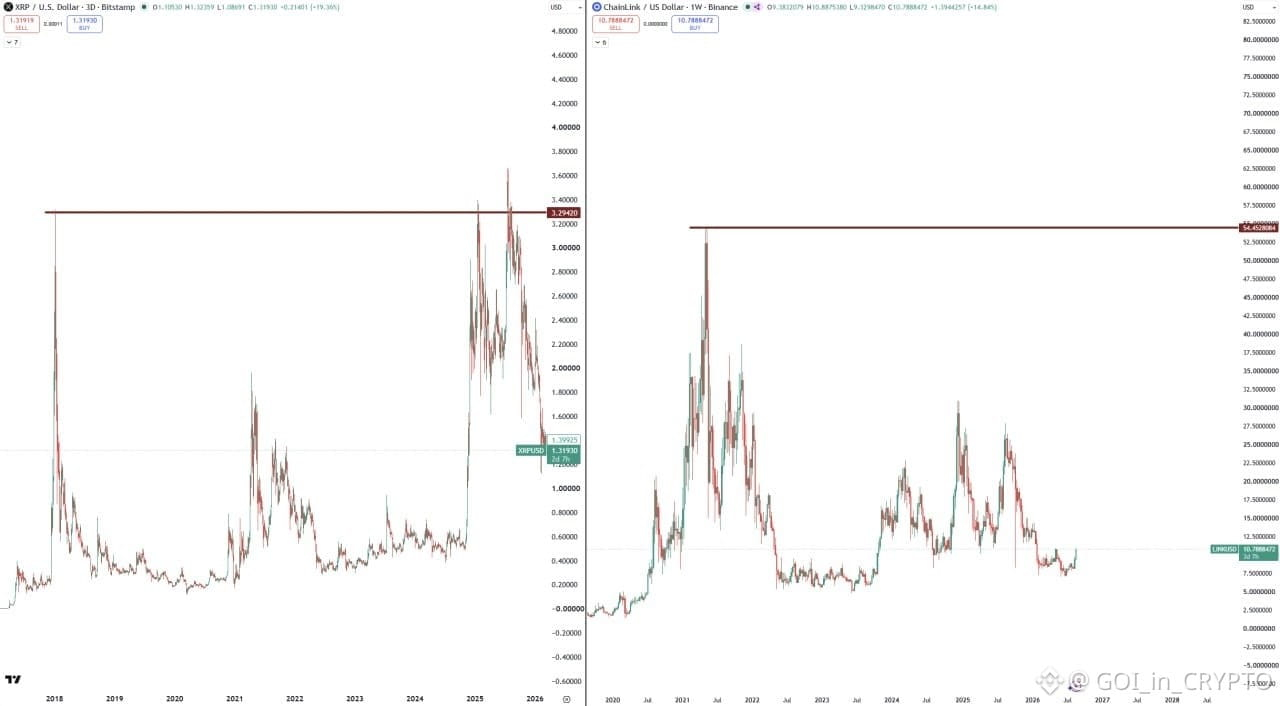
The provided chart illustrates a striking macro fractal comparison between XRP and Chainlink (LINK), highlighting the immense potential of multi-year consolidation breakouts. On the left, XRP’s long-term accumulation beneath a rigid $3.29 resistance culminated in a massive vertical expansion during the latter half of 2024. The right chart suggests that LINK is currently mirroring this exact market structure, quietly printing a massive multi-year rounding bottom beneath its historic $54.45 ceiling. Because LINK is fundamentally lagging behind XRP's historical timeline by roughly two years, the visual thesis strongly positions late 2026 as the prime macro launchpad for Chainlink's next major parabolic run. If history repeats and LINK decisively reclaims its key macro resistance, it could trigger an aggressive wave of price discovery similar to XRP's previous cycle. However, technical fractals are inherently speculative and depend heavily on global liquidity conditions, meaning strict risk management and portfolio diversification remain essential to guard against sudden market rejections.
The provided chart illustrates a striking macro fractal comparison between XRP and Chainlink (LINK), highlighting the immense potential of multi-year consolidation breakouts. On the left, XRP’s long-term accumulation beneath a rigid $3.29 resistance culminated in a massive vertical expansion during the latter half of 2024. The right chart suggests that LINK is currently mirroring this exact market structure, quietly printing a massive multi-year rounding bottom beneath its historic $54.45 ceiling. Because LINK is fundamentally lagging behind XRP's historical timeline by roughly two years, the visual thesis strongly positions late 2026 as the prime macro launchpad for Chainlink's next major parabolic run. If history repeats and LINK decisively reclaims its key macro resistance, it could trigger an aggressive wave of price discovery similar to XRP's previous cycle. However, technical fractals are inherently speculative and depend heavily on global liquidity conditions, meaning strict risk management and portfolio diversification remain essential to guard against sudden market rejections.