
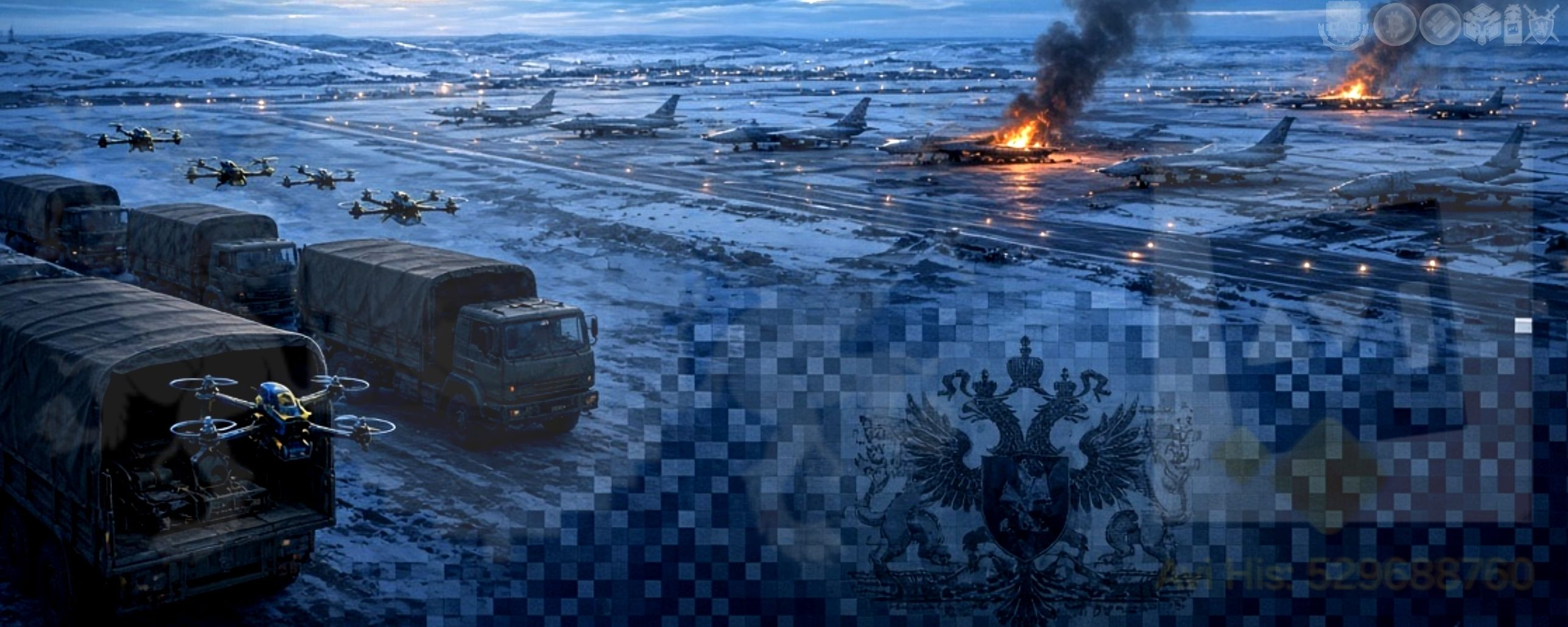
In the pre-dawn hours across multiple time zones, a carefully prepared set of low-cost drones rose almost simultaneously from concealed positions on the backs of ordinary-looking trucks parked near several of Russia’s most important long-range aviation bases. The targets stretched from near the Arctic Circle in the north to Belaya air base in eastern Siberia—more than 4,000 km from Ukrainian-held territory—and included other key sites in between. Within roughly an hour, the drones had reached their objectives.
Ukrainian officials later stated that 117 drones participated. Footage released by Ukraine’s Security Service showed drones approaching and striking parked strategic bombers—Tu-95s, Tu-22Ms, and related aircraft used to carry long-range cruise missiles—hitting them in vulnerable areas. Satellite imagery afterward confirmed multiple aircraft reduced to burned wreckage or heavily damaged in their parking spots and revetments. Ukrainian claims put the number of aircraft hit at around 41, with at least a dozen destroyed or rendered irreparable and roughly one-third of Russia’s strategic cruise-missile carrier force affected. Independent U.S. assessments and open-source analysis supported significant losses on the order of 10–20 aircraft hit, with several clearly destroyed. The estimated value of the damage ran to about $7 billion. Because Russia no longer produces these bomber types, the losses could not be quickly replaced.
The operation’s geographic span—five air bases across five time zones—and its success against high-value, relatively static strategic assets deep inside Russian territory made it stand out. Russian sources acknowledged attacks had occurred and confirmed some aircraft damage at certain bases while claiming others were largely repelled. The psychological and strategic impact was immediate: pro-Russian commentators called it a “Pearl Harbor” moment for Russia’s long-range aviation, and Ukrainian leadership described it as one of the most damaging strikes of the war on Russia’s ability to launch certain types of missile attacks.
Production and repair of the affected bombers is slow or impossible at scale, so the effect lingered beyond the single morning of strikes. The entire effort used inexpensive drones against aircraft that cost hundreds of millions each, illustrating the asymmetric potential of the technology.
This is the kind of exceptional situation that stands out in recent drone warfare: not the highest body count (drone attacks rarely approach the death tolls of 20th-century mass bombing raids), and not the absolute largest number of drones launched in one wave (Russian saturation attacks in the same war have used several hundred in a single night), but one of the highest-impact combinations of reach, surprise, concentration on strategic targets, and measurable degradation of a major power’s high-end air capabilities. Traditional large-scale bombing raids (e.g., WWII firebombings) caused far higher death tolls and physical destruction than any drone operation to date. Drone attacks stand out instead for precision, surprise, low cost relative to effect, and asymmetric impact.
Only two stand out as exceptional in different ways: the 2019 Abqaiq–Khurais strikes on Saudi oil facilities (for global economic shock) and Ukraine’s June 2025 Operation Spiderweb (for strategic military effect and ingenuity of reach).
The 2019 Abqaiq–Khurais attack: economic shockwave
On 14 September 2019, coordinated strikes hit Saudi Aramco’s Abqaiq oil-processing facility (one of the world’s most important crude stabilization plants) and the Khurais oil field. Production was cut by roughly 5.7 million barrels per day—about half of Saudi output and around 5% of global supply at the time. Fires were contained within hours, and no fatalities were publicly reported, but the disruption was immediate and worldwide.
Oil markets reacted sharply: Brent crude futures surged nearly 15–20% in the largest single-day percentage jump in decades (comparable in scale to shocks around the 1990 Iraqi invasion of Kuwait). Saudi stocks fell, and global energy prices spiked before partially easing as Aramco restored significant capacity within days and aimed for full recovery by month’s end using other fields, storage, and rapid repairs. Estimated direct repair costs ran into the hundreds of millions to low billions of dollars, with broader economic ripple effects higher. Attribution was contested (Houthis claimed it; Saudi Arabia, the U.S., and others pointed to Iran), but the event demonstrated how limited, precise strikes on critical energy infrastructure could temporarily remove a major share of world oil supply and rattle markets
It remains a benchmark for economic damage from drones (or mixed drone/missile attacks) because the target was a chokepoint in the global energy system rather than a battlefield asset.
Operation Spiderweb (1 June 2025): strategic military blow
In a highly coordinated operation deep inside Russia during the ongoing war, Ukrainian forces used 117 drones against multiple Russian long-range aviation air bases (including sites spanning several time zones, one as far as Belaya in eastern Siberia—thousands of kilometers from Ukraine). Ukrainian officials claimed hits on around 41 aircraft (including strategic bombers such as Tu-95, Tu-22M, and others used as cruise-missile carriers), with roughly a third of Russia’s strategic cruise-missile carrier force affected and an estimated $7 billion in damage. Independent assessments and satellite imagery confirmed significant destruction or serious damage to multiple bombers (U.S. officials cited roughly 20 aircraft hit and about 10 destroyed; visual evidence supported losses of at least a dozen in key categories).
These aircraft are no longer in production, so losses are hard or impossible to replace quickly. The operation disrupted Russia’s capacity to launch certain long-range strikes, delivered a psychological and propaganda effect (pro-Russian voices compared it to a “Pearl Harbor”), and showcased extreme geographic reach and surprise against high-value, relatively static strategic assets. It was widely described as one of the most significant Ukrainian blows of the war in terms of degrading specific military capabilities at low relative cost.
Scale by numbers of drones
In the Russia–Ukraine war, sheer volume has repeatedly set new records. Russian launches have included assaults with several hundred drones in a single wave (examples in 2025 reports include 355, then 477+, 539, 728, and later claims approaching or exceeding 800–900+ combined drones and missiles). These overwhelm air defenses through saturation and cause cumulative infrastructure and civilian harm, though individual waves rarely match the strategic concentration of Spiderweb or the economic punch of Abqaiq.
Broader context
Drone warfare has expanded rapidly, producing high civilian tolls in places such as Sudan (where drones became a leading cause of civilian deaths in periods of 2026) and elsewhere, but single-incident death tolls remain lower than conventional mass air raids of the 20th century. The “exceptional” quality of modern drone attacks often lies in asymmetry: inexpensive systems achieving effects once reserved for manned aircraft or missiles, against targets previously considered secure by distance or defenses.
High-level analysis of the drone technologies referenced in the exceptional attacks discussed (primarily Ukraine’s Operation Spiderweb in June 2025 and the 2019 Abqaiq–Khurais strikes), based on public reporting.
Operation Spiderweb (Ukraine, June 2025)
Public accounts identify the systems used as small first-person-view (FPV) quadcopters, specifically Ukrainian-produced models referred to as Osa (“Wasp”). These are compact, multi-rotor platforms adapted from commercial/hobbyist-style designs rather than large military-grade long-endurance aircraft.
Key publicly described characteristics include:
- Relatively low unit cost (reports commonly cite figures in the range of roughly $1,000–$2,000 each).
- Modest payload capacity (around 3 kg class).
- Use of open-source autopilot software (ArduPilot is frequently mentioned) supporting autonomous or semi-autonomous flight segments, including dead-reckoning navigation that can continue even if control links are temporarily interrupted.
- Remote piloting via commercial mobile networks (4G/LTE) available inside Russia, allowing operators located in Ukraine to receive video feeds and issue commands over long distances once the drones were already near the targets.
- Reports of AI-assisted targeting elements trained to recognize and prioritize vulnerable points on specific aircraft types.
Strengths demonstrated: Extreme cost asymmetry (inexpensive platforms versus multi-million-dollar strategic bombers that are no longer in production). High precision possible against static, soft-skinned, high-value targets when the drones could be launched from nearby concealed positions. Difficulty of detection due to small size and low altitude/profile once airborne near the bases. Ability to coordinate multiple simultaneous strikes across widely separated locations.
Limitations inherent to this class: Short inherent endurance and range of typical small FPV platforms, which made pre-positioning near the targets essential. Dependence on local cellular networks for the final control phase. Vulnerability to electronic warfare, physical interception, or simple visual/ acoustic detection once in the air near defended sites. Success relied heavily on the element of surprise and the specific vulnerability of parked aircraft rather than on the drones’ ability to penetrate layered air defenses over long distances.
This represents a mature evolution of tactical FPV technology that has become ubiquitous on the Ukraine front lines, scaled and adapted for a deep, clandestine strategic strike.
2019 Abqaiq–Khurais attack
The systems involved were longer-range one-way attack / loitering munitions, described as delta-wing designs. Saudi and U.S. assessments attributed them primarily to Iranian-origin technology (variants similar to designs such as the Toofan or related systems), with Houthi claims of using multiple types including propeller-driven and some jet-powered variants. They were employed in combination with cruise missiles.
These platforms offered greater range and endurance than small FPV quadcopters, enabling strikes from farther away, and were optimized for saturation or precision attacks on fixed infrastructure. Their impact was economic and systemic rather than purely military-tactical: temporary removal of a significant share of global oil processing capacity.
Broader context in the Russia–Ukraine war (2022–2026)
Two dominant categories have defined the conflict’s drone technology landscape:
- Short- to medium-range FPV and tactical attack drones — cheap, mass-produced, operator-guided or semi-autonomous systems used intensively for frontline attrition, logistics interdiction, and precision strikes against vehicles, positions, and individuals. Production has scaled into the millions annually on both sides.
- Longer-range one-way attack drones (e.g., Iranian-origin Shahed-136 / Russian Geran-2 and subsequent jet-powered variants such as Geran-3/4) — propeller- or jet-driven loitering munitions with ranges of hundreds to over a thousand kilometers, used primarily for saturation attacks on energy infrastructure, air bases, and cities. Russia has emphasized volume (hundreds per night in large packages, often mixed with decoys and missiles) to overwhelm defenses.
Overall technological trends:
- Democratization and commercialization: Heavy reliance on adapted civilian components, open-source software, and rapid iteration rather than traditional expensive military R&D cycles.
- Asymmetry: Low unit costs enable mass employment and acceptance of high attrition rates.
- Hybrid control: Combinations of pre-programmed autonomy, real-time human piloting (via radio, cellular, or fiber-optic links), and increasingly AI-assisted target recognition.
- Countermeasures race: Defenses have evolved toward layered systems including electronic warfare, interceptor drones, mobile gun groups, and improved detection, which in turn drives further adaptation (faster jets, fiber-optic guidance immune to jamming, better autonomy, decoys).
The standout technologies in the exceptional cases discussed prioritize accessibility, low cost, and clever employment over sophisticated stealth or high speed. Small FPV systems excel at precise, opportunistic strikes when proximity can be achieved; longer-range one-way attack drones excel at volume and reach against fixed infrastructure. Both have forced major changes in air defense priorities, force protection, and the economics of high-value asset basing.
Abqaiq–Khurais is frequently cited for the largest short-term global economic disruption attributable in significant part to drones, while Operation Spiderweb stands out for audacious strategic impact on a major power’s high-end air assets. Records for volume continue to be broken in ongoing conflicts, and “biggest/most damaging” depends on the metric chosen.
The connections between the major drone attacks in question (especially Operation Spiderweb on 1 June 2025) and Ukraine were drawn openly and directly by Ukrainian officials themselves.
Ukraine’s Security Service (SBU) claimed full responsibility for the operation. SBU head Lt. Gen. Vasyl Maliuk publicly described it in detail, stating that the agency planned, prepared, and executed the strikes using 117 drones against Russian long-range aviation bases. President Volodymyr Zelenskyy said he personally supervised the effort, which took “one year, six months and nine days” from the start of planning to execution, and he highlighted the results in official statements.
Ukrainian sources released video footage from the drones showing approaches to and impacts on aircraft at the targeted bases. They asserted the operation was conducted entirely with Ukrainian resources and personnel, with no foreign partners involved in the planning or execution. When Russian officials later suggested a possible “foreign trace,” the SBU explicitly rejected the claim and reiterated that the operation was carried out solely by its own forces.
Russia confirmed that attacks had taken place at several air bases (including sites in Murmansk, Irkutsk, and others) and acknowledged some aircraft damage, while disputing the full scale of losses claimed by Ukraine. Independent reporting, satellite imagery analysis, and open-source verification corroborated significant damage to multiple strategic bombers, consistent with the Ukrainian account of responsibility.
In short, the primary “line” linking the attacks to Ukraine was Ukraine’s own clear, high-level public attribution and documentation of the operation. This stood in contrast to earlier or other deep-strike incidents in the conflict, where responsibility was sometimes left unclaimed or more ambiguous.