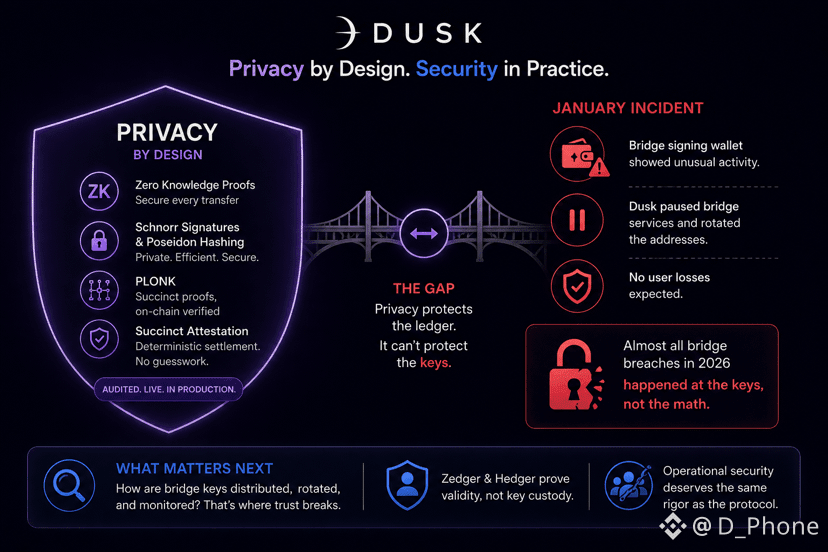
Dusk Network sells itself on a simple premise. Privacy should live inside the protocol, not get bolted on afterward. Zero knowledge proofs secure every Phoenix transfer. Schnorr signatures and Poseidon hashing sit under the hood, and PLONK makes the proofs succinct enough to verify on chain. All of that is real, it is audited, and it runs in production today under Succinct Attestation, a consensus design built specifically for deterministic settlement rather than probabilistic guesswork. Then January happened.
A team managed wallet used for bridge operations started showing unusual activity. Dusk paused bridge services, disabled and recycled the affected addresses, and stated publicly that it did not expect user losses to materialize. I take that account seriously. But the incident exposes something the privacy pitch tends to skip over. The cryptography protecting a shielded note has nothing to do with the operational security of a signing wallet moving assets on the outside edge of that same system.
This is not unique to Dusk. Bridges across the industry bled hundreds of millions of dollars in 2026 alone, almost always through compromised keys rather than broken math. So what do I actually want from Dusk Network next? Not another paper explaining PLONK circuits. A public account of how bridge signing authority gets distributed, rotated, and monitored, because that is where trust breaks in practice, not the zero knowledge layer.
Zedger and Hedger can prove a transaction is valid without revealing its contents to the public. Neither can prove a signing wallet was operated correctly. Selective disclosure protects the ledger. It says very little about the people holding keys around it, and that particular gap deserves as much attention as the circuits do.
If the base protocol can be this rigorous about what it proves, the wallets and addresses just outside that boundary deserve the same standard. Dusk Network answered the incident quickly. Whether that discipline holds permanently, not just after a scare
@Dusk #dusk $DUSK $BTW $ACE
A team managed wallet used for bridge operations started showing unusual activity. Dusk paused bridge services, disabled and recycled the affected addresses, and stated publicly that it did not expect user losses to materialize. I take that account seriously. But the incident exposes something the privacy pitch tends to skip over. The cryptography protecting a shielded note has nothing to do with the operational security of a signing wallet moving assets on the outside edge of that same system.
This is not unique to Dusk. Bridges across the industry bled hundreds of millions of dollars in 2026 alone, almost always through compromised keys rather than broken math. So what do I actually want from Dusk Network next? Not another paper explaining PLONK circuits. A public account of how bridge signing authority gets distributed, rotated, and monitored, because that is where trust breaks in practice, not the zero knowledge layer.
Zedger and Hedger can prove a transaction is valid without revealing its contents to the public. Neither can prove a signing wallet was operated correctly. Selective disclosure protects the ledger. It says very little about the people holding keys around it, and that particular gap deserves as much attention as the circuits do.
If the base protocol can be this rigorous about what it proves, the wallets and addresses just outside that boundary deserve the same standard. Dusk Network answered the incident quickly. Whether that discipline holds permanently, not just after a scare
@Dusk #dusk $DUSK $BTW $ACE