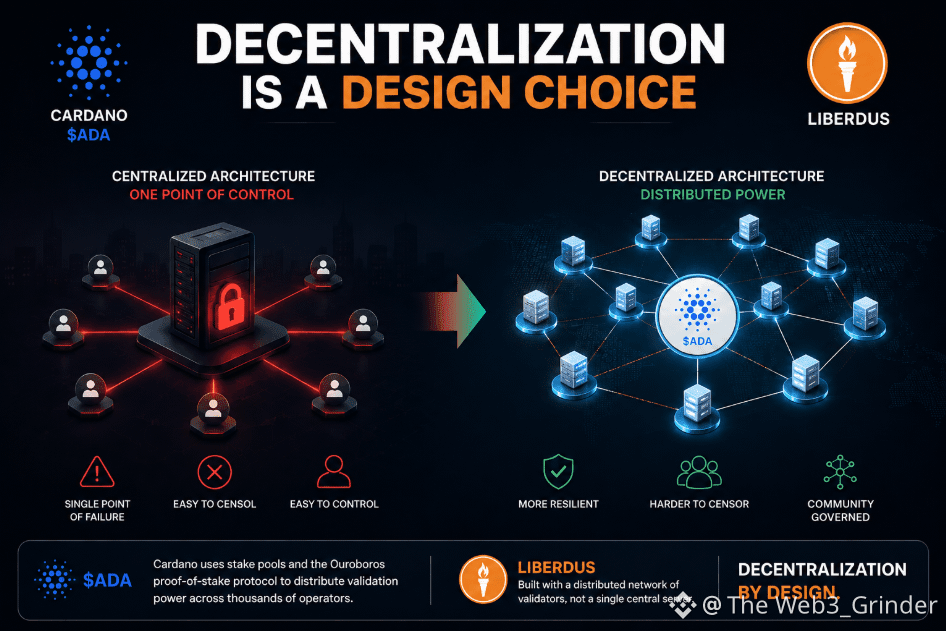
DECENTRALIZATION IS A DESIGN CHOICE
Decentralization doesn't happen just because you call a network decentralized.
It has to be built into the way the network works.
Take Cardano ( $ADA )
Instead of having one company decide who validates transactions, Cardano uses stake pools through its Ouroboros proof-of-stake protocol.
ADA holders can delegate their stake to different pools, while pool operators run the infrastructure that produces and validates blocks.
Cardano also uses a saturation mechanism that discourages too much stake from concentrating in a single pool, encouraging delegation across multiple pools.
That's the important part:
Decentralization isn't a feature you switch on.
It's a design choice.
And that's also why the architecture behind Liberdus matters.
Its network is designed around distributed validators rather than one central server.
Different networks. Different architectures.
But the same question remains:
How much control should one entity have?
#ADA #Cardano
Decentralization doesn't happen just because you call a network decentralized.
It has to be built into the way the network works.
Take Cardano ( $ADA )
Instead of having one company decide who validates transactions, Cardano uses stake pools through its Ouroboros proof-of-stake protocol.
ADA holders can delegate their stake to different pools, while pool operators run the infrastructure that produces and validates blocks.
Cardano also uses a saturation mechanism that discourages too much stake from concentrating in a single pool, encouraging delegation across multiple pools.
That's the important part:
Decentralization isn't a feature you switch on.
It's a design choice.
And that's also why the architecture behind Liberdus matters.
Its network is designed around distributed validators rather than one central server.
Different networks. Different architectures.
But the same question remains:
How much control should one entity have?
#ADA #Cardano