#termmax @TermMax
I kept coming back to one number after looking through TermMax the gap between its TVL and active loans.
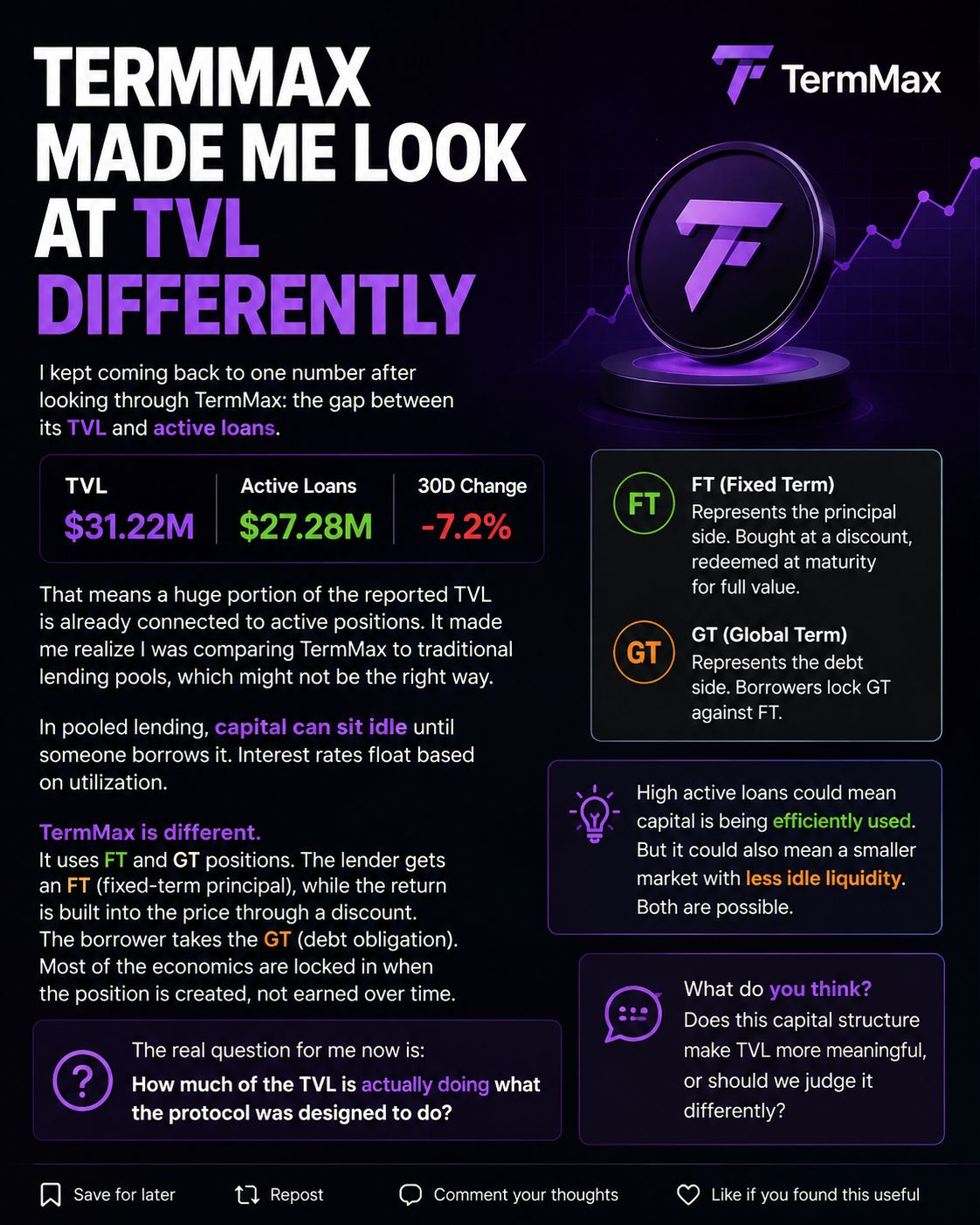
When I checked DefiLlama TVL was around $31.22M, while active loans were about $27.28M. TVL was down roughly 7.2% over 30 days, which by itself doesn’t tell me much. DeFi liquidity moves all the time.
The active-loan figure was the part I found more interesting.
That is a huge portion of the reported TVL already connected to active positions. It made me realize that I was looking at TermMax through the same lens I use for traditional pooled lending protocols, and that probably isn’t the best comparison.
With a typical lending pool, capital can sit there unused until someone borrows it. The pool has available liquidity, borrowers come and go, and the interest rate changes depending on utilization.
TermMax works around a different structure.
Its fixed-term markets use FT and GT positions. When a lender enters, the FT represents the principal side of the position, while the fixed return is built into the price through the discount. The borrower takes on the corresponding GT debt obligation.
So the yield isn’t simply some floating number slowly appearing in a dashboard. A lot of the economics are defined when the position is created.
That changes how I think about TVL here.
A high percentage of active loans could point toward capital being efficiently deployed, but I don’t think it automatically proves the market is efficient. It could also reflect a smaller market with less unused liquidity.
That distinction matters.
For me, the interesting question is no longer just How much TVL does TermMax have?”
It’s How much of that capital is actually doing what the protocol was designed to do?
What do you think does this capital structure make TVL more meaningful, or should we judge it differently?
I kept coming back to one number after looking through TermMax the gap between its TVL and active loans.
When I checked DefiLlama TVL was around $31.22M, while active loans were about $27.28M. TVL was down roughly 7.2% over 30 days, which by itself doesn’t tell me much. DeFi liquidity moves all the time.
The active-loan figure was the part I found more interesting.
That is a huge portion of the reported TVL already connected to active positions. It made me realize that I was looking at TermMax through the same lens I use for traditional pooled lending protocols, and that probably isn’t the best comparison.
With a typical lending pool, capital can sit there unused until someone borrows it. The pool has available liquidity, borrowers come and go, and the interest rate changes depending on utilization.
TermMax works around a different structure.
Its fixed-term markets use FT and GT positions. When a lender enters, the FT represents the principal side of the position, while the fixed return is built into the price through the discount. The borrower takes on the corresponding GT debt obligation.
So the yield isn’t simply some floating number slowly appearing in a dashboard. A lot of the economics are defined when the position is created.
That changes how I think about TVL here.
A high percentage of active loans could point toward capital being efficiently deployed, but I don’t think it automatically proves the market is efficient. It could also reflect a smaller market with less unused liquidity.
That distinction matters.
For me, the interesting question is no longer just How much TVL does TermMax have?”
It’s How much of that capital is actually doing what the protocol was designed to do?
What do you think does this capital structure make TVL more meaningful, or should we judge it differently?