#termmax @TermMax
I was thinking about how most DeFi lending still leaves users exposed to moving interest rates. Then I looked deeper into @TermMax, and the architecture felt different.
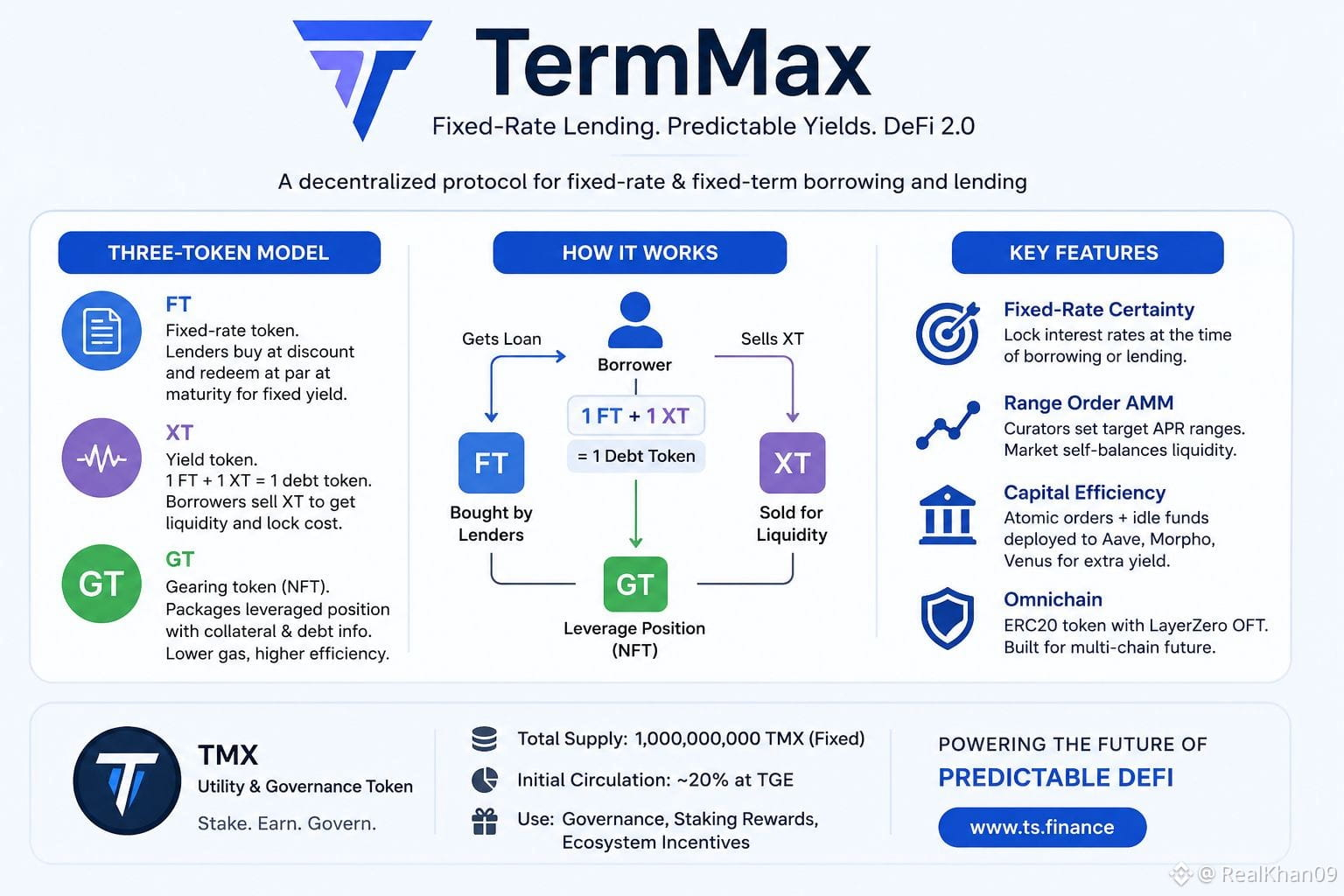
TermMax is built around fixed-rate, fixed-term lending through a three-token model: FT represents the right to redeem debt at face value at maturity, while XT is the complementary yield component. In simple terms, 1 FT + 1 XT = 1 debt token. Borrowers can sell XT immediately, locking borrowing cost at entry. GT packages leveraged collateral and debt into an NFT, reducing repeated leverage loops and gas usage.
The interesting part is its custom Range Order AMM. Instead of only quoting price ranges, curators define target APR ranges, while market forces help balance liquidity. Atomic Orders can distribute virtual liquidity across multiple orders, and idle capital can be deployed into Aave, Morpho or Venus rather than sitting unused.
Compared with Aave’s pool-based model, where supply and borrow rates dynamically change with utilization, TermMax focuses on rate certainty and maturity-based markets. Aave is excellent for flexible liquidity; TermMax adds a structured fixed-rate layer.
TMX connects governance, staking and ecosystem incentives, with a fixed 1B supply and omnichain ERC20/OFT design.
$BNB
I was thinking about how most DeFi lending still leaves users exposed to moving interest rates. Then I looked deeper into @TermMax, and the architecture felt different.
TermMax is built around fixed-rate, fixed-term lending through a three-token model: FT represents the right to redeem debt at face value at maturity, while XT is the complementary yield component. In simple terms, 1 FT + 1 XT = 1 debt token. Borrowers can sell XT immediately, locking borrowing cost at entry. GT packages leveraged collateral and debt into an NFT, reducing repeated leverage loops and gas usage.
The interesting part is its custom Range Order AMM. Instead of only quoting price ranges, curators define target APR ranges, while market forces help balance liquidity. Atomic Orders can distribute virtual liquidity across multiple orders, and idle capital can be deployed into Aave, Morpho or Venus rather than sitting unused.
Compared with Aave’s pool-based model, where supply and borrow rates dynamically change with utilization, TermMax focuses on rate certainty and maturity-based markets. Aave is excellent for flexible liquidity; TermMax adds a structured fixed-rate layer.
TMX connects governance, staking and ecosystem incentives, with a fixed 1B supply and omnichain ERC20/OFT design.
$BNB