
I’ve been watching DeFi for years, and one thing I’ve learned is that the hardest part of a protocol is rarely the contract itself.
It’s the people around it.
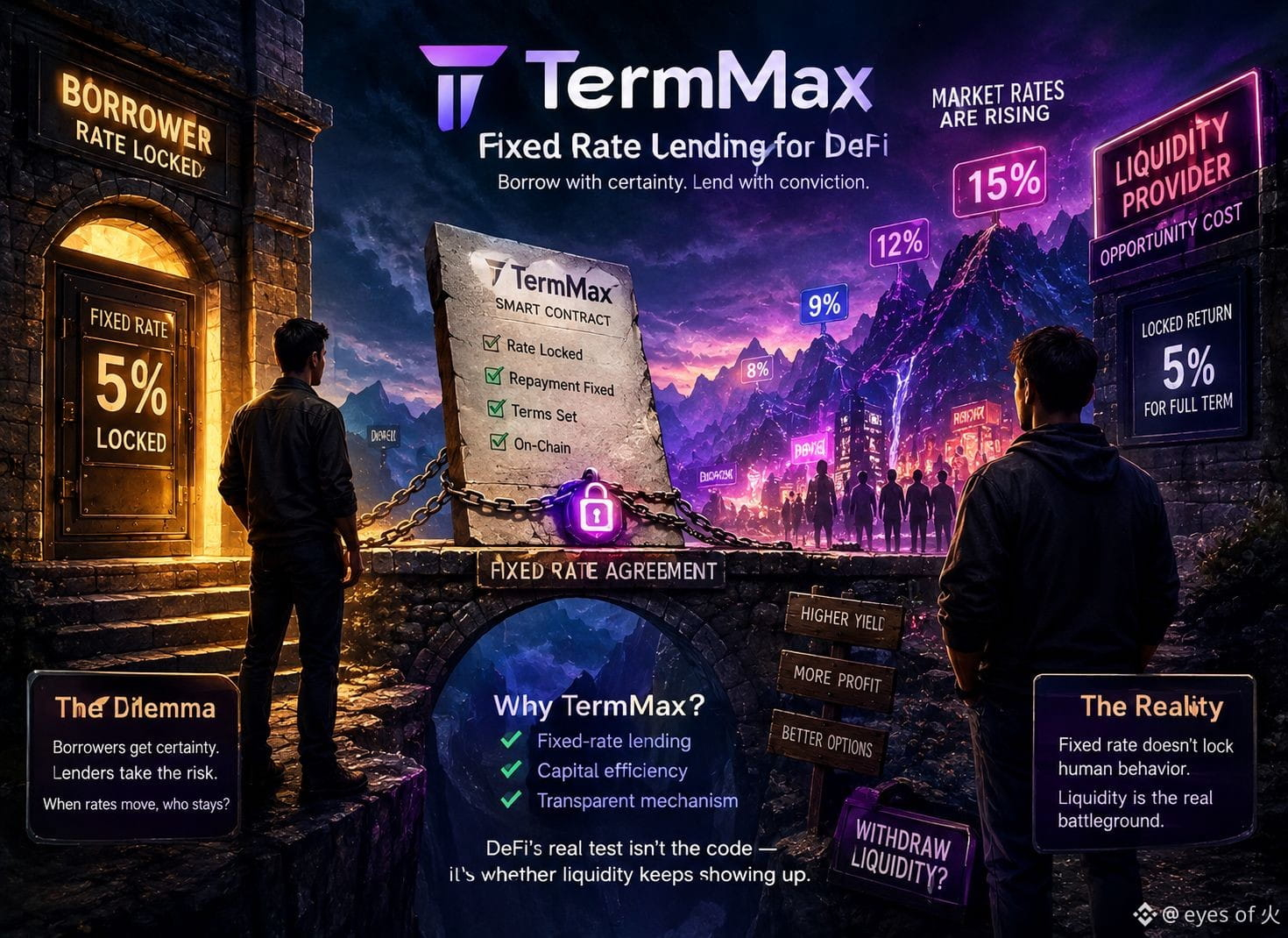
That’s what keeps bothering me about TermMax’s fixed-rate model. On paper, it’s easy to love. Borrow at 5%, lock the rate, and know exactly what you’ll repay. No guessing where rates go next.
But somewhere on the other side, an LP has to say, “Yeah, I’m comfortable lending at 5%.”
And markets don’t stay polite.
If rates suddenly jump to 15%, the borrower still has their 5% locked in. The contract keeps its promise. But the LP is now watching better opportunities appear everywhere else.
This is the part I don’t think gets enough attention.
I’ve seen plenty of DeFi designs that look almost perfect until you ask what happens when incentives change. People don’t behave like liquidity providers in a spreadsheet. They move. They chase yield. They get nervous. They change their minds.
A smart contract can lock a rate.
It can’t lock conviction.
That doesn’t mean TermMax’s idea doesn’t work. Actually, I find the attempt pretty interesting. The protocol is trying to make fixed-rate lending work without pretending DeFi has the same safety nets as traditional finance.
But that creates the real question for me:
When the market moves hard, who is willing to stay?
Because fixed-rate borrowing is only as strong as the liquidity willing to stand behind it.
And that’s the part I’m still watching.
@TermMax #termmax
It’s the people around it.
That’s what keeps bothering me about TermMax’s fixed-rate model. On paper, it’s easy to love. Borrow at 5%, lock the rate, and know exactly what you’ll repay. No guessing where rates go next.
But somewhere on the other side, an LP has to say, “Yeah, I’m comfortable lending at 5%.”
And markets don’t stay polite.
If rates suddenly jump to 15%, the borrower still has their 5% locked in. The contract keeps its promise. But the LP is now watching better opportunities appear everywhere else.
This is the part I don’t think gets enough attention.
I’ve seen plenty of DeFi designs that look almost perfect until you ask what happens when incentives change. People don’t behave like liquidity providers in a spreadsheet. They move. They chase yield. They get nervous. They change their minds.
A smart contract can lock a rate.
It can’t lock conviction.
That doesn’t mean TermMax’s idea doesn’t work. Actually, I find the attempt pretty interesting. The protocol is trying to make fixed-rate lending work without pretending DeFi has the same safety nets as traditional finance.
But that creates the real question for me:
When the market moves hard, who is willing to stay?
Because fixed-rate borrowing is only as strong as the liquidity willing to stand behind it.
And that’s the part I’m still watching.
@TermMax #termmax