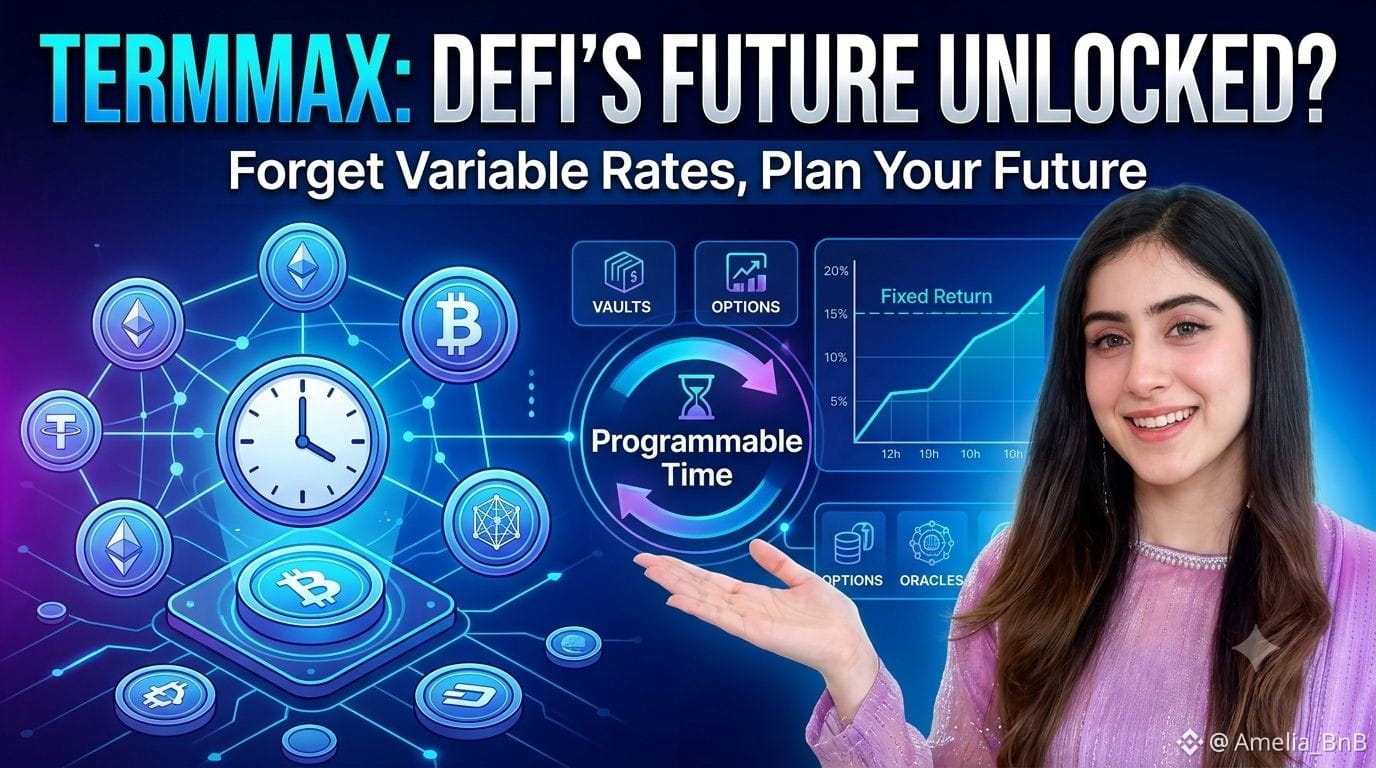

#termmax @TermMax I’ll be honest, I initially thought TermMax was just another DeFi lending protocol with a fixed-rate twist. But the deeper I looked, the more interesting the idea became.
DeFi is excellent at moving capital, yet it often struggles with something basic: predictability. Variable rates can change as liquidity and demand shift, making it difficult for borrowers to know their real financing cost or for lenders to plan future returns.
TermMax approaches this differently by building markets around fixed maturities. Its architecture turns borrowing obligations and future claims into programmable, tradable positions, creating a clearer relationship between capital today and value at a defined point in the future.
That sounds simple, but it introduces an important question: can decentralized markets make commitments without recreating the complexity of traditional finance?
The answer is far from settled.
Fixed rates don't remove risk. They redistribute it. Vaults, routing, leverage, options, oracles, and governance all add useful flexibility, but each also creates another layer that users must trust or understand.
What interests me most is the broader idea.
Maybe DeFi's next evolution isn't about making everything liquid every second. Maybe it's about making time, maturity, obligations, and expectations programmable.
TermMax may not have the final answer, but it is asking a question DeFi increasingly needs to confront: how do you build decentralized financial markets that people can actually plan their future around?
DeFi is excellent at moving capital, yet it often struggles with something basic: predictability. Variable rates can change as liquidity and demand shift, making it difficult for borrowers to know their real financing cost or for lenders to plan future returns.
TermMax approaches this differently by building markets around fixed maturities. Its architecture turns borrowing obligations and future claims into programmable, tradable positions, creating a clearer relationship between capital today and value at a defined point in the future.
That sounds simple, but it introduces an important question: can decentralized markets make commitments without recreating the complexity of traditional finance?
The answer is far from settled.
Fixed rates don't remove risk. They redistribute it. Vaults, routing, leverage, options, oracles, and governance all add useful flexibility, but each also creates another layer that users must trust or understand.
What interests me most is the broader idea.
Maybe DeFi's next evolution isn't about making everything liquid every second. Maybe it's about making time, maturity, obligations, and expectations programmable.
TermMax may not have the final answer, but it is asking a question DeFi increasingly needs to confront: how do you build decentralized financial markets that people can actually plan their future around?