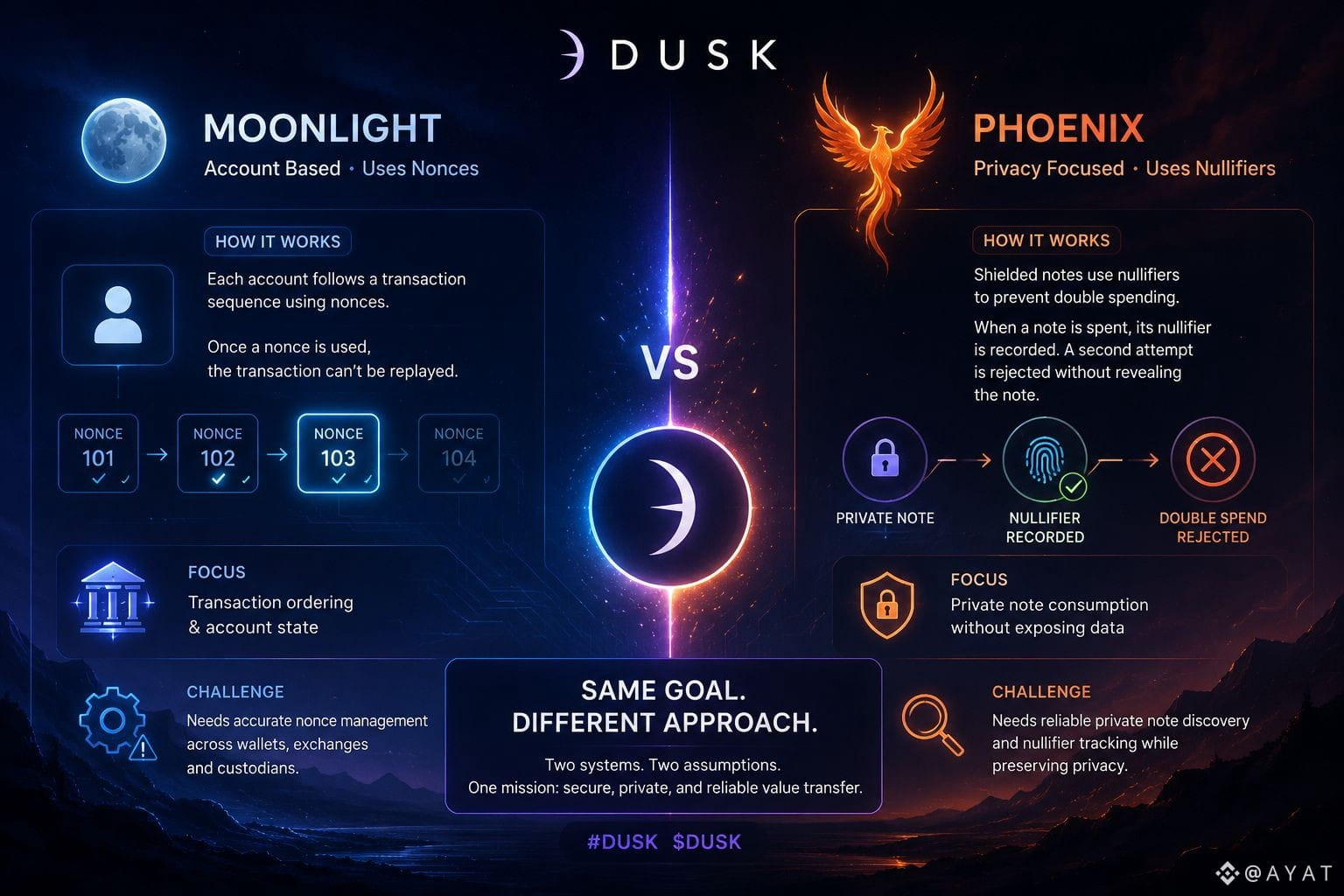
The deeper I get into @Dusk , the more I realize that the interesting part isn’t always the big headline feature. Sometimes it’s a small design decision that makes you stop and think. I had that moment when I was looking at how Moonlight and Phoenix handle something as basic as making sure the same transaction or asset can’t be used twice. Moonlight uses the model most of us already understand: nonces. Every account moves through a transaction sequence, and once a nonce is used, that transaction can’t simply be replayed. It’s simple and predictable, but when you look at real-world usage, there’s more going on underneath. Wallets, exchanges and custodians have to keep that state accurate, especially when multiple transactions are being signed or sent at the same time. Phoenix made me look at the same problem from a completely different angle. Because it uses shielded notes, it relies on nullifiers instead. When a private note is spent, its nullifier tells the network that the note has already been consumed. If someone tries to spend it again, the attempt can be rejected without exposing the private note itself. That distinction is what I found most interesting. Moonlight is keeping account activity organized, while Phoenix is proving that private value has already been spent without revealing what that value actually was. Same goal, very different approach. And I think that’s a good example of why privacy-focused infrastructure is harder than simply hiding transaction data. Once privacy becomes part of the architecture, even basic things like replay protection and double-spend prevention need to be redesigned around it. Now I’m more curious about what happens as Dusk scales. Does account-state coordination become the bigger challenge, or does private note discovery and nullifier tracking become harder? Those are the quiet engineering decisions that could end up mattering the most.
@Dusk #dusk $DUSK
@Dusk #dusk $DUSK