
Donald Trump picked Wednesday evening to declare economic war, and he did it the way he does everything else: in capital letters, on his own platform, with no warning to allies who'd now have to scramble to figure out what it meant for them.
"I am announcing the MOST CRUSHING ECONOMIC OPERATION EVER TAKEN AGAINST ANY COUNTRY," the president wrote on Truth Social. He'd offered Iran more chances than anyone, he said, and Tehran had thrown them all away. What comes next, in his framing, is an economic D-Day.
The machinery Washington wants shut down
Trump didn't stop at slogans. He named the specific plumbing that has kept Iran's economy breathing under sanctions and said all of it needs to stop immediately: oil smuggling routes, currency swap lines, cash transfers, exchange houses, ship registries, front companies. Any country whose banks, businesses, airports or government bodies offer Tehran what he called a lifeline will face steep consequences of their own, he warned, adding that Iran will never be allowed a nuclear weapon.
None of this is new in kind, only in volume. The administration has run a sanctions campaign against Iran since April under the label Operation Economic Fury, aimed at strangling the regime's revenue and, in Washington's telling, its capacity to fund terror abroad. Wednesday's announcement is that campaign turned up to its loudest setting yet.
Trump's language about the state of Iran's military matched the scale of his economic threat. Its navy is gone, he said, its air force destroyed, its production facilities reduced to rubble, its currency worthless, the country hanging by a thread.
Tehran's response arrived through its foreign minister. Abbas Araghchi accused Washington of ratcheting up sanctions precisely because earlier rounds failed to bring Iran to heel, and cast the entire approach as a wall standing between the war and any negotiated way out of it not a bridge toward one. He retaliated that Resistance is the only path to victory, and if we are not prepared for war, negotiations will also be fruitless
A missile denial and a trade relationship gone overnight
One day before Trump's post, the United Arab Emirates said it had come under attack. Two ballistic missiles, fired from Iran, splashed into the Gulf near Emirati waters. Abu Dhabi didn't wait for further clarity. It suspended all trade, commerce and financial transactions with Tehran, effective immediately, citing a threat to regional security.
Iran denied it fired anything. A Foreign Ministry spokesman called the accusation baseless and suggested the whole episode had the fingerprints of a false flag operation, pointing a finger back at Washington and Israel.
Whoever is right about the missiles, the economic damage is not in dispute. The UAE supplied more than 30 percent of everything Iran imported last year, worth some 21 billion dollars, according to World Trade Organization figures its single largest source of goods from abroad. That channel is now closed, layered on top of a war economy already straining under blockade and battlefield losses.
The quiet operation keeping oil moving at all
Away from the headlines, the U.S. Navy has spent months running something closer to a covert logistics operation than a blockade. Since May, it has stealthily guided tankers through the southern reaches of the Strait of Hormuz, hugging routes close to the Omani coast, often with the ships' transponders switched off to keep them off Iran's radar. More than 1,000 vessels have made it through under this cover.
The numbers tell you how much has been lost even so. Before the war, roughly 15 million barrels a day flowed through the Strait. In July, protected routes were moving about five million barrels daily out of the Persian Gulf a fraction of normal, but enough to keep prices from spiraling further than they already have.
Weekly transit counts from Lloyd's List Intelligence show that fragility in real time. Preliminary figures put transits at 73 for the week ending August 16, down from 91 the week before a decline the firm attributes to Iran's continued targeting of vessels and the ongoing American blockade of Iranian ports, which together have kept most operators away from the chokepoint. Only a small core of shippers is still willing to run the risk.
Crude holds its ground as the market absorbs the threat
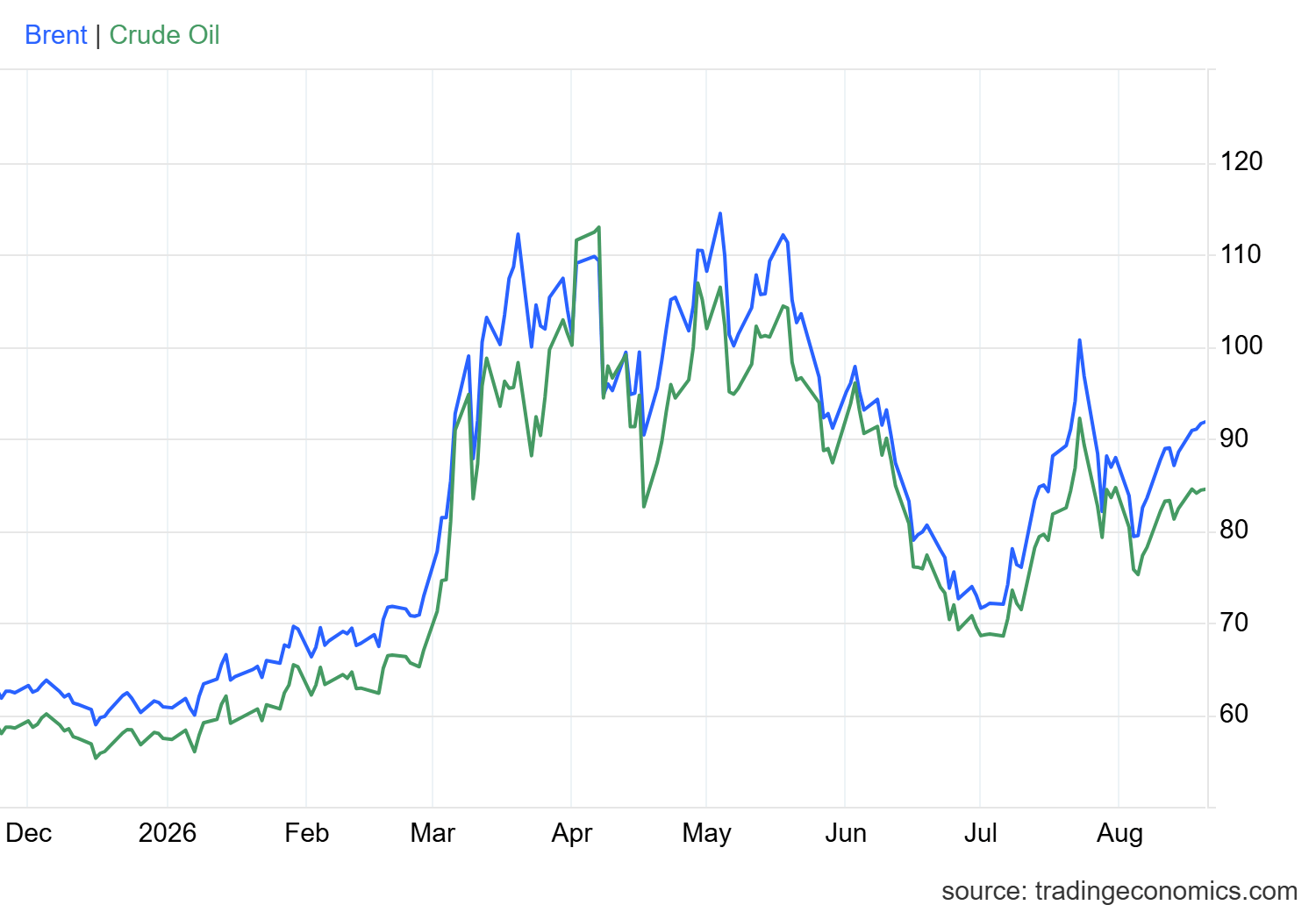
Oil didn't panic on Wednesday so much as grind higher. Brent for October delivery settled at 91.62 dollars a barrel, up 60 cents, or 0.7 percent. WTI for the same month closed at 84.39 dollars, up 33 cents, or 0.4 percent. Both benchmarks pushed further into Thursday's Asian session, with Brent adding another fifth of a percent.
It's a market pricing in duration, not shock a war that keeps finding new fronts rather than resolving on any of the old ones.
The war Iran might be preparing to widen
That's the backdrop against which a Financial Times report landed Wednesday, citing insiders close to the Iranian regime who said Tehran has been quietly assessing whether to hit American and allied assets well outside the Middle East if Washington escalates again. Bulgaria and Cyprus were named as possible targets both places where the United States and its allies keep a military footprint, and neither anywhere near the Gulf.
NATO didn't wait to be asked twice. An alliance official said NATO stood ready to address any threat and would do whatever necessary to defend every ally, pointing to a track record as evidence: alliance air defenses shot down Iranian ballistic missiles bound for Turkish airspace on four separate occasions earlier this year.
Whether Tehran's Europe planning is serious contingency work or a message meant to be intercepted is impossible to say from the outside. What's clear is that the map of this war keeps getting bigger, one Truth Social post and one Foreign Ministry statement at a time.