
#dusk $DUSK @Dusk
Optimism-style rollups make you wait 7 days to withdraw funds back to L1.
Dusk's EVM layer claims ~15 minutes.
That's not a small UX tweak.
It's a different security bet, and I wanted to understand why it holds.
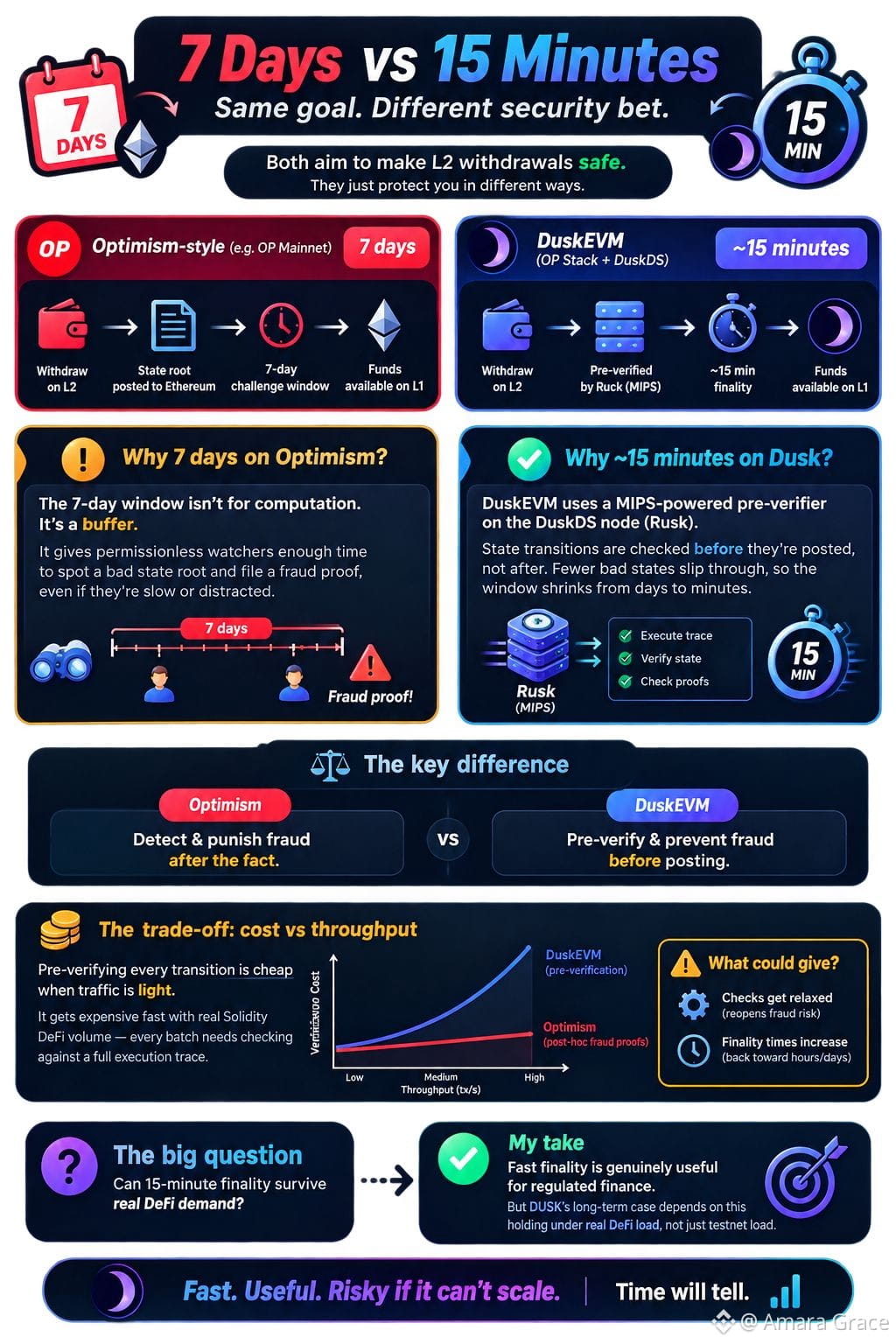
The 7-day window on chains like Optimism isn't computation time.
It's a buffer, giving permissionless watchers enough time to catch a bad state root and file a fraud proof, even if they're slow or distracted.
Remove the need for that buffer, and the wait shrinks with it.
DuskEVM runs on the OP Stack but settles to DuskDS instead of Ethereum.
Its shortcut is a MIPS-powered pre-verifier on the DuskDS node (Rusk), checking state transitions before they post, instead of waiting for someone to catch fraud afterward.
Fewer surprises slip through, so the window drops from days to minutes.
Here's what I keep circling back to.
Pre-verifying every transition is cheap when DuskEVM traffic is light.
It gets expensive fast once real Solidity DeFi volume shows up, since every batch needs checking against a full execution trace before it's accepted.
If that throughput can't keep pace, something gives either checks get relaxed, reopening the exact risk the window was built to prevent, or finality times start creeping back up.
Fast finality is genuinely useful for regulated finance.
But DUSK's long-term case depends on this holding under real DeFi load, not testnet load.
Does 15-minute finality survive actual demand, or is it still a testnet number?
Optimism-style rollups make you wait 7 days to withdraw funds back to L1.
Dusk's EVM layer claims ~15 minutes.
That's not a small UX tweak.
It's a different security bet, and I wanted to understand why it holds.
The 7-day window on chains like Optimism isn't computation time.
It's a buffer, giving permissionless watchers enough time to catch a bad state root and file a fraud proof, even if they're slow or distracted.
Remove the need for that buffer, and the wait shrinks with it.
DuskEVM runs on the OP Stack but settles to DuskDS instead of Ethereum.
Its shortcut is a MIPS-powered pre-verifier on the DuskDS node (Rusk), checking state transitions before they post, instead of waiting for someone to catch fraud afterward.
Fewer surprises slip through, so the window drops from days to minutes.
Here's what I keep circling back to.
Pre-verifying every transition is cheap when DuskEVM traffic is light.
It gets expensive fast once real Solidity DeFi volume shows up, since every batch needs checking against a full execution trace before it's accepted.
If that throughput can't keep pace, something gives either checks get relaxed, reopening the exact risk the window was built to prevent, or finality times start creeping back up.
Fast finality is genuinely useful for regulated finance.
But DUSK's long-term case depends on this holding under real DeFi load, not testnet load.
Does 15-minute finality survive actual demand, or is it still a testnet number?