
$DUSK caught my attention today — not because it’s up 10.7%, but because the move is starting to expose what’s underneath it.
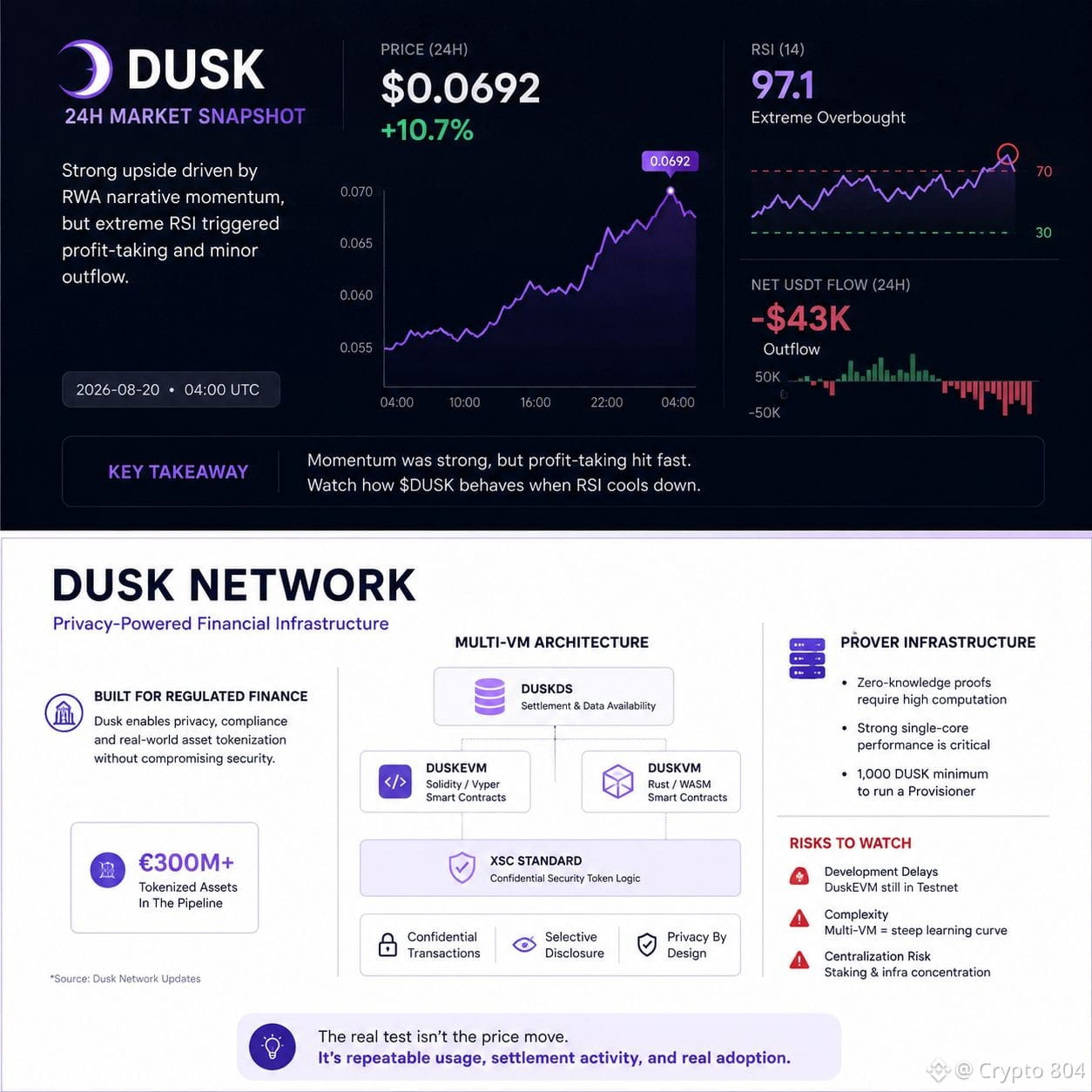
Price pushed toward $0.0692, while RSI went absolutely vertical, touching 97.1 at the local top. Then came the predictable part: profit-taking and around $43K in USDT net outflow.
Nothing unusual there.
What I find more interesting is what happens after the excitement fades.
Dusk is trying to solve a very specific problem: making privacy work inside regulated financial infrastructure.
The DuskEVM side is important because it gives Solidity developers a familiar entry point, while the native stack still handles things like XSC-based assets and confidential transactions.
But there’s a trade-off people rarely mention.
More execution environments mean more flexibility — and more complexity for developers to navigate. With DuskEVM still in testnet, onboarding and real application usage are going to matter far more than another short-term price spike.
Then there’s the prover side.
Zero-knowledge infrastructure isn’t free computationally. Prover performance matters, and if staking or infrastructure requirements become concentrated among fewer participants, decentralization deserves scrutiny.
That’s the part I’d keep in the back of my mind.
The €300M+ tokenized-asset angle is interesting, but the real test isn’t the headline number.
It’s whether those assets eventually create repeatable settlement, transfers, users and fees on the network.
So yes, the chart looks much healthier than it did recently.
But I’m watching what happens when RSI normalizes and the traders move on.
If activity remains, that tells me much more about DUSK than a green candle ever could.
#dusk $DUSK @Dusk
Price pushed toward $0.0692, while RSI went absolutely vertical, touching 97.1 at the local top. Then came the predictable part: profit-taking and around $43K in USDT net outflow.
Nothing unusual there.
What I find more interesting is what happens after the excitement fades.
Dusk is trying to solve a very specific problem: making privacy work inside regulated financial infrastructure.
The DuskEVM side is important because it gives Solidity developers a familiar entry point, while the native stack still handles things like XSC-based assets and confidential transactions.
But there’s a trade-off people rarely mention.
More execution environments mean more flexibility — and more complexity for developers to navigate. With DuskEVM still in testnet, onboarding and real application usage are going to matter far more than another short-term price spike.
Then there’s the prover side.
Zero-knowledge infrastructure isn’t free computationally. Prover performance matters, and if staking or infrastructure requirements become concentrated among fewer participants, decentralization deserves scrutiny.
That’s the part I’d keep in the back of my mind.
The €300M+ tokenized-asset angle is interesting, but the real test isn’t the headline number.
It’s whether those assets eventually create repeatable settlement, transfers, users and fees on the network.
So yes, the chart looks much healthier than it did recently.
But I’m watching what happens when RSI normalizes and the traders move on.
If activity remains, that tells me much more about DUSK than a green candle ever could.
#dusk $DUSK @Dusk