
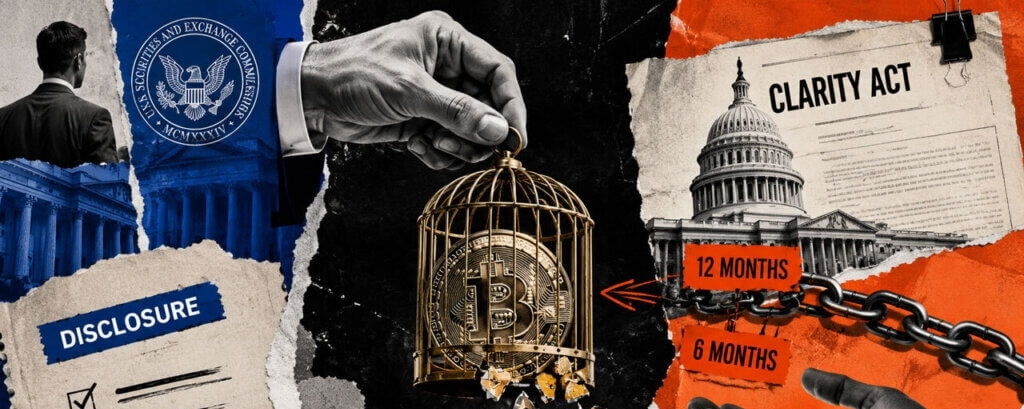
The regulator imposes offering caps but no federal time-based lockup, while senators want some insiders held for 12 months before network decentralization.
he SEC's new crypto fundraising proposal deliberately treats tokens as free to trade as soon as a buyer acquires them, unless the issuer or another law says otherwise.
Insiders typically know more than the public while a token project is still being built, and their incentives do not always line up with everyone else's.
The Senate's July 22 CLARITY draft would force insiders to hold a token for a full year before its network clears a specific control test, then six more months once it does. The bill also limits how much they can sell, but the SEC's proposal skips those requirements.
The SEC's Regulation Crypto Assets spends space building the case for insider lockups before setting one aside. It discusses the information gap between insiders and buyers, reviews research showing token offerings tend to do better under vesting or lockup terms, and then settles on disclosure as its answer.
The proposal still caps how much insiders can sell, even without a mandatory holding period. A Tier 2 offering under the SEC's fundraising exemption can raise up to $75 million in a year, and affiliates of the issuer can supply up to $22.5 million of that. Tier 1 tops out at $20 million total, with $6 million available to those same insiders.
A separate cap kicks in during an issuer's first year of offerings, capping securities sold by insiders at 30% of the total raise. Run the math on a full $75 million Tier 2 offering, and that ceiling lands at $22.5 million, the same number as the affiliate cap itself.
The caps govern how much insiders can sell through a qualified offering, leaving timing as the real open question. An insider can sell the moment a token stops counting as a restricted security, with no minimum holding period required.
The Senate draft, in a section titled Special Restrictions on Disposition, requires insiders to hold a covered token for at least 12 months before its network is certified as free of coordinated control.
The bear case is that the SEC's disclosure-first approach becomes the operating reality while CLARITY sits unfinished in Congress. Crypto lockups turn into something projects opt into for credibility, and a project with no restrictions at all can still raise money.
It just does so at a steeper discount, since the risk of insiders cashing out early stays on the buyer's side of the ledger.
Neither version is law yet, and the two frameworks define insider in genuinely different ways. They agree the risk is real, but split on who has to live with it: the buyer who gets a disclosure or the insider who gets a deadline.