Today I did something I usually skip when looking at a new DeFi protocol.
I stopped looking at the UI and went through @TermMax security design instead.
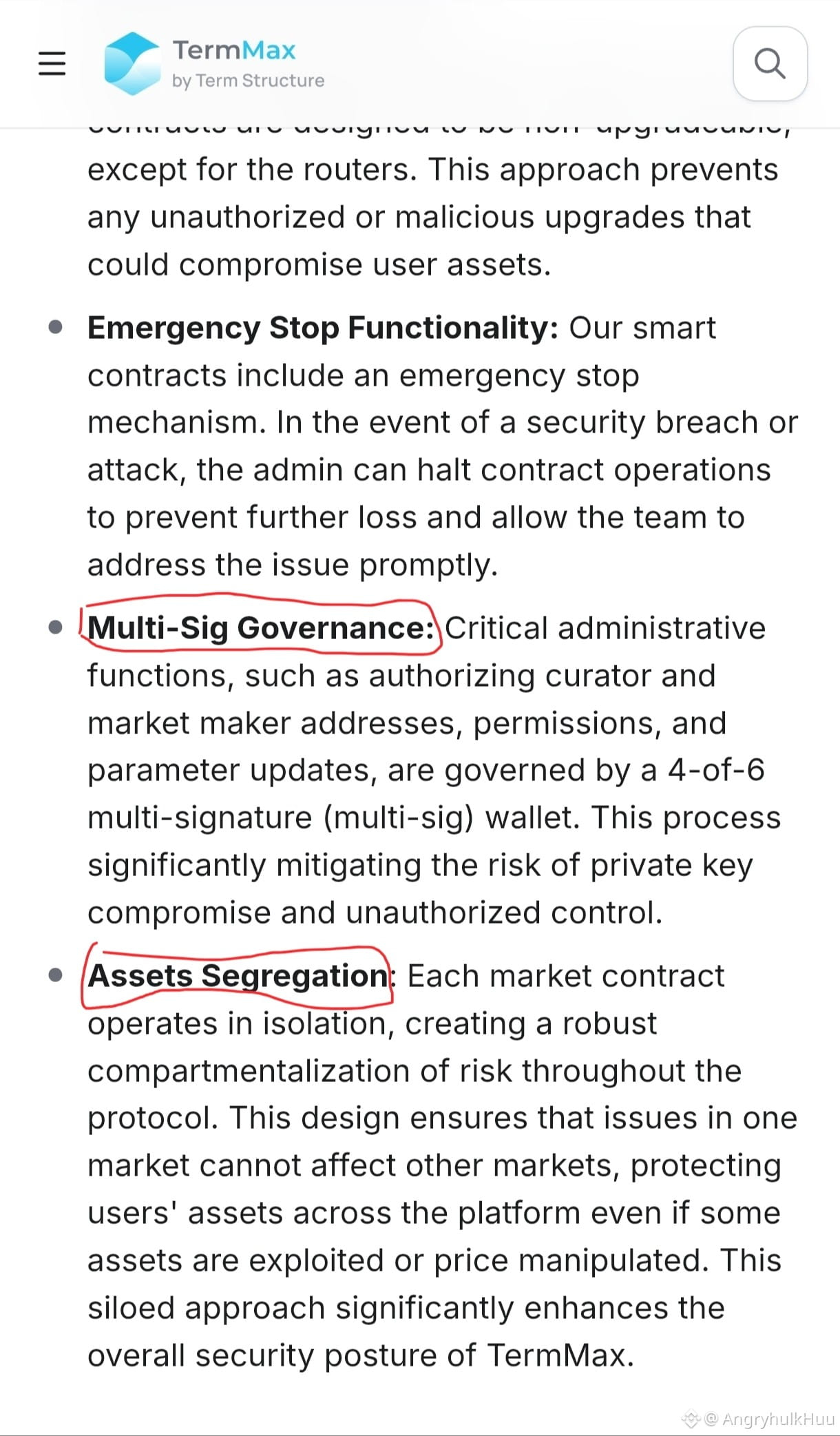
One detail I found interesting is that each market operates in isolation, so an issue in one market isn’t automatically supposed to spill across the entire protocol.
I also checked the admin setup and found that critical functions are controlled through a 4-of-6 multisig.
Those numbers matter to me more than another flashy APY screenshot.
A DeFi product can have great rates and clever mechanics, but if the underlying risk controls are weak, none of that means much.
What I’m starting to appreciate about TermMax is that the product design and the risk architecture seem to be treated as two parts of the same system.
That was probably the most useful thing I learned while digging through the docs today.
$TMX #TermMax
I stopped looking at the UI and went through @TermMax security design instead.
One detail I found interesting is that each market operates in isolation, so an issue in one market isn’t automatically supposed to spill across the entire protocol.
I also checked the admin setup and found that critical functions are controlled through a 4-of-6 multisig.
Those numbers matter to me more than another flashy APY screenshot.
A DeFi product can have great rates and clever mechanics, but if the underlying risk controls are weak, none of that means much.
What I’m starting to appreciate about TermMax is that the product design and the risk architecture seem to be treated as two parts of the same system.
That was probably the most useful thing I learned while digging through the docs today.
$TMX #TermMax