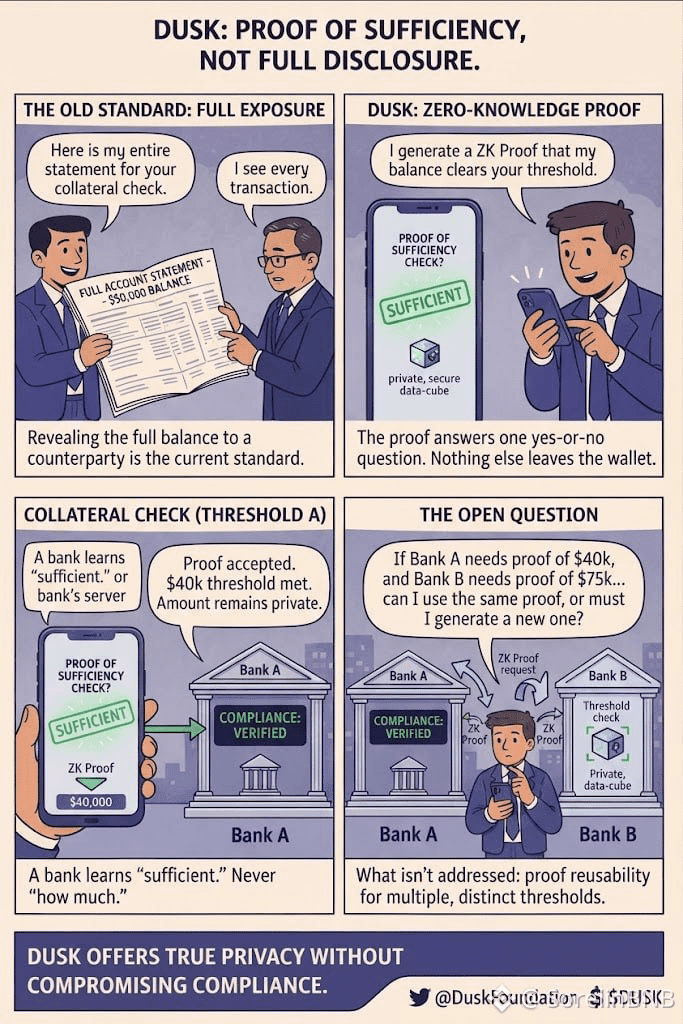
A bank doesn't need your exact balance. A bank needs proof it's enough. Dusk builds that distinction into the protocol itself.
I assumed on-chain compliance meant revealing the full number to whoever's checking. Then I found how the proof actually works.
A user can generate a zero-knowledge proof that a balance clears a required threshold, enough for a margin call, a collateral check, a minimum-holding rule, without disclosing what the balance actually is. The proof answers one yes-or-no question. Nothing else leaves the wallet.
Financially, that replaces the current standard, a full account statement handed over to prove solvency, with a single proof scoped to exactly what was asked. A counterparty learns "sufficient." Never "how much."
This is the same primitive Dusk's own technical writeups point to when explaining what separates the design from simple transaction hiding: proving a fact, not concealing a number, has been core to the model from the start.
What isn't addressed: whether two counterparties needing proof of two different thresholds from the same balance can reuse one proof, or each needs its own generated from scratch.
@Dusk $DUSK #dusk $HEMI $MUBARAK
I assumed on-chain compliance meant revealing the full number to whoever's checking. Then I found how the proof actually works.
A user can generate a zero-knowledge proof that a balance clears a required threshold, enough for a margin call, a collateral check, a minimum-holding rule, without disclosing what the balance actually is. The proof answers one yes-or-no question. Nothing else leaves the wallet.
Financially, that replaces the current standard, a full account statement handed over to prove solvency, with a single proof scoped to exactly what was asked. A counterparty learns "sufficient." Never "how much."
This is the same primitive Dusk's own technical writeups point to when explaining what separates the design from simple transaction hiding: proving a fact, not concealing a number, has been core to the model from the start.
What isn't addressed: whether two counterparties needing proof of two different thresholds from the same balance can reuse one proof, or each needs its own generated from scratch.
@Dusk $DUSK #dusk $HEMI $MUBARAK