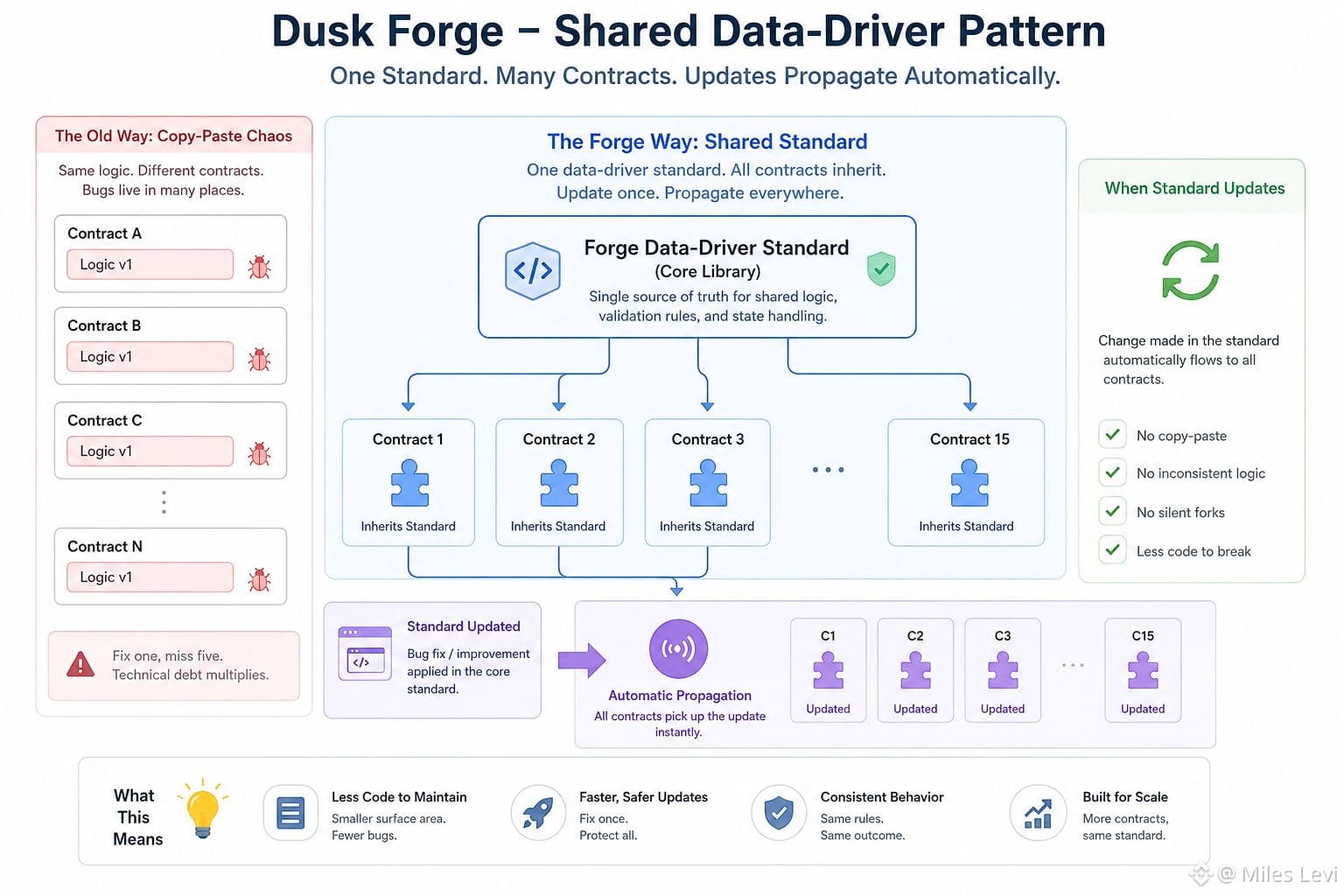
Been sitting with this Dusk thing for a couple nights now — Forge, the shared data-driver pattern rolled across their DuskEVM contracts. Fifteen contracts on L1 alone, one standard, updates propagate automatically instead of getting copy-pasted into six slightly different versions of the same logic. On paper it's the kind of thing that should've existed from day one.
I keep noticing how much of crypto's technical debt comes from exactly this — teams shipping fast, forking their own code across contracts because nobody had time to abstract it properly, then finding the same bug living in six places because it was never actually fixed once, just patched wherever someone looked. I've seen this before. Every cycle produces its own version of "we finally standardized internal tooling" dressed up as a breakthrough, when really it's just catching up to debt that shouldn't have existed.
What I don't fully trust yet is what happens when the standard itself carries a flaw. Fifteen contracts inheriting one shared pattern means fifteen contracts inheriting one mistake, silently, all at once. Centralizing risk isn't removing it — it just relocates the blast radius, and audits tend to lag behind refactors like this by a cycle or two.
Still, something about this feels different from the usual announcement. No token, no partnership, no number going up. Just less code to break. Nobody trades on that. Nobody exits on that either — which might be the actual point.
#dusk $DUSK @Dusk
I keep noticing how much of crypto's technical debt comes from exactly this — teams shipping fast, forking their own code across contracts because nobody had time to abstract it properly, then finding the same bug living in six places because it was never actually fixed once, just patched wherever someone looked. I've seen this before. Every cycle produces its own version of "we finally standardized internal tooling" dressed up as a breakthrough, when really it's just catching up to debt that shouldn't have existed.
What I don't fully trust yet is what happens when the standard itself carries a flaw. Fifteen contracts inheriting one shared pattern means fifteen contracts inheriting one mistake, silently, all at once. Centralizing risk isn't removing it — it just relocates the blast radius, and audits tend to lag behind refactors like this by a cycle or two.
Still, something about this feels different from the usual announcement. No token, no partnership, no number going up. Just less code to break. Nobody trades on that. Nobody exits on that either — which might be the actual point.
#dusk $DUSK @Dusk