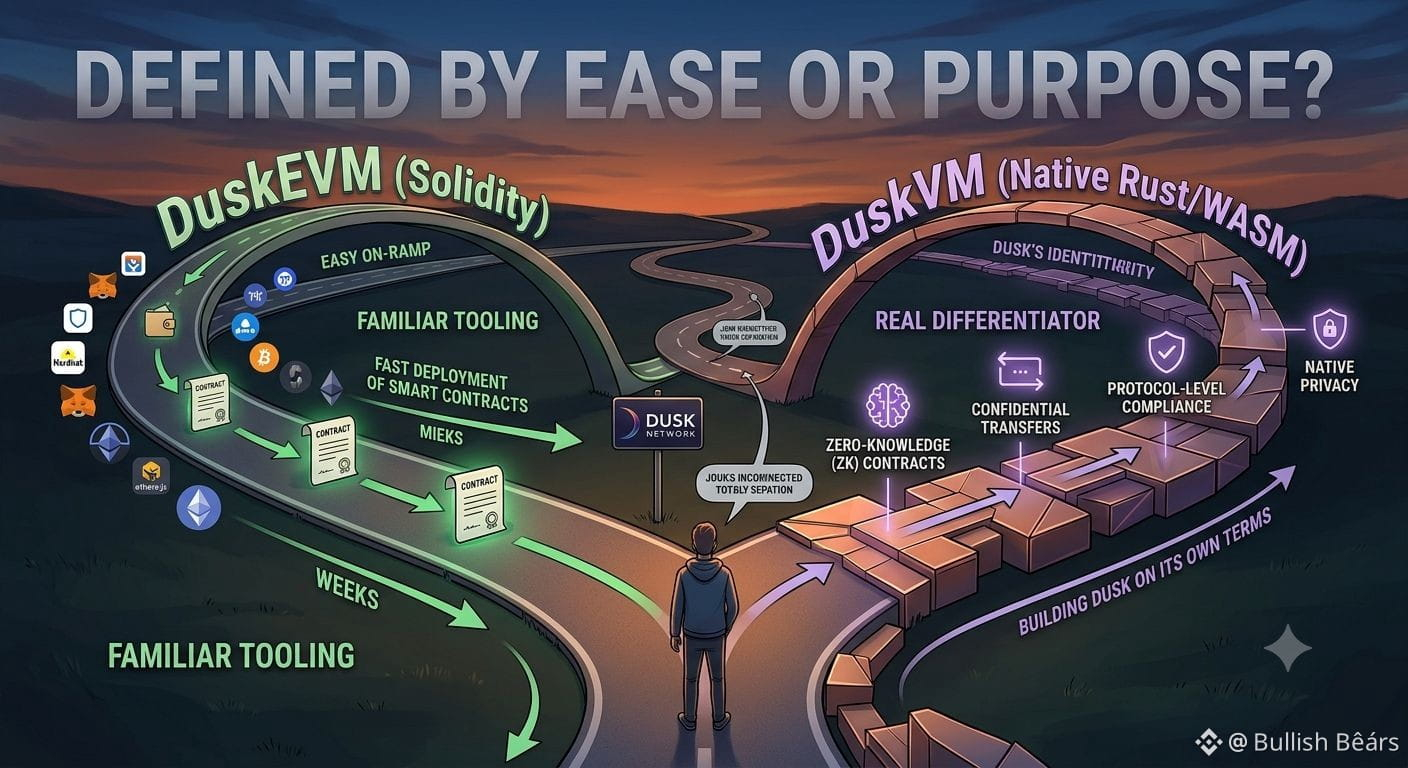
Exploring Dusk this week, what stayed with me wasn't a feature but a fork in the road. Dusk $DUSK #dusk @Dusk runs two execution paths side by side: DuskEVM, where Solidity contracts deploy in weeks using tooling everyone already knows, and DuskVM, the native Rust/WASM environment where the project's actual privacy and zero knowledge machinery lives. Poking around both, the EVM side felt immediate, wallets connect, contracts deploy, nothing unfamiliar. The native side felt like a different project entirely, slower to approach, fewer shortcuts, clearly built for people willing to learn Dusk on its own terms rather than through an EVM lens. What's interesting is that the second path is the one that actually makes Dusk distinct, confidential transfers, compliance at the protocol level, ZK contracts, yet it's the path fewer people will touch first. The easy on-ramp and the real differentiator aren't the same road. I don't think that's unusual for modular chains, but it does raise a quiet question: does a project's identity end up defined by what's easiest to adopt, or by what it was actually built for?

نشر

--صاعد
إخلاء مسؤولية: يتضمن آراء جهات خارجية. لا تُعدّ نصيحة. يُمكن استخدام Binance AI دون أي ضمان. اطلع على الشروط والأحكام.