Last night I was studying @Dusk and one thought stayed with me: does transparency always mean showing everything?
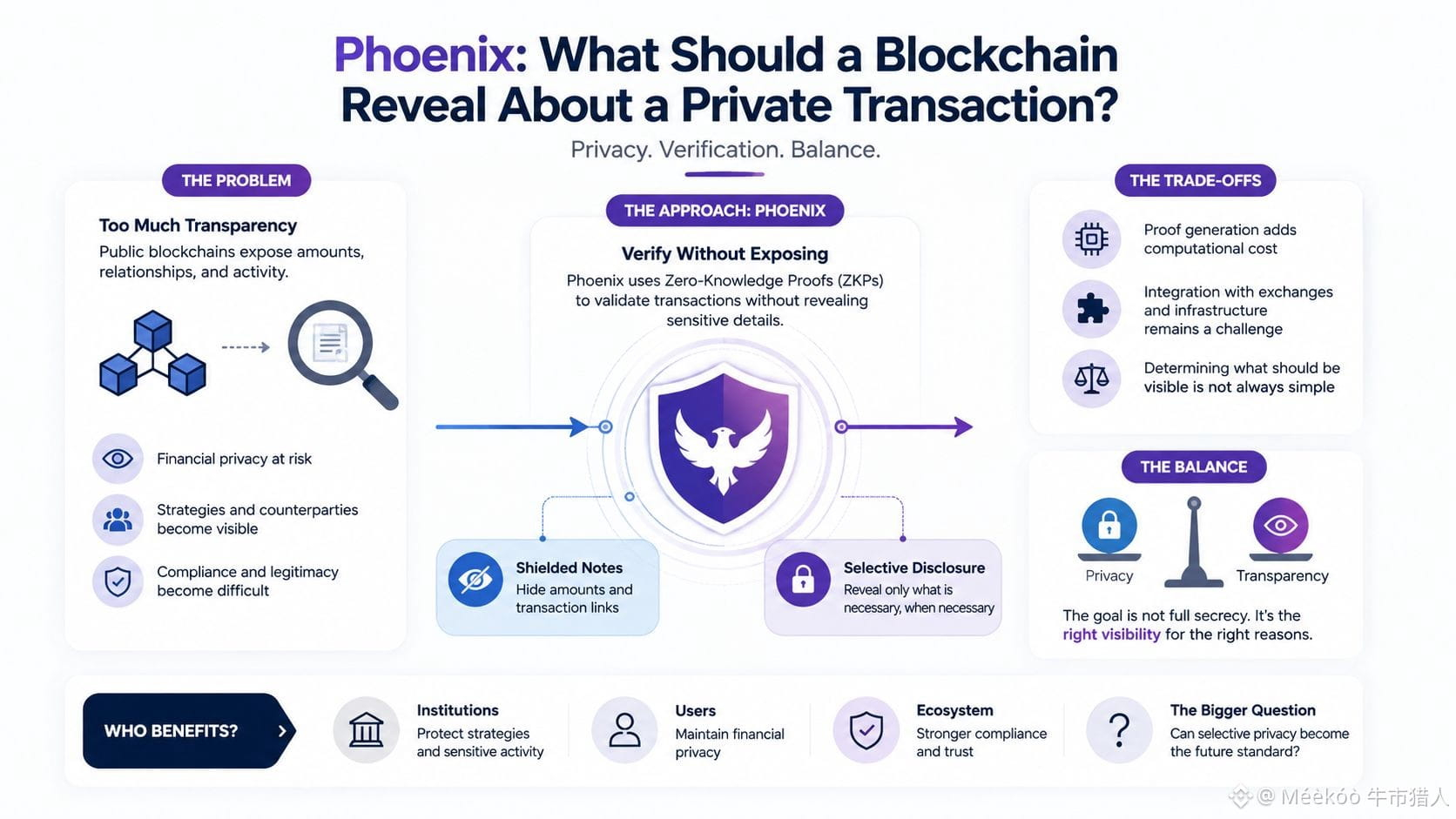
On public blockchains, transaction details can remain visible. That works for verification, but sensitive financial activity may need another level of privacy.
Traditional privacy systems tried to hide activity, yet too much secrecy can make compliance and verification difficult.
That made me look deeper.
Phoenix uses zero-knowledge proofs to verify transactions without exposing every underlying detail. The idea is simple, but the design challenge is not.
Its approach allows sensitive information to stay private while still proving that transactions follow the required rules.
But this is where things change.
Privacy can bring trade-offs around proof generation, integration, usability, and the amount of information that should become visible when required.
For me, the interesting question is not whether blockchains should be private or public.
It is whether they can offer the right amount of visibility for different users and situations.
Could selective privacy become a more practical model for blockchain finance?
#dusk $DUSK @Dusk
On public blockchains, transaction details can remain visible. That works for verification, but sensitive financial activity may need another level of privacy.
Traditional privacy systems tried to hide activity, yet too much secrecy can make compliance and verification difficult.
That made me look deeper.
Phoenix uses zero-knowledge proofs to verify transactions without exposing every underlying detail. The idea is simple, but the design challenge is not.
Its approach allows sensitive information to stay private while still proving that transactions follow the required rules.
But this is where things change.
Privacy can bring trade-offs around proof generation, integration, usability, and the amount of information that should become visible when required.
For me, the interesting question is not whether blockchains should be private or public.
It is whether they can offer the right amount of visibility for different users and situations.
Could selective privacy become a more practical model for blockchain finance?
#dusk $DUSK @Dusk