During a sharp market drop, the lending dashboard was still showing attractive numbers, but I looked at the maturity schedule first. The money was still there, the yield was still running, only the ability to rotate capital had disappeared right when it was needed most.
TermMax goes straight into that part of DeFi. Debt is not only about borrowing and repaying, but also about how long the loan lasts and at what price one can exit. A 30 day term is different from a 180 day term because the cost of capital, depth of liquidity, and probability of market conditions changing are different.
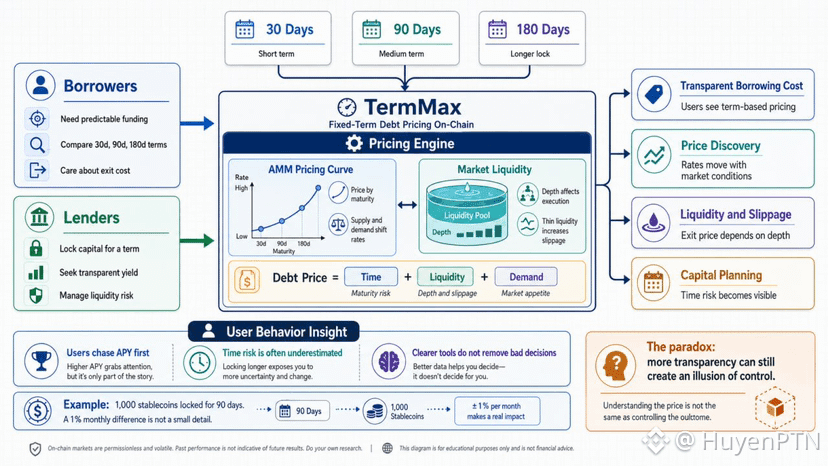
What stands out about TermMax is that it brings fixed term debt pricing into a market based mechanism instead of leaving users to negotiate through intuition. The AMM creates a price curve for debt assets by maturity, while market liquidity helps prices move when lending supply or borrowing demand shifts. If 1000 stablecoins are locked for another 90 days, a 1 percent difference per month is no longer a small detail.
Crypto users usually like clean numbers. The clearer the APY looks, the more the brain wants to ignore the conditions behind it. TermMax makes maturity, slippage, and liquidity visible at the same time, but that is only useful if users read it like capital managers, not like reward hunters.
The paradox is that the more precise the tool becomes, the easier it is for the illusion of control to appear. A loan priced transparently can still become a mistake if users forget that their own need for cash can also change.
I do not see TermMax as a neat solution for every on chain debt market. It is more like a technical mirror, forcing us to see the price of time, the price of liquidity, and the remaining question is whether seeing more clearly will actually lead to better behavior.
#termmax @TermMax
TermMax goes straight into that part of DeFi. Debt is not only about borrowing and repaying, but also about how long the loan lasts and at what price one can exit. A 30 day term is different from a 180 day term because the cost of capital, depth of liquidity, and probability of market conditions changing are different.
What stands out about TermMax is that it brings fixed term debt pricing into a market based mechanism instead of leaving users to negotiate through intuition. The AMM creates a price curve for debt assets by maturity, while market liquidity helps prices move when lending supply or borrowing demand shifts. If 1000 stablecoins are locked for another 90 days, a 1 percent difference per month is no longer a small detail.
Crypto users usually like clean numbers. The clearer the APY looks, the more the brain wants to ignore the conditions behind it. TermMax makes maturity, slippage, and liquidity visible at the same time, but that is only useful if users read it like capital managers, not like reward hunters.
The paradox is that the more precise the tool becomes, the easier it is for the illusion of control to appear. A loan priced transparently can still become a mistake if users forget that their own need for cash can also change.
I do not see TermMax as a neat solution for every on chain debt market. It is more like a technical mirror, forcing us to see the price of time, the price of liquidity, and the remaining question is whether seeing more clearly will actually lead to better behavior.
#termmax @TermMax