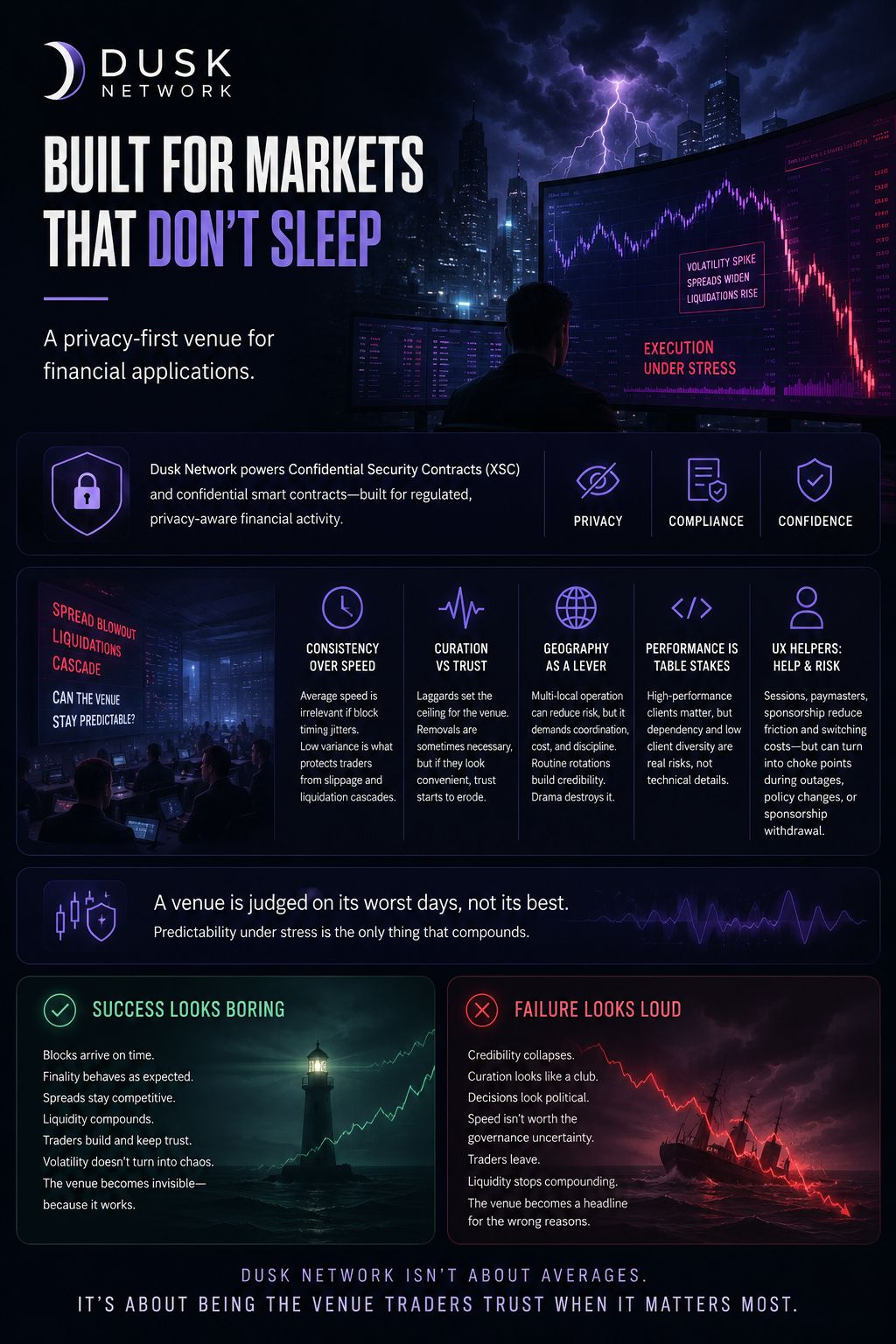
#dusk I’m waiting for the ugly day. I’m watching how execution behaves when spreads blow out, liquidations cascade, and every millisecond of jitter starts carrying a price. I’m looking for consistency, not impressive averages. I’ve seen fast systems become unreliable when pressure arrives. I focus on whether traders can predict what happens next.
That is how I look at Dusk: as financial venue infrastructure, not simply another chain. Its value comes down to whether block timing, settlement, and execution remain stable when markets become disorderly. Low variance matters because unstable timing becomes slippage, wider spreads, weaker liquidity, and eventually forced selling feeding more forced selling.
Privacy and controlled financial workflows can make the venue more useful, but every layer of control adds a trust question. What looks like quality control today can look like politics later if decisions become opaque. The same applies to validator performance: laggards can set the ceiling for everyone, but removing them too conveniently can damage credibility.
Performance is table stakes. The real moat is disciplined behavior under stress. Success is boring consistency, trust compounding, and volatility staying manageable. Failure is credibility collapse, curation looking like a club, decisions looking political, speed no longer worth governance uncertainty, and liquidity stopping its compounding.
@Dusk
$DUSK
#dusk
That is how I look at Dusk: as financial venue infrastructure, not simply another chain. Its value comes down to whether block timing, settlement, and execution remain stable when markets become disorderly. Low variance matters because unstable timing becomes slippage, wider spreads, weaker liquidity, and eventually forced selling feeding more forced selling.
Privacy and controlled financial workflows can make the venue more useful, but every layer of control adds a trust question. What looks like quality control today can look like politics later if decisions become opaque. The same applies to validator performance: laggards can set the ceiling for everyone, but removing them too conveniently can damage credibility.
Performance is table stakes. The real moat is disciplined behavior under stress. Success is boring consistency, trust compounding, and volatility staying manageable. Failure is credibility collapse, curation looking like a club, decisions looking political, speed no longer worth governance uncertainty, and liquidity stopping its compounding.
@Dusk
$DUSK
#dusk