
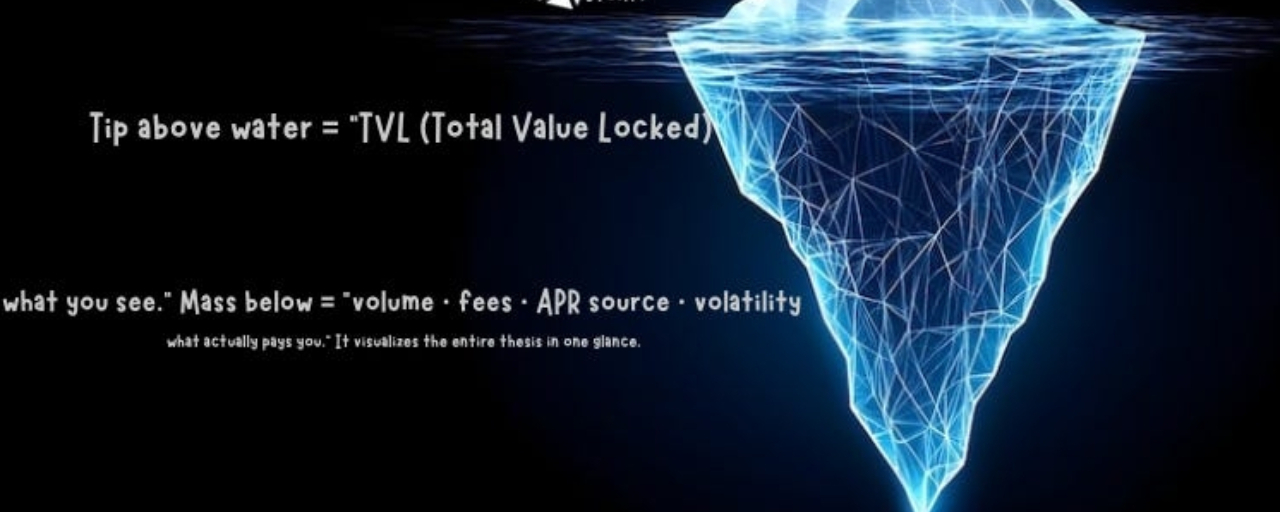
You open a liquidity pool. The number staring back at you is $14M in TVL. Your brain does the thing brains do: big number = safe = good opportunity. Done. You ape in
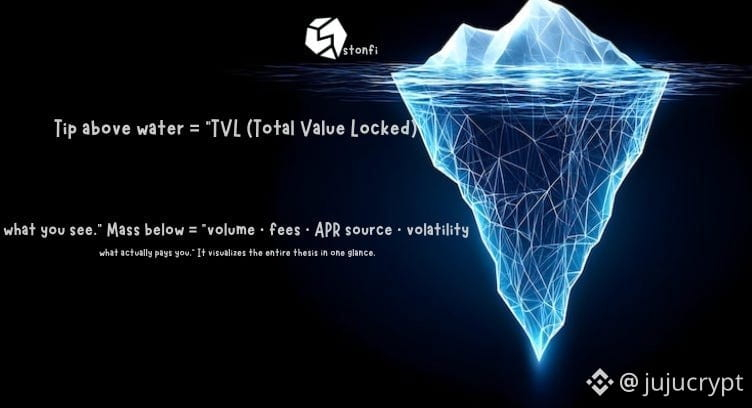
And then three weeks later, your APR is basically a rounding error, the pool’s volume flatlined, and you’re sitting there wondering what happened.
I’ve been there. And honestly? That one number Total Value Locked is the most over-trusted metric in DeFi. It’s not wrong, but it’s doing the equivalent of judging a restaurant by how many chairs it has instead of whether anyone’s actually eating.
So let’s fix that. Because if you’re anywhere near the TON ecosystem, or you’ve heard of STON.fi but haven’t popped the hood yet, this is the 5-minute read that’ll change how you evaluate a pool.
What TVL actually tells you (and what it doesn’t)
TVL tells you one thing: how much capital is currently parked in a pool. That’s it.
It doesn’t tell you if anyone is trading through that pool. It doesn’t tell you if the APR you’re eyeing is coming from real fee generation or from temporary token incentives that dry up in two weeks. It doesn’t warn you that the two assets in the pair are volatile enough to eat your returns through impermanent loss.
A $10M pool with almost no trading activity and a $3M pool generating consistent volume and fees? The second one is likely the better place for your capital. But you’d never know that from the headline number alone.
So what should you look at?
Here’s the mental checklist I use now, and the one I’d hand to anyone getting into liquidity provision on TON:
→ Trading volume. Is this pool actually being used? Consistent volume means the pool is alive, not just a parking lot.
→ Fee generation. Volume is nice, but fees are what actually pay you. Look at what the pool is generating over 24h, 7d, 30d.
→ APR source. Is the yield coming from real trading fees, or is it propped up by incentive programs with an end date? Incentive APRs are borrowed time.
→ Asset volatility. Two stablecoins? Lower risk. A volatile alt paired with TON? You need to factor in impermanent loss before the APR even matters.
None of this is complicated. But it is work the kind of work most people skip because the information feels scattered.
This is where STON.fi quietly does the heavy lifting
If you haven’t used STON.fi yet, here’s the short version: it’s a DEX aggregator built on $GRAM . You swap tokens, you provide liquidity, and you get access to some of the deepest pools in the TON ecosystem.
But the part I want to highlight the part that actually ties into everything above is how the pool pages are set up.
When you pull up a pool on STON.fi, you’re not just staring at TVL. You get volume, fees, and APR laid out right there. You can see the activity. You can compare pools side by side without opening six tabs and a spreadsheet.
And if you want to go one layer deeper before committing your capital, there are two tools I’d genuinely recommend:
The APR Calculator — lets you model what your actual returns might look like based on different scenarios, not just the headline number.
The Impermanent Loss Calculator — lets you stress-test a pair before you’re in it. “What happens to my position if TON moves 20%?” Now you know before you find out the hard way.
That’s not a small thing. Most DEXes hand you a number and say “good luck.” STON.fi hands you the context to make a decision.
The bigger picture (for the GRAM -curious)
If you’ve been watching GRAM from the sideline maybe you’ve got a wallet, maybe you’ve swapped a token or two liquidity provision is one of the most underused ways to actually put your assets to work on this chain. But only if you walk in with eyes open.
You don’t need to be a DeFi veteran. You don’t need to understand bonding curves or AMM math at a protocol level. You just need to look past the first number you see and ask: is this pool actually doing something, or is it just… sitting there?
STON.fi makes asking that question genuinely easy. And on a chain that’s still growing, that kind of clarity matters more than you’d think.
The one-line takeaway
Don’t judge a pool by one number. TVL is the cover. Volume, fees, and APR source are the actual story. Read the whole book before you put your money in.
That’s it. That’s the lesson. Save this one for next time you’re pool-hunting