I’ve been thinking a lot about how little we actually control once assets leave our wallet.
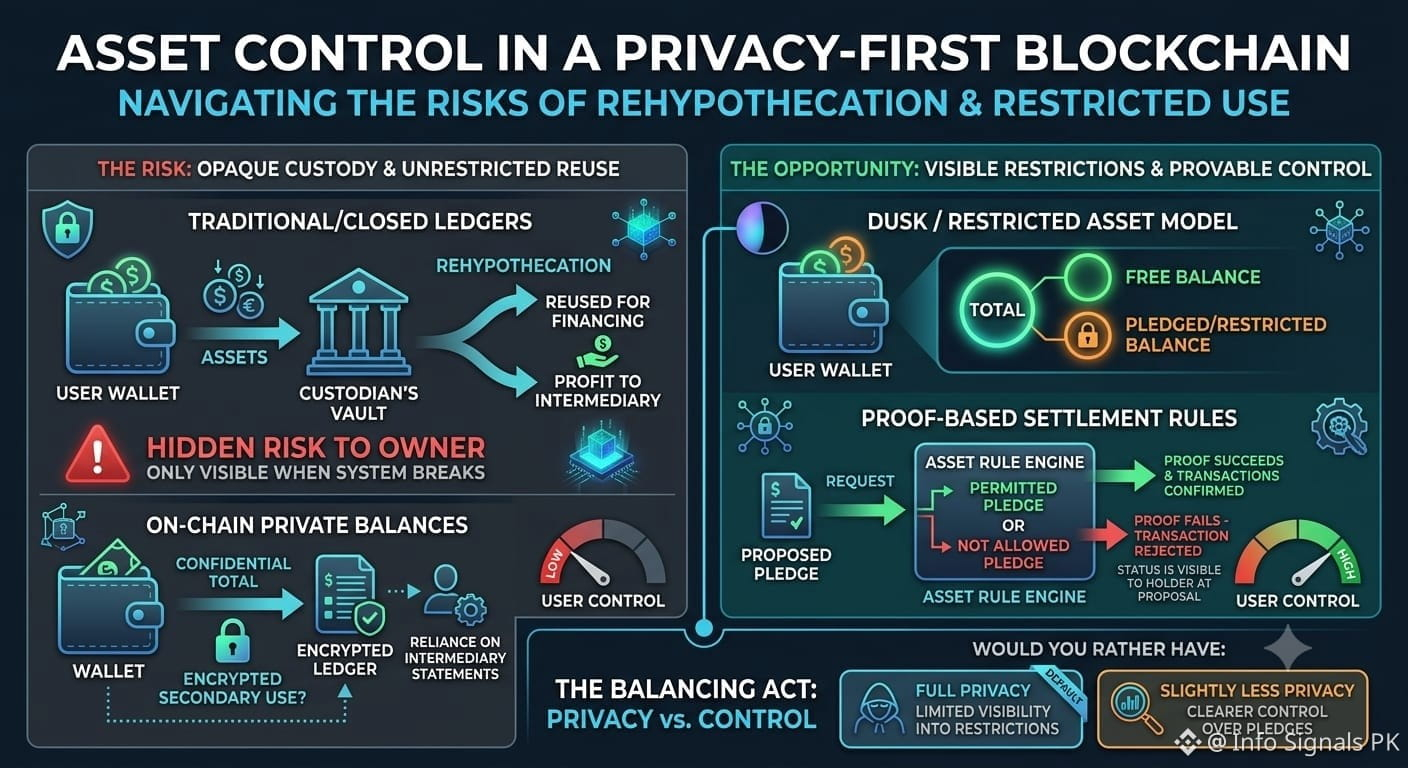
In traditional finance, rehypothecation has always been a quiet risk. You think your securities are sitting safely with the custodian, but they can be reused for someone else’s financing. The profits go elsewhere. The risk stays with you. Most people only notice when something breaks.
That same issue is now showing up on-chain, especially with private or confidential balances. If the only number visible is a total, it becomes easier to hide secondary use behind encrypted ledgers. Customers end up trusting statements from the same intermediary holding the assets. That’s not real control. That’s a closed loop.
This is what made me look closer at Dusk. The practical point that stood out is the idea of restricted assets. The pledge itself has to be an allowed action under the rules. If it’s not permitted, the proof should simply fail. Not something you discover later in a report.
That kind of status needs to be visible to the holder too. How much is free, how much is already pledged. Without that, you’re back to trusting statements.
The opportunity is clearer settlement rules for assets that actually matter. The realistic risk is that privacy features can also make secondary use harder to spot if the status fields aren’t designed carefully.
Lesson for me: treat unrestricted secondary use as the default until the protocol proves otherwise. Don’t rely on the custodian’s good intentions.
Would you rather have full privacy with limited visibility into restrictions, or slightly less privacy but clearer control over what’s been pledged?
#dusk @Dusk $DUSK $BR $SAND
In traditional finance, rehypothecation has always been a quiet risk. You think your securities are sitting safely with the custodian, but they can be reused for someone else’s financing. The profits go elsewhere. The risk stays with you. Most people only notice when something breaks.
That same issue is now showing up on-chain, especially with private or confidential balances. If the only number visible is a total, it becomes easier to hide secondary use behind encrypted ledgers. Customers end up trusting statements from the same intermediary holding the assets. That’s not real control. That’s a closed loop.
This is what made me look closer at Dusk. The practical point that stood out is the idea of restricted assets. The pledge itself has to be an allowed action under the rules. If it’s not permitted, the proof should simply fail. Not something you discover later in a report.
That kind of status needs to be visible to the holder too. How much is free, how much is already pledged. Without that, you’re back to trusting statements.
The opportunity is clearer settlement rules for assets that actually matter. The realistic risk is that privacy features can also make secondary use harder to spot if the status fields aren’t designed carefully.
Lesson for me: treat unrestricted secondary use as the default until the protocol proves otherwise. Don’t rely on the custodian’s good intentions.
Would you rather have full privacy with limited visibility into restrictions, or slightly less privacy but clearer control over what’s been pledged?
#dusk @Dusk $DUSK $BR $SAND