Public blockchains force a choice.
Broadcast every trade to everyone, or hide it from everyone including the regulator.
Dusk skips that choice with selective disclosure.
I assumed a privacy blockchain meant privacy from all parties, full stop. Then I read how Phoenix actually works.
Phoenix uses zero-knowledge proofs, cryptographic commitments and nullifiers, to hide sender, receiver, and amount by default. But the same proof structure lets a transaction reveal specific details to a chosen party on demand, without exposing anything to anyone else watching the chain.
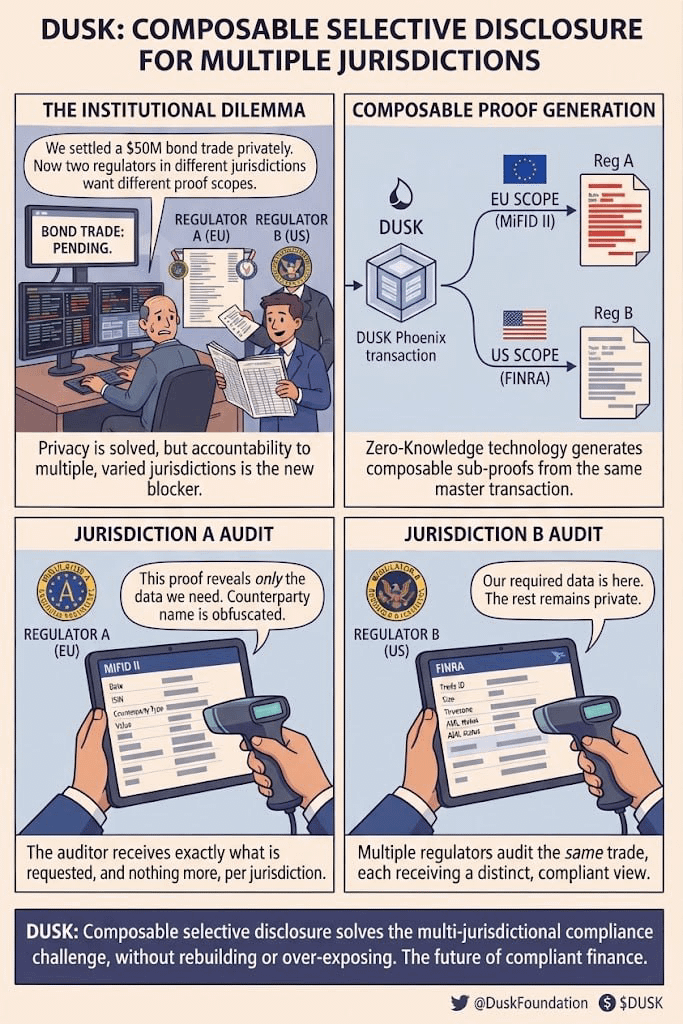
Financially, that's the actual institutional blocker solved, not privacy in the abstract. A bank can settle a bond trade without leaking size or counterparty to competitors, then produce the exact disclosure a regulator requires for that one trade. Same transaction, two audiences, no rebuild.
Dusk's own documentation frames this directly as privacy by default, auditability when required, built specifically around MiCA and MiFID II style securities issuance.
What isn't addressed publicly: how selective disclosure holds up when two regulators in different jurisdictions want different scopes revealed on the same trade.
What I'm sitting with: is that composable, or does every jurisdiction just get its own separate proof request bolted on after the fact.
@Dusk $DUSK #dusk $ACE $ALPINE
Broadcast every trade to everyone, or hide it from everyone including the regulator.
Dusk skips that choice with selective disclosure.
I assumed a privacy blockchain meant privacy from all parties, full stop. Then I read how Phoenix actually works.
Phoenix uses zero-knowledge proofs, cryptographic commitments and nullifiers, to hide sender, receiver, and amount by default. But the same proof structure lets a transaction reveal specific details to a chosen party on demand, without exposing anything to anyone else watching the chain.
Financially, that's the actual institutional blocker solved, not privacy in the abstract. A bank can settle a bond trade without leaking size or counterparty to competitors, then produce the exact disclosure a regulator requires for that one trade. Same transaction, two audiences, no rebuild.
Dusk's own documentation frames this directly as privacy by default, auditability when required, built specifically around MiCA and MiFID II style securities issuance.
What isn't addressed publicly: how selective disclosure holds up when two regulators in different jurisdictions want different scopes revealed on the same trade.
What I'm sitting with: is that composable, or does every jurisdiction just get its own separate proof request bolted on after the fact.
@Dusk $DUSK #dusk $ACE $ALPINE