I've spent enough time on leveraged positions to know that most liquidation events aren't caused by bad calls, they're caused by the mechanics of getting into and out of a position taking too many steps under pressure. Every extra transaction is a window where price can move against you before you finish executing.
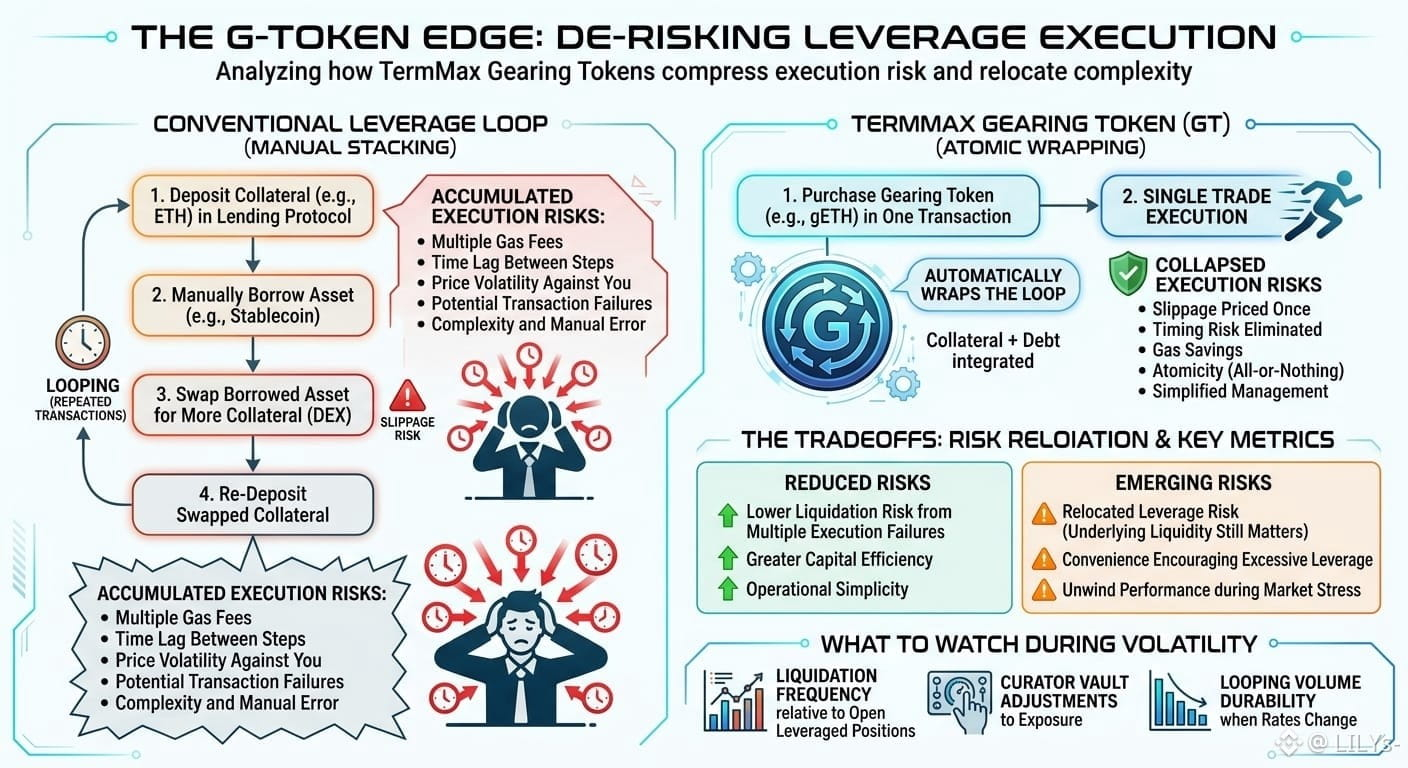
That's the angle that made me look closer at TermMax's Gearing Token. Instead of manually borrowing, swapping, and re-depositing to build a leveraged position, GT wraps the whole loop into a single token representing collateral plus debt. One transaction instead of a sequence of them.
The interesting part isn't the convenience, it's what compressing that sequence does to execution risk. When looping happens atomically, slippage and timing risk collapse into one priced event instead of accumulating across several separate trades. That's a structural advantage over manually stacked leverage, even before you account for gas savings, and I think most people evaluating the protocol focus on the yield side and miss this.
The tradeoff is that wrapping complexity into a single token doesn't remove the underlying leverage risk, it just relocates where you have to look for it. Collateral quality still matters, and a token that behaves simply on the surface can still unwind badly if the underlying market for that collateral thins out during stress. Convenience can quietly encourage people to take on more leverage than they'd otherwise manage by hand.
Given that, I'd watch how GT positions behave during actual volatility rather than during calm markets. Liquidation frequency relative to open leveraged positions, how curator-managed vaults adjust exposure when conditions shift, and whether looping volume holds up or disappears the moment rates get uncomfortable all tell me more than adoption numbers collected in quiet periods.
I don't think convenience and risk ever fully separate, they just get repackaged. Whether GT's design meaningfully lowers risk or just makes it easier to accumulate is something I am looking forward. #TermMax @TermMax $ACE $CLO
That's the angle that made me look closer at TermMax's Gearing Token. Instead of manually borrowing, swapping, and re-depositing to build a leveraged position, GT wraps the whole loop into a single token representing collateral plus debt. One transaction instead of a sequence of them.
The interesting part isn't the convenience, it's what compressing that sequence does to execution risk. When looping happens atomically, slippage and timing risk collapse into one priced event instead of accumulating across several separate trades. That's a structural advantage over manually stacked leverage, even before you account for gas savings, and I think most people evaluating the protocol focus on the yield side and miss this.
The tradeoff is that wrapping complexity into a single token doesn't remove the underlying leverage risk, it just relocates where you have to look for it. Collateral quality still matters, and a token that behaves simply on the surface can still unwind badly if the underlying market for that collateral thins out during stress. Convenience can quietly encourage people to take on more leverage than they'd otherwise manage by hand.
Given that, I'd watch how GT positions behave during actual volatility rather than during calm markets. Liquidation frequency relative to open leveraged positions, how curator-managed vaults adjust exposure when conditions shift, and whether looping volume holds up or disappears the moment rates get uncomfortable all tell me more than adoption numbers collected in quiet periods.
I don't think convenience and risk ever fully separate, they just get repackaged. Whether GT's design meaningfully lowers risk or just makes it easier to accumulate is something I am looking forward. #TermMax @TermMax $ACE $CLO