

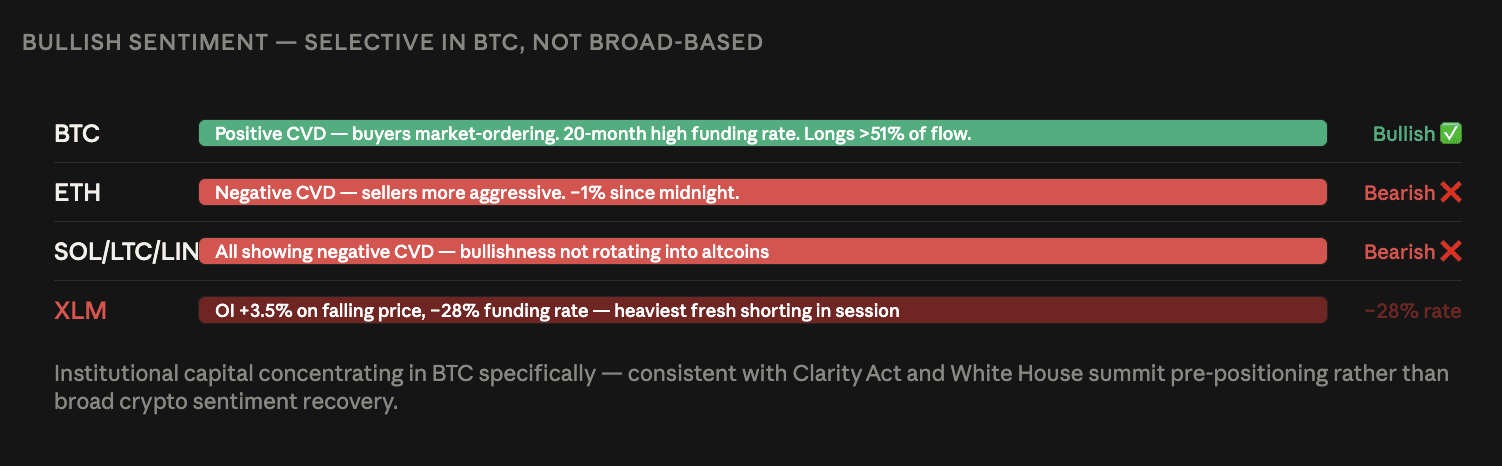
Bitcoin traded around $64,000 — down 0.6% since midnight UTC — after rallying from $62,600 on Monday, as Nasdaq 100 futures slipped 1.1% and Treasury yields rose ahead of Wednesday's FOMC July meeting minutes release. Brent crude rose back to $94 per barrel after the 60-day US-Iran ceasefire expired Monday without a deal, reviving the oil-inflation headwind that has capped Bitcoin all summer. BTC perpetual funding rates surged to a 20-month high according to CryptoQuant — the strongest expression of bullish futures bias since the current bear market began — while BTC's positive CVD showed buyer leadership even as ETH, SOL, LTC, LINK, and DOGE all registered negative CVD, suggesting the bullish sentiment is concentrated in Bitcoin rather than broadly distributed. Also due Wednesday: US President Trump is expected to attend a meeting with crypto CEOs at the White House — a policy catalyst that has been identified as a key driver of Bitcoin's stop-start range-bound performance.
Brent at $94 — the Highest Since the Conflict Began on a Ceasefire Expiration
Brent crude rising to $94 per barrel after the 60-day ceasefire expired without a deal is the most significant single-session oil development since the conflict began in February. The $94 level — up from the $81.55 low reached when Trump signaled the WWII-scale canceled strike and deal "imminent" language — represents a nearly complete reversal of the deal-optimism discount that briefly made the macro chain constructive for Bitcoin. With the ceasefire formally expired and no deal, the Hormuz situation has reverted to its most adversarial configuration: no active truce, no Iran-Oman deal formally consummated, and shipping at near-zero with only five ships on Saturday and zero on Sunday per Kpler data.
At $94 Brent, the oil-inflation transmission that Fidelity's Timmer identified as the mechanism keeping Bitcoin capped is operating at near-maximum intensity. For Wednesday's FOMC minutes — which capture the July 29 meeting when BVIV was at 37%, BTC was near $64,524, and the ceasefire was still in effect — the key interpretive question is whether the minutes reflect the hawkish forward guidance that Warsh delivered post-meeting, or whether they show a more divided committee that was already conditioning rate decisions on incoming inflation data. With Brent now at $94 versus $87 at the July 29 meeting, the August inflation picture is materially worse than what the FOMC was working with in July — making the minutes potentially dated by the time they are released.
Funding Rates at a 20-Month High — the Most Bullish Futures Positioning Since the Bear Market Began
BTC perpetual funding rates surging to a 20-month high — meaning futures are trading at the largest premium to spot price in 20 months — is the most significant derivatives signal of the current recovery period. Positive funding rates indicate that long holders are paying short holders to maintain their positions, with the rate reflecting the intensity of demand for leveraged long Bitcoin exposure. A 20-month high funding rate means the bullish bias in Bitcoin futures is at its most extreme since before the current bear market began in early 2026 — a period when Bitcoin was trading at significantly higher prices with correspondingly stronger sentiment.
The 20-month high funding rate in the context of Bitcoin at $64,000 — approximately 15.7% below the $75,385 average acquisition cost of the market's largest corporate holder — creates a specific tension. Futures traders are expressing maximum bullish conviction at a price level where the market's most prominent institutional holder is underwater. Extreme positive funding rates have historically preceded one of two outcomes: a price acceleration that validates the bullish positioning, or a funding rate-driven long squeeze where the cost of maintaining leveraged longs becomes unsustainable and forces position closures that push prices lower. The distinction depends on whether fresh spot buying accompanies the leveraged positioning — which BTC's positive CVD suggests is occurring — or whether the bullishness is purely leveraged and therefore vulnerable to a squeeze.
Selective Bullishness — BTC Positive CVD, Most Majors Negative
Bitcoin's positive 24-hour CVD showing buyer leadership while ETH, SOL, LTC, LINK, and DOGE all register negative CVD is the most precise expression of the selective rather than broad-based nature of the current bullish positioning. A positive CVD means Bitcoin buyers are executing through market orders — paying the ask rather than waiting on bids — while sellers in other assets are similarly using market orders to exit. The configuration describes institutional or sophisticated capital concentrating specifically in Bitcoin rather than rotating into the broader altcoin market.
This is analytically consistent with the Clarity Act thesis: if crypto CEOs meeting Trump at the White House Wednesday are focused on Bitcoin's regulatory clarity as the primary policy priority — and the Clarity Act's September vote window is the vehicle — then the institutional capital most sensitive to regulatory outcomes would concentrate in Bitcoin rather than altcoins whose regulatory status is more uncertain. The selective BTC bullishness in funding rates and CVD may be reflecting pre-White House summit positioning from participants who expect the summit to produce Bitcoin-positive regulatory signals.
The White House Crypto Summit — the Policy Catalyst That Changes the Narrative
Trump attending a meeting with crypto CEOs at the White House on Wednesday is the most significant executive-branch crypto engagement since the current administration took office. The White House summit's potential outcomes cover a wide range: an endorsement of the Clarity Act's September timeline, direct engagement on the ethics compromise that has held up Democratic votes, executive action on crypto regulatory clarity that supplements legislative progress, or simply visible presidential support that accelerates the Clarity Act's political momentum.
The summit's significance in the current context — Bitcoin at $64,000 with 20-month high funding rates, the Clarity Act alive for September, and institutional capital concentrating specifically in Bitcoin per the CVD data — is that executive-branch visible support for crypto legislation is the one variable that could accelerate the Democratic vote-counting that the Clarity Act requires. The bipartisan ethics compromise proposal that has sat unanswered at the White House for weeks may receive a response through the summit framework, resolving the primary obstacle to Democratic support and making the September cloture vote more likely to reach 60 votes.
FOMC Minutes Wednesday — Hawkish Guidance or Divided Committee?
The Federal Reserve's July 29 meeting minutes arriving the same day as the White House summit creates a double-catalyst Wednesday that could produce significant price movement in either direction. The minutes will reveal whether the Fed's July hold reflected a genuinely divided committee with dovish dissenters or a unified hawkish stance behind Warsh's post-meeting guidance. A divided committee — with multiple members expressing comfort with holding rates without further hikes — would provide Goldman Sachs's "very unlikely" September hike call with institutional Fed validation, compressing September hike odds below the current 30.6%. A unified hawkish tone in the minutes would complicate Goldman's call and potentially push hike odds back toward 50%.
The specific tension is that the July 29 meeting occurred before Brent rose from $87 to $94 on the ceasefire expiration — meaning the committee members were working with a less inflationary oil price environment than the one that currently exists. If the minutes show the committee was already concerned about oil-driven inflation at $87 Brent, the $94 current level makes a hawkish September read more likely. If the minutes show the committee was already leaning toward a hold regardless of oil, the current $94 Brent is a headwind but not a game-changer for the September decision.
XLM's -28% Funding Rate — the Session's Clearest Bearish Derivatives Signal
XLM's annualized funding rate at -28% — paired with OI rising 3.5% to its highest since June 4 as the price drops nearly 3% to 15 cents — is the session's clearest single-asset bearish derivatives signal. The combination mirrors the HBAR -20% funding rate pattern from earlier in the week: aggressive short sellers building positions at extreme negative funding rates that are expensive to maintain. XLM's reversal from a 27-cent peak at the end of May to 15 cents — its lowest since May 27 — represents a 44% decline that the -28% funding rate suggests sophisticated traders expect to continue. As with HBAR, the -28% funding rate is either vindicated by continued XLM price decline or forces a short-covering squeeze if the rate becomes unsustainably expensive.
Token Highlights — XMR +11% Weekly, PUMP Holds Monday Gains, SUI -4.62%
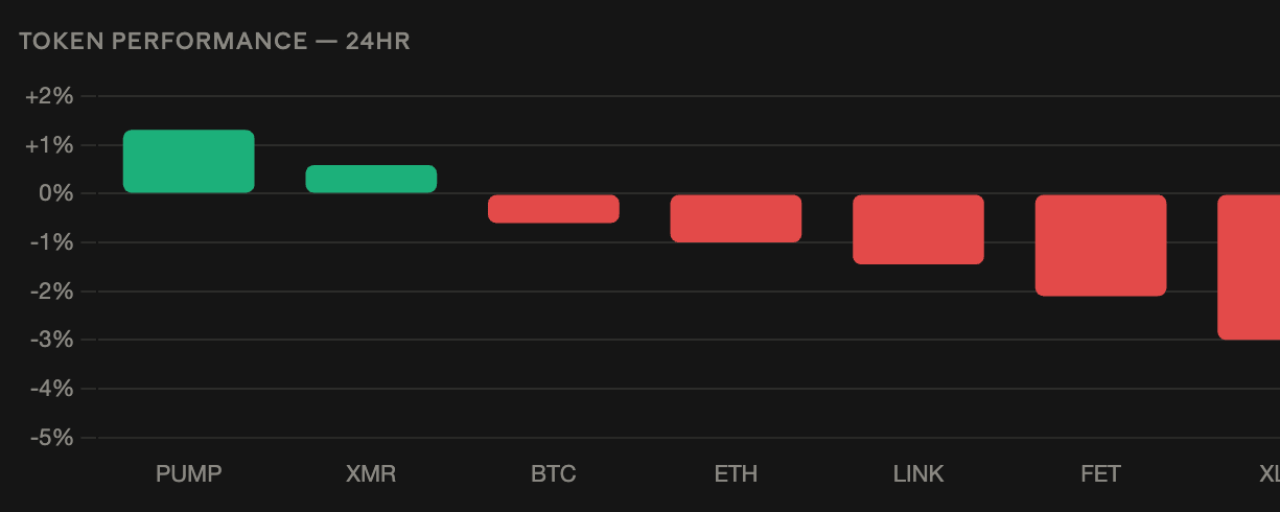
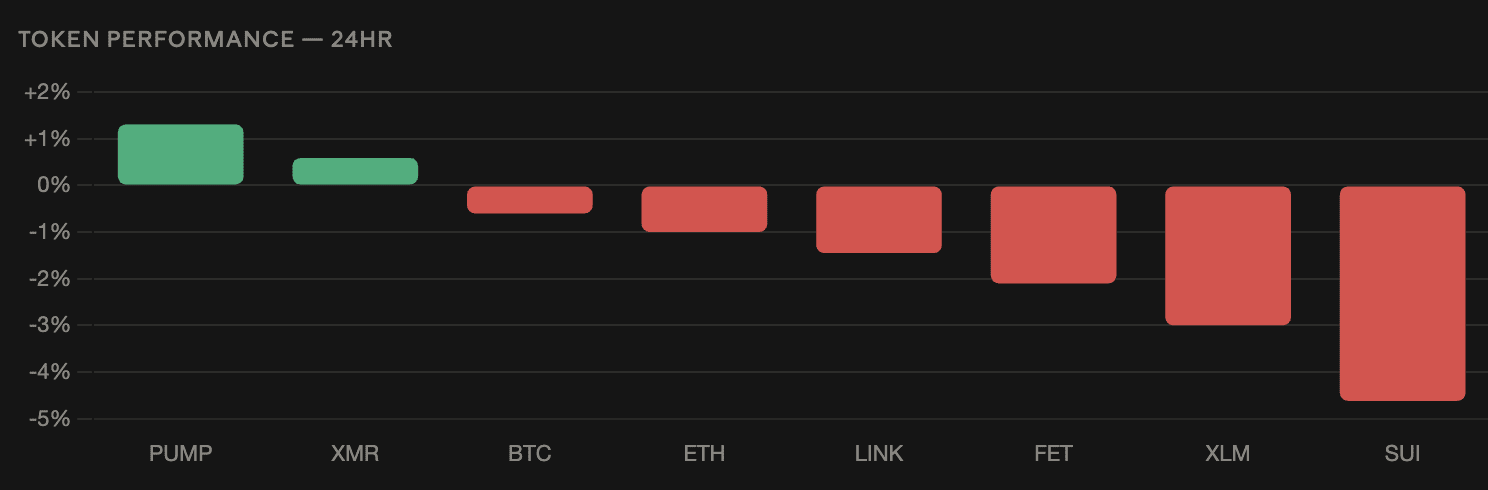
XMR's 0.59% daily gain to $417 extends the seven-day gain to more than 11% — making the privacy coin August's clearest outperformer among major altcoins. The 28% annualized funding rate and most positive CVD among majors identified earlier in the week have sustained the XMR rally through multiple sessions. PUMP holding above $0.00277 after Monday's 7.8% surge on 55% higher trading volume describes the token stabilizing its gains. SUI's 4.62% decline to 64.36 cents reverses its relative strength period — consistent with SUI being among the notable OI gainers in a session where OI growth with negative price suggests fresh short selling. LINK's 1.45% decline to $9.39 represents a partial retracement of the Standard Chartered 2,000% by 2030 prediction catalyst but the token remains up 8% since the forecast.