
@Dusk #dusk
Ok..honestly Been spending time lately going deep on Dusk, and the more I look at it, the more I think it's solving a problem most of crypto hasn't seriously tried to address yet.
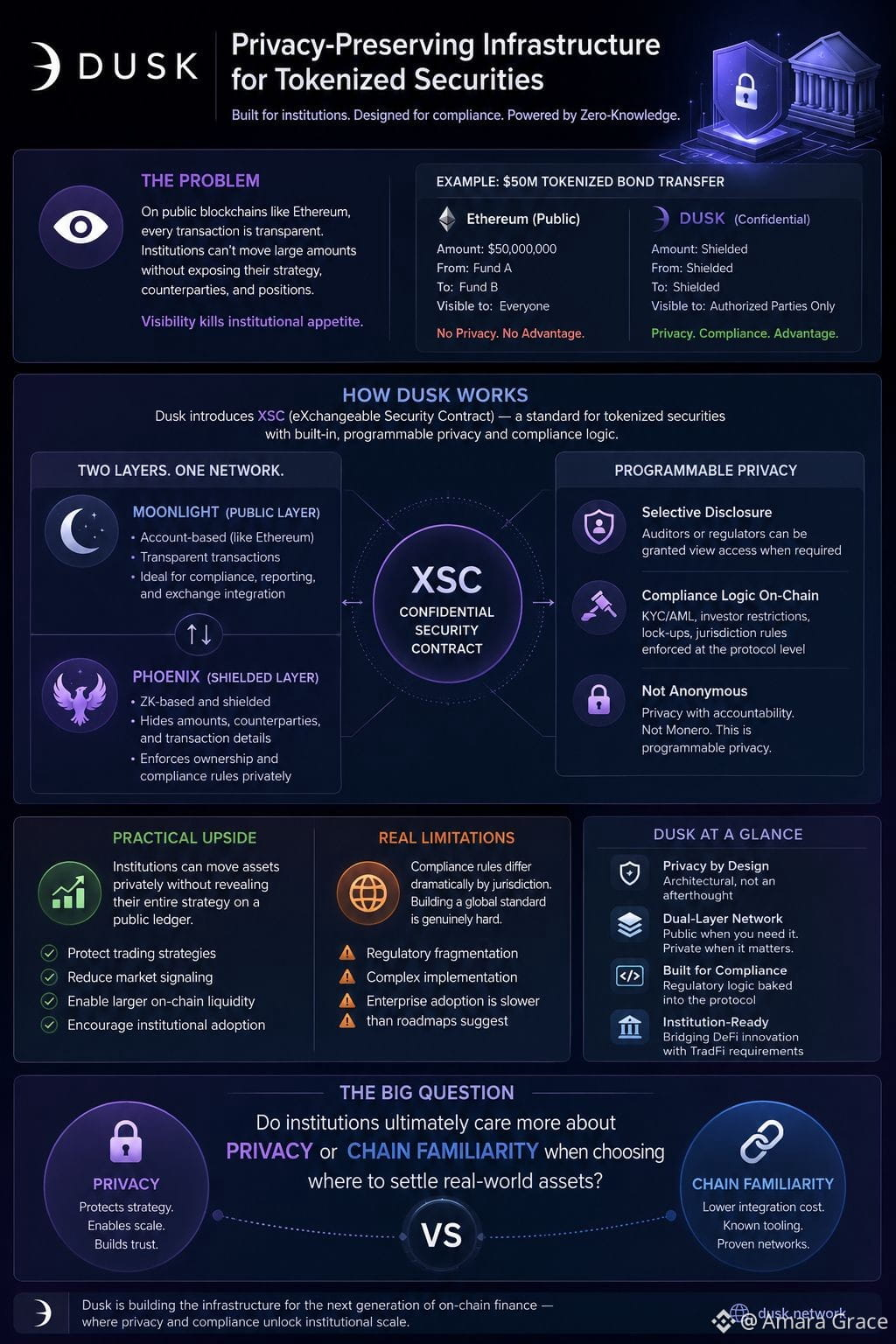
The core idea behind XSC Dusk's Confidential Security Contract standard is that you can issue and trade tokenized securities on-chain without broadcasting every detail to the world. That's not how other chains work. On Ethereum, if a fund moves $50M into a tokenized bond, that's visible. Full stop. That visibility alone kills institutional appetite before it starts.
Dusk handles this through two transaction layers: Moonlight, which is fully public and account-based, closer to Ethereum solid for compliance reporting and exchange integration and Phoenix, which is ZK-based and shielded, hiding amounts and counterparties while still enforcing ownership rules. You can actually switch between them. Auditors or regulators can be granted selective view access when it's required. It's not anonymous in the Monero sense it's programmable privacy with compliance logic baked in at the protocol level.
What genuinely stood out: the privacy isn't bolted on as an afterthought. It's architectural. That's a meaningful difference.
Practical upside: institutions can move assets without leaking their entire trading strategy to competitors on a public ledger.
Real limitation: compliance rules differ dramatically by jurisdiction. Building a global standard around regulatory logic is genuinely hard, and enterprise adoption in this space has always been slower than the roadmaps suggest.
So do you think institutions ultimately care more about privacy or about chain familiarity when choosing where to settle real-world assets?
$DUSK
$CLO
$TUT
Ok..honestly Been spending time lately going deep on Dusk, and the more I look at it, the more I think it's solving a problem most of crypto hasn't seriously tried to address yet.
The core idea behind XSC Dusk's Confidential Security Contract standard is that you can issue and trade tokenized securities on-chain without broadcasting every detail to the world. That's not how other chains work. On Ethereum, if a fund moves $50M into a tokenized bond, that's visible. Full stop. That visibility alone kills institutional appetite before it starts.
Dusk handles this through two transaction layers: Moonlight, which is fully public and account-based, closer to Ethereum solid for compliance reporting and exchange integration and Phoenix, which is ZK-based and shielded, hiding amounts and counterparties while still enforcing ownership rules. You can actually switch between them. Auditors or regulators can be granted selective view access when it's required. It's not anonymous in the Monero sense it's programmable privacy with compliance logic baked in at the protocol level.
What genuinely stood out: the privacy isn't bolted on as an afterthought. It's architectural. That's a meaningful difference.
Practical upside: institutions can move assets without leaking their entire trading strategy to competitors on a public ledger.
Real limitation: compliance rules differ dramatically by jurisdiction. Building a global standard around regulatory logic is genuinely hard, and enterprise adoption in this space has always been slower than the roadmaps suggest.
So do you think institutions ultimately care more about privacy or about chain familiarity when choosing where to settle real-world assets?
$DUSK
$CLO
$TUT