#dusk $DUSK
Most blockchains make financial activity transparent by default.
Dusk is building around a different question:
What if privacy and compliance were properties of the asset itself?
That’s where its XSC standard gets interesting.
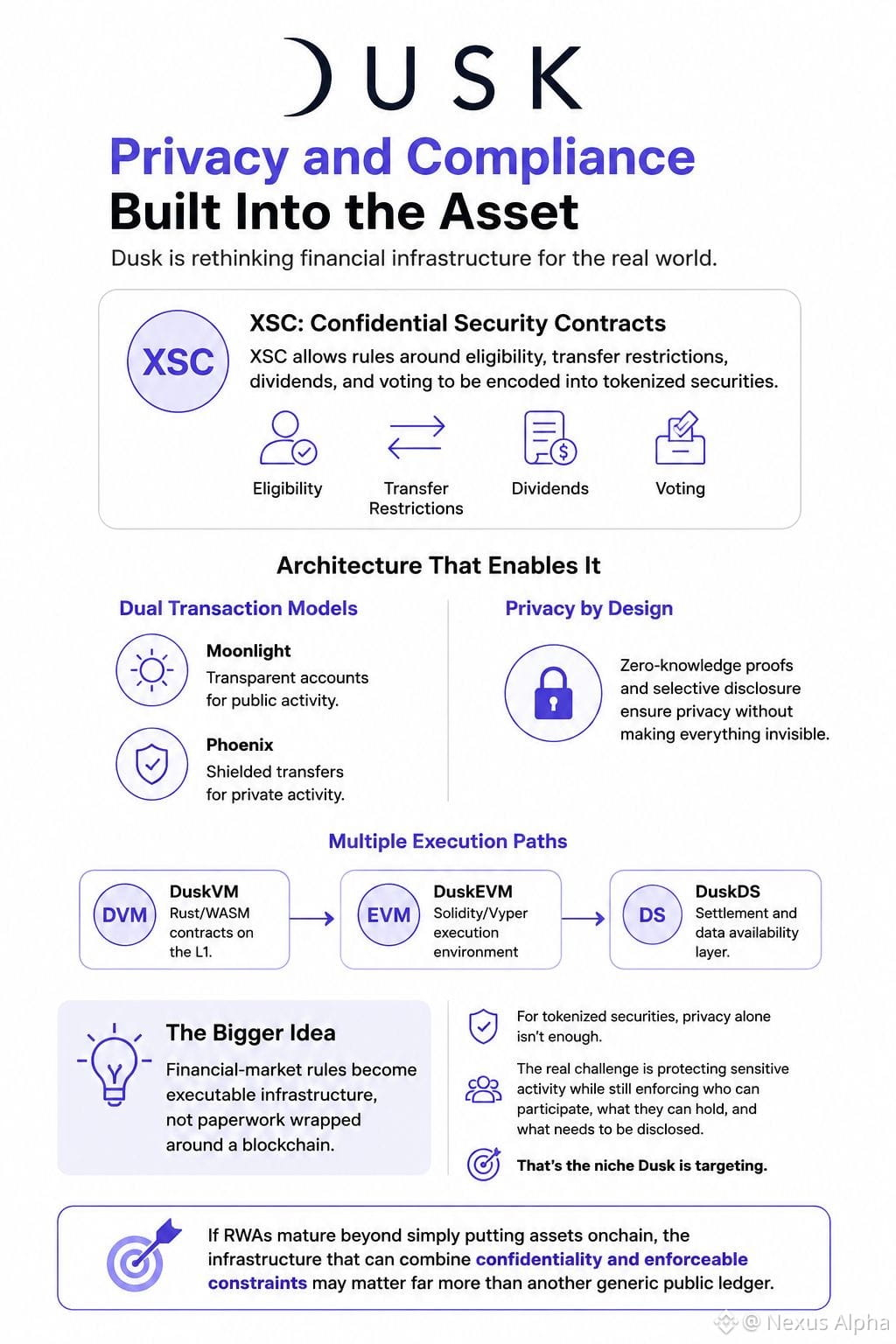
XSC is designed for confidential security contracts, allowing rules around eligibility transfer restrictions dividends and voting to be encoded into tokenized securities.
The architecture reinforces that approach.
Dusk supports both transparent and shielded transaction models Moonlight for public accounts and Phoenix for shielded transfers. Its cryptography stack uses zero knowledge proofs and selective disclosure, so privacy doesn’t have to mean making everything invisible.
There’s also more than one execution path.
DuskVM runs Rust/WASM contracts on the L1, while DuskEVM supports Solidity/Vyper execution, with settlement and data availability through DuskDS.
The bigger idea is easy to miss:
financial market rules becoming executable infrastructure, rather than paperwork wrapped around a blockchain.
For tokenized securities, privacy alone isn’t enough. Sensitive activity still needs to remain confidential while rules around participation ownership and disclosure can be enforced.
That’s the niche Dusk is targeting.
If RWAs mature beyond simply putting assets onchain the interesting infrastructure may be the layer that can make confidentiality and constraints work together.
@Dusk
#DUSKARMY. #dusk
Most blockchains make financial activity transparent by default.
Dusk is building around a different question:
What if privacy and compliance were properties of the asset itself?
That’s where its XSC standard gets interesting.
XSC is designed for confidential security contracts, allowing rules around eligibility transfer restrictions dividends and voting to be encoded into tokenized securities.
The architecture reinforces that approach.
Dusk supports both transparent and shielded transaction models Moonlight for public accounts and Phoenix for shielded transfers. Its cryptography stack uses zero knowledge proofs and selective disclosure, so privacy doesn’t have to mean making everything invisible.
There’s also more than one execution path.
DuskVM runs Rust/WASM contracts on the L1, while DuskEVM supports Solidity/Vyper execution, with settlement and data availability through DuskDS.
The bigger idea is easy to miss:
financial market rules becoming executable infrastructure, rather than paperwork wrapped around a blockchain.
For tokenized securities, privacy alone isn’t enough. Sensitive activity still needs to remain confidential while rules around participation ownership and disclosure can be enforced.
That’s the niche Dusk is targeting.
If RWAs mature beyond simply putting assets onchain the interesting infrastructure may be the layer that can make confidentiality and constraints work together.
@Dusk
#DUSKARMY. #dusk