Last night, I revisited the Dusk documentation, focusing on grasping the actual role $DUSK plays within the protocol—its technical function rather than the market-driven story.
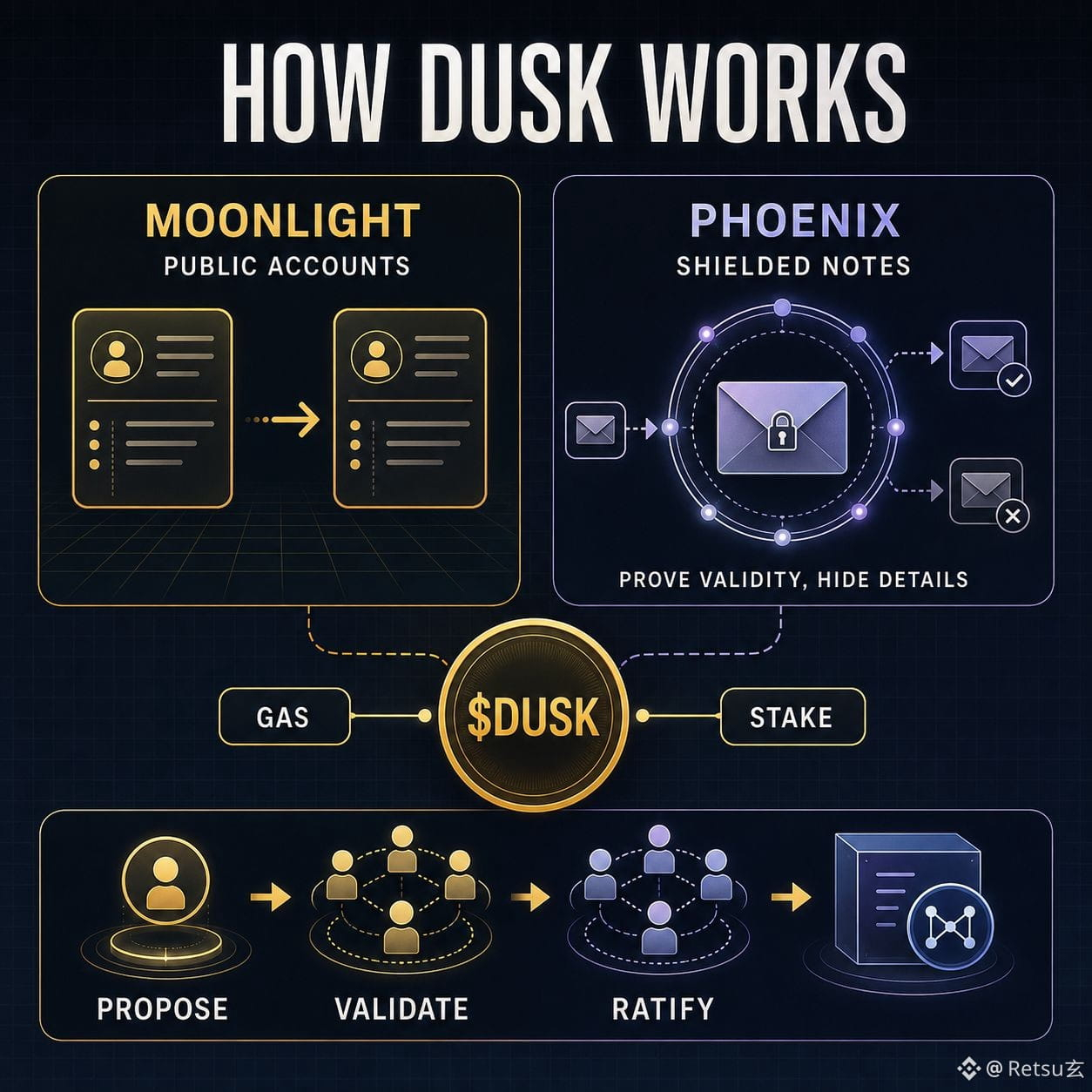
The first thing I had to untangle was DuskDS’s two transaction models. Moonlight is the familiar route: public accounts, visible balances, sender, recipient, amount. Phoenix works with encrypted “notes.” To spend one, the user supplies a zero-knowledge proof that ownership and balance rules hold. Think of handing a clerk a sealed envelope whose seal proves every required box is checked, without exposing the contents. A nullifier then lets the network reject a second spend without identifying which note in the public tree was used. I reread that part twice—then a notification pulled me away—because privacy doesn’t mean “nothing is checked.” It means the network checks a proof instead of the hidden transaction details. Viewing keys can selectively reveal information.
Consensus took another pass. Dusk calls it Succinct Attestation: stakers, or provisioners, lock DUSK; deterministic, stake-weighted selection picks a block proposer, then one committee validates and another ratifies. Aggregated signatures become an attestation that a quorum agreed. So $DUSK is both gas and the stake behind participation.
The part I’d examine next is concentration. Selection is permissionless, but how distributed are effective committee credits in practice? In the pages I read, I couldn’t find a clear account of who changes global parameters. maybe I missed it.
What evidence would show committee power is genuinely dispersed? How are viewing keys governed in real deployments? who can change protocol parameters, and through what process?
#dusk $DUSK @Dusk
The first thing I had to untangle was DuskDS’s two transaction models. Moonlight is the familiar route: public accounts, visible balances, sender, recipient, amount. Phoenix works with encrypted “notes.” To spend one, the user supplies a zero-knowledge proof that ownership and balance rules hold. Think of handing a clerk a sealed envelope whose seal proves every required box is checked, without exposing the contents. A nullifier then lets the network reject a second spend without identifying which note in the public tree was used. I reread that part twice—then a notification pulled me away—because privacy doesn’t mean “nothing is checked.” It means the network checks a proof instead of the hidden transaction details. Viewing keys can selectively reveal information.
Consensus took another pass. Dusk calls it Succinct Attestation: stakers, or provisioners, lock DUSK; deterministic, stake-weighted selection picks a block proposer, then one committee validates and another ratifies. Aggregated signatures become an attestation that a quorum agreed. So $DUSK is both gas and the stake behind participation.
The part I’d examine next is concentration. Selection is permissionless, but how distributed are effective committee credits in practice? In the pages I read, I couldn’t find a clear account of who changes global parameters. maybe I missed it.
What evidence would show committee power is genuinely dispersed? How are viewing keys governed in real deployments? who can change protocol parameters, and through what process?
#dusk $DUSK @Dusk