#dusk $DUSK @Dusk
I almost ignored Dusk’s January bridge incident because the market reaction was louder than the actual details.
Then I went back to Dusk’s own notice and started reading it more carefully.
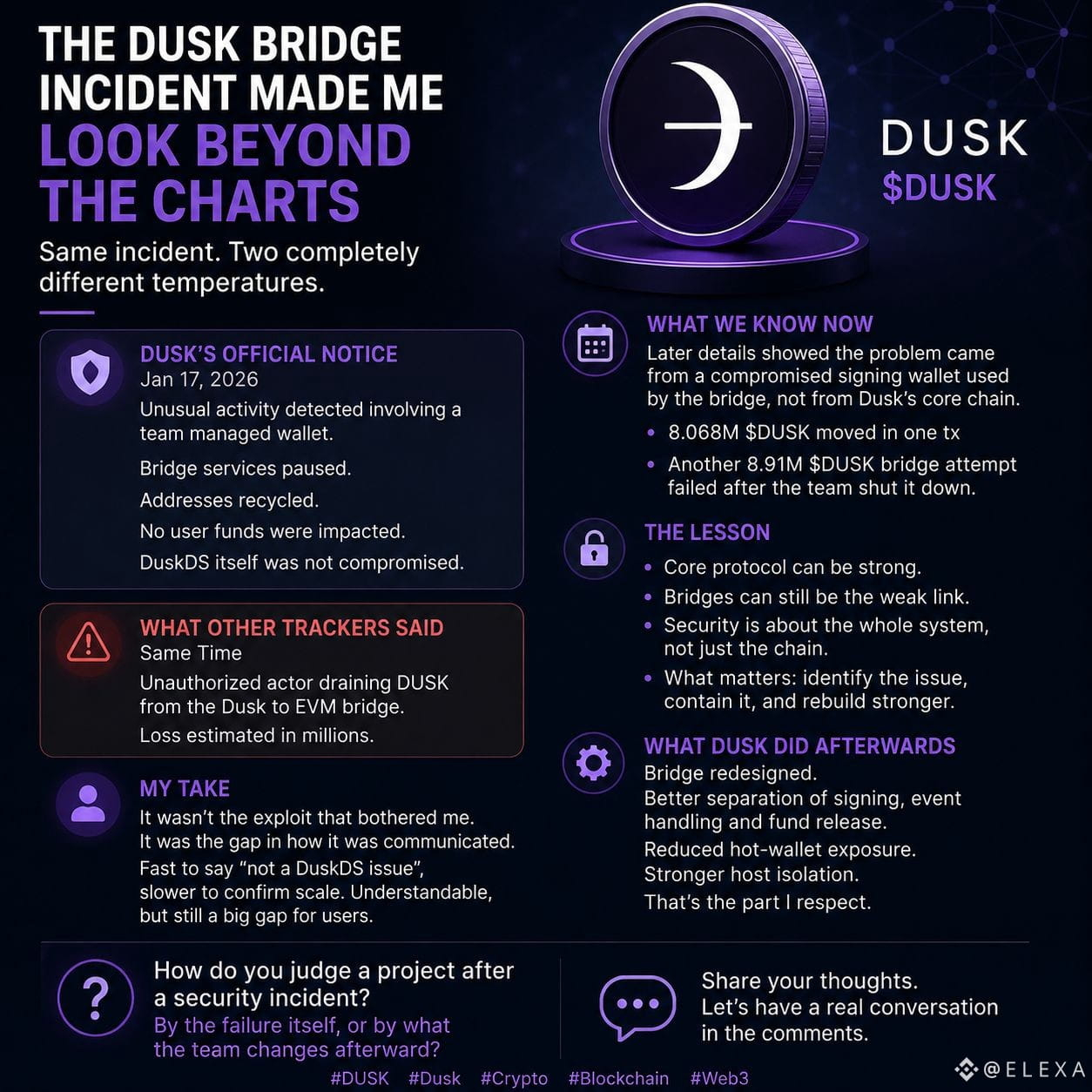
The team said unusual activity had been detected around a team-managed wallet, bridge services were paused, addresses were recycled, and user funds were not impacted. They also made it clear that DuskDS itself wasn’t compromised.
What caught my attention was the gap between that careful wording and what other trackers were reporting at the time. Some were already pointing to an attacker draining millions of DUSK through the Dusk-to-EVM bridge.
Same incident, very different picture.
Later details made the situation easier to understand. The problem was connected to a compromised signing wallet used by the bridge, rather than a failure of Dusk’s core consensus or blockchain infrastructure.
That distinction matters.
A chain can have strong consensus, privacy and compliance features, but the infrastructure connecting it to another network can still become the weak point.
Bridges move real value, so their signing systems deserve just as much attention as the underlying protocol.
What I actually want to see after an incident like this is not a perfect story. I want to see whether the team identifies the weak point, limits the damage and makes the architecture harder to attack again.
For me, that is more useful than staring at the DUSK chart.
How do you judge a project after a security incident: by the failure itself, or by what the team changes afterward?
I almost ignored Dusk’s January bridge incident because the market reaction was louder than the actual details.
Then I went back to Dusk’s own notice and started reading it more carefully.
The team said unusual activity had been detected around a team-managed wallet, bridge services were paused, addresses were recycled, and user funds were not impacted. They also made it clear that DuskDS itself wasn’t compromised.
What caught my attention was the gap between that careful wording and what other trackers were reporting at the time. Some were already pointing to an attacker draining millions of DUSK through the Dusk-to-EVM bridge.
Same incident, very different picture.
Later details made the situation easier to understand. The problem was connected to a compromised signing wallet used by the bridge, rather than a failure of Dusk’s core consensus or blockchain infrastructure.
That distinction matters.
A chain can have strong consensus, privacy and compliance features, but the infrastructure connecting it to another network can still become the weak point.
Bridges move real value, so their signing systems deserve just as much attention as the underlying protocol.
What I actually want to see after an incident like this is not a perfect story. I want to see whether the team identifies the weak point, limits the damage and makes the architecture harder to attack again.
For me, that is more useful than staring at the DUSK chart.
How do you judge a project after a security incident: by the failure itself, or by what the team changes afterward?