
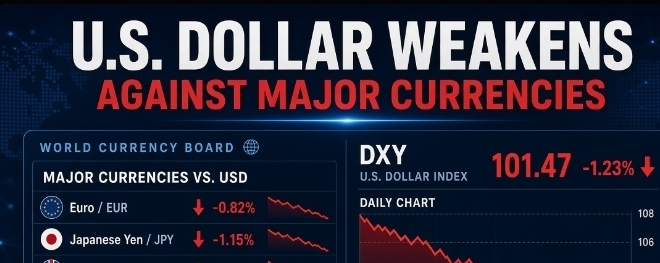

The US dollar is under pressure as traders cut their expectations for further Federal Reserve rate hikes. The dollar has moved to multi-month lows against a basket of major currencies, with the Dollar Index, or DXY, falling to around 99.29 on August 18. This was its lowest level in about 10 weeks.The weakness comes after a run of softer US economic data. Jobs, inflation and retail sales numbers have given investors fewer reasons to expect the Federal Reserve to raise interest rates soon.
Why is the dollar falling?
The main reason is : markets are changing their view on US interest rates.
When traders expect US interest rates to stay high or rise, the dollar often gets support because higher rates can make US assets more attractive.
But recent data has changed that view.
The US economy lost 23,000 jobs in July, while economists had expected an increase of about 80,000 jobs. Retail sales also fell 0.6% in July. These numbers have raised questions about the strength of the US economy.
As a result, markets have reduced their expectations for another Fed rate hike.
Fed rate decision is now a key factor
The Federal Reserve has kept its policy rate at 3.5%-3.75% since July. But traders are no longer as confident that another increase is coming soon.
Markets were pricing only about a one-third chance of a September rate hike.
That matters for the dollar.
If the Fed looks less likely to raise rates while other central banks remain relatively firm, the interest-rate advantage of holding US assets can shrink. That can put pressure on the dollar.
What about inflation?
Inflation is another important part of the story.
Recent US inflation data has not been strong enough to convince markets that the Fed needs to keep raising rates aggressively. At the same time, weaker economic activity is making traders more cautious about the outlook.
Here's the thing: the dollar's next move will still depend heavily on incoming US data.
A stronger jobs report or a fresh rise in inflation could quickly change rate expectations and give the dollar some support.
Middle East tensions could change the picture
The dollar's decline is not happening in a completely calm market.
The conflict involving the US and Iran, along with concerns around the Strait of Hormuz, has pushed oil prices higher. Brent crude moved close to $92 a barrel on August 18.
Geopolitical tension can sometimes support the dollar because investors look for safe-haven assets.
But there is another side to it. Higher oil prices can increase inflation, which could force central banks to keep interest rates higher for longer.
So the dollar faces two competing forces: weaker US economic data is hurting it, while geopolitical risk could provide some support.
What does a weaker dollar mean for India?
For Indian consumers and businesses, the dollar's move needs to be viewed alongside the rupee. The Indian rupee was trading around ₹95.68 per dollar on August 18 and slipped to its weakest level since July 30 during the session. Rising crude oil prices have put pressure on the rupee because India imports a large amount of oil.
The Reserve Bank of India has also been active in the foreign exchange market to limit sharp moves in the rupee.
So, a weaker US dollar does not automatically mean the rupee will rise.
Oil prices, foreign investment flows, US interest rates and RBI action all matter.
What should investors watch next?
The next major clue will come from US economic data and the Federal Reserve. The minutes from the Fed's July meeting are due on August 19. Investors will look for signs about how officials view inflation, employment and the possibility of another rate move.
For now, the message from markets is clear: expectations for higher US interest rates have weakened, and that is weighing on the dollar.
But calling this the start of a long-term dollar decline would be premature.
Currency markets can turn quickly. If US inflation picks up, employment improves or geopolitical risks increase, the dollar could regain some ground.
For now, traders are watching the Fed, US economic data and oil prices closely.
The dollar is near multi-month lows because weaker US economic data has reduced expectations for further Fed rate hikes. The move is important, but it does not guarantee a continued fall. The next few economic reports and the Fed's signals will be key for the dollar's direction.