The Part of TermMax Nobody's Explaining Right: Who Actually Holds FT and XT
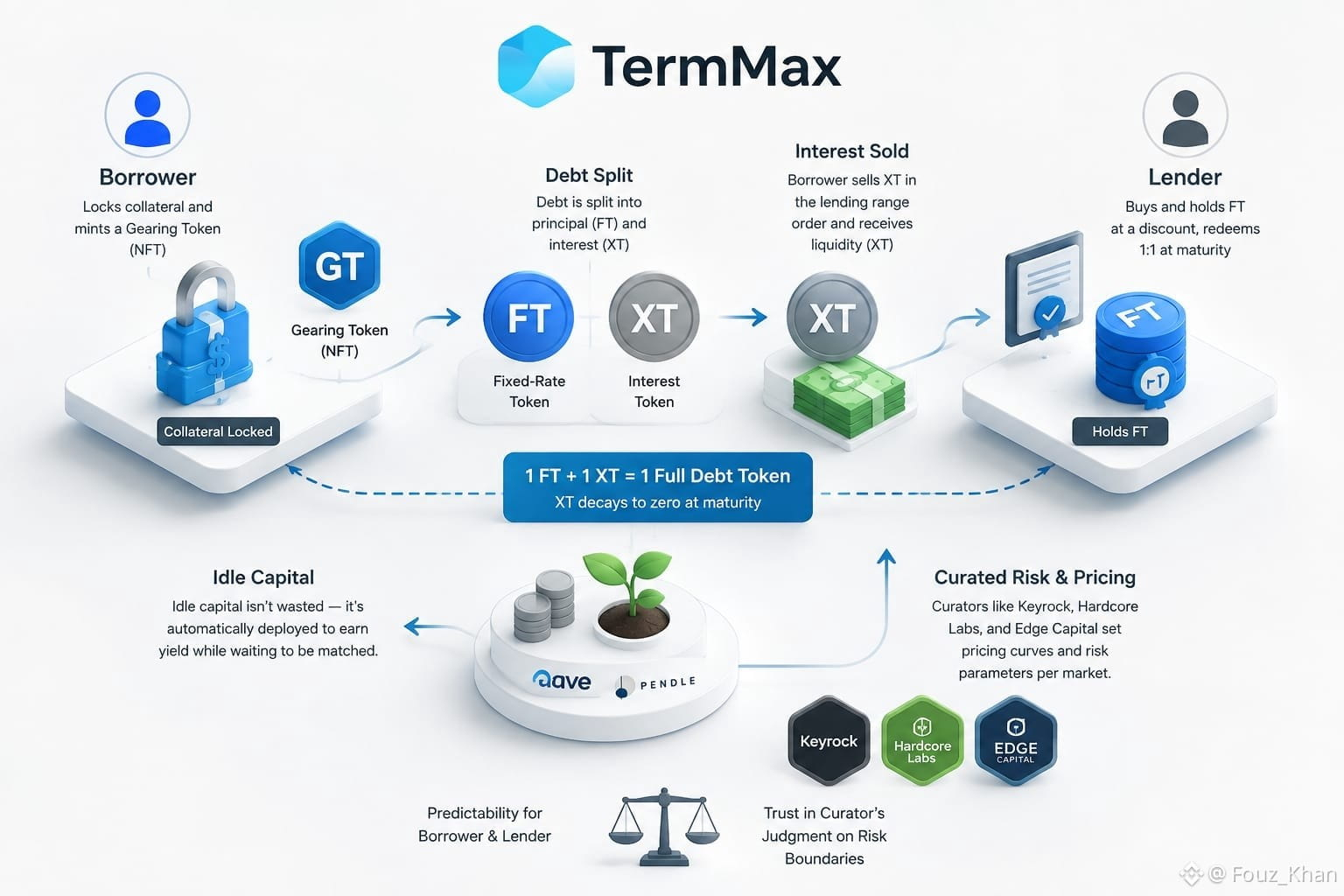
A borrower locks collateral in TermMax and mints a Gearing Token an NFT wrapper around their leveraged position. The debt splits into a Fixed-Rate Token (FT) and an interest component. The borrower sells the interest piece into the market, receiving XT in return. Combined with the principal portion of the FT, this gives the borrower immediate liquidity at a rate locked in the moment of the trade.
On the other side, lenders buy and hold FT paying a discount now, redeeming 1:1 at maturity (a zero-coupon bond, essentially).
XT is the counterpart: 1 FT + 1 XT always equals 1 full debt token. XT's value decays to zero as maturity approaches, since it represents interest that's been stripped out and sold.
Get this backwards borrower holds FT, lender holds XT and you'll misread the entire risk structure. It's an easy mistake from the surface-level pitch.
What stands out: idle capital doesn't sit dead. Per the protocol's materials, it's automatically deployed into Aave and Pendle to earn yield while waiting to be matched. Curators (Keyrock, Hardcore Labs, Edge Capital) set pricing curves and risk parameters per market so TermMax isn't just fixing the rate, it's making sure capital isn't wasted.
The trade-off: predictability, in exchange for trusting a curator's risk judgment. So does routing idle capital into external protocols like Aave add a second layer of counterparty risk, or is it a net gain over idle capital earning zero?
#TermMax @TermMax $TMX
A borrower locks collateral in TermMax and mints a Gearing Token an NFT wrapper around their leveraged position. The debt splits into a Fixed-Rate Token (FT) and an interest component. The borrower sells the interest piece into the market, receiving XT in return. Combined with the principal portion of the FT, this gives the borrower immediate liquidity at a rate locked in the moment of the trade.
On the other side, lenders buy and hold FT paying a discount now, redeeming 1:1 at maturity (a zero-coupon bond, essentially).
XT is the counterpart: 1 FT + 1 XT always equals 1 full debt token. XT's value decays to zero as maturity approaches, since it represents interest that's been stripped out and sold.
Get this backwards borrower holds FT, lender holds XT and you'll misread the entire risk structure. It's an easy mistake from the surface-level pitch.
What stands out: idle capital doesn't sit dead. Per the protocol's materials, it's automatically deployed into Aave and Pendle to earn yield while waiting to be matched. Curators (Keyrock, Hardcore Labs, Edge Capital) set pricing curves and risk parameters per market so TermMax isn't just fixing the rate, it's making sure capital isn't wasted.
The trade-off: predictability, in exchange for trusting a curator's risk judgment. So does routing idle capital into external protocols like Aave add a second layer of counterparty risk, or is it a net gain over idle capital earning zero?
#TermMax @TermMax $TMX