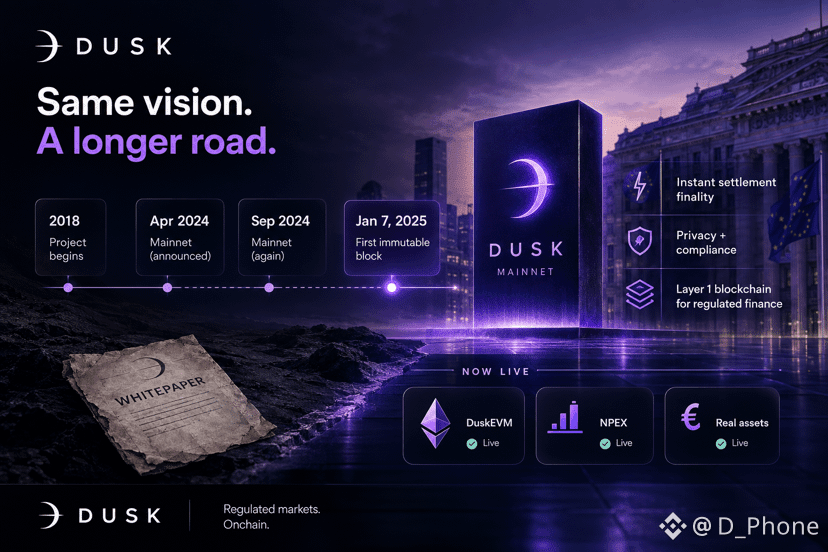
I keep coming back to one detail whenever I explain Dusk Network to someone new: the mainnet was supposed to arrive in April 2024. It didn't. The team pushed the date to September 2024, then again, and Dusk Network's first immutable block wasn't produced until January 7, 2025, nearly 6 years after the project began in 2018. On paper, the pitch was always simple: a Layer-1 blockchain giving financial institutions instant settlement finality without forcing a choice between privacy and compliance. In practice, building that took far longer than any announcement admitted up front.
The team's own explanation is that delays came from a moving regulatory target, not broken code. MiCA kept evolving while Dusk Network was building, and rather than ship a chain that might not survive contact with European securities law, the founders chose to rebuild parts of the stack, including a reworked version of Succinct Attestation that rewards voters, not just block producers, a change the team says increases participation and strengthens finality guarantees for compliance-sensitive settlement. That's a defensible choice. It's also a reminder that "regulated finance in seconds" describes a settlement layer, not a company timeline, and the two move at very different speeds.
What I keep asking: does a 6-year gap between whitepaper and working mainnet count as caution, or as a warning sign about execution pace? Dusk Network would say caution, and given what MiCA actually demanded, I'm inclined to agree. But nobody outside the team can fully verify how much delay was regulatory necessity versus underestimated complexity. A year into mainnet operation, DuskEVM has shipped and NPEX is live. The theory finally has a working chain behind it. Whether it can move at the speed institutional finance requires is the next test, and it's a different one than shipping a mainnet at all.
@Dusk #dusk $DUSK $PORTAL $BTW
The team's own explanation is that delays came from a moving regulatory target, not broken code. MiCA kept evolving while Dusk Network was building, and rather than ship a chain that might not survive contact with European securities law, the founders chose to rebuild parts of the stack, including a reworked version of Succinct Attestation that rewards voters, not just block producers, a change the team says increases participation and strengthens finality guarantees for compliance-sensitive settlement. That's a defensible choice. It's also a reminder that "regulated finance in seconds" describes a settlement layer, not a company timeline, and the two move at very different speeds.
What I keep asking: does a 6-year gap between whitepaper and working mainnet count as caution, or as a warning sign about execution pace? Dusk Network would say caution, and given what MiCA actually demanded, I'm inclined to agree. But nobody outside the team can fully verify how much delay was regulatory necessity versus underestimated complexity. A year into mainnet operation, DuskEVM has shipped and NPEX is live. The theory finally has a working chain behind it. Whether it can move at the speed institutional finance requires is the next test, and it's a different one than shipping a mainnet at all.
@Dusk #dusk $DUSK $PORTAL $BTW