🌐 The AI Race Is Moving Beyond Models — The Next Battle Is Access
For the past few years, the AI industry has been obsessed with one question:
Which model is the strongest?
Which one reasons better?
Which one codes better?
Which one handles longer context?
Which one wins the latest benchmark?
Those questions still matter. But they may no longer define the most important competition in AI.
A new battlefield is emerging:
Who can put powerful intelligence into the hands of the largest number of people at the lowest practical cost?
That shift changes how we should think about AI platforms.
And it makes B.AI's strategy of aggregating leading models while continuously reducing invocation costs particularly interesting.
🧠 Intelligence Is Becoming Abundant
The first phase of the generative AI boom was driven by scarcity.
Only a small number of companies had access to frontier-level models.
Each major release created a significant performance gap.
Today, the landscape is becoming much more competitive.
Models continue improving rapidly, but users increasingly have multiple strong options.
For developers, the question is therefore becoming less about identifying a single “best” model and more about assembling the right combination of models for specific workloads.
A fast model might handle routine tasks.
A stronger reasoning model might solve difficult problems.
A coding-focused model could power development workflows.
Another may be better suited to long-context analysis.
The AI stack is becoming modular.
💸 Cost Could Become the New Performance Metric
As model capability converges, economics becomes more important.
An AI model can be brilliant and still be impractical if running it costs too much.
This becomes particularly obvious with AI Agents.
A chatbot might require one inference call.
An Agent could require dozens.
It may reason, use tools, inspect results, retry failed actions, maintain memory, and interact with several other systems before completing one objective.
Multiply that across thousands of users and the economics become critical.
This means cost per useful task may eventually matter as much as benchmark scores.
Platforms that continuously reduce invocation costs could therefore unlock applications that simply would not make sense under expensive inference models.
🤖 AI Agents Need Infrastructure, Not Just Intelligence
The Agent era changes another assumption.
Developers no longer need only access to powerful models.
They need an environment where those models can become components inside larger systems.
Agents require APIs.
They need tools.
They need memory.
They need reliable infrastructure.
They may eventually require identity, payments, permissions, and connections with external services.
That means the real competition could shift from model providers toward AI infrastructure ecosystems.
B.AI's approach of aggregating multiple top-tier models fits naturally into this future.
Instead of asking developers to commit to a single intelligence provider, a platform can become an access layer through which different models serve different tasks.
🧩 The “Super Entrance” Could Be a Multi-Model Gateway
This leads to a larger question:
What will the super entrance of the AI era actually look like?
It may not resemble today's search engine.
It may not be one chatbot.
And it may not revolve around one dominant model.
The AI super entrance could instead become a universal gateway to intelligence.
A user expresses an objective.
The platform determines which model or Agent should handle it.
Complex tasks may be automatically decomposed.
Different models could collaborate behind the scenes.
Users would not necessarily care which model performed every individual step.
They would care about whether the task was completed quickly, accurately, and affordably.
In that future, orchestration becomes extremely valuable.
🔀 Model Routing Could Become Invisible
Consider how cloud computing works today.
Most users do not think about which physical server executes every operation.
The infrastructure abstracts that complexity away.
AI may develop in the same direction.
The user asks a question or defines an objective.
Behind the interface, one model may handle reasoning.
Another handles code.
Another analyzes a large document.
An Agent coordinates the entire process.
All of this could happen without requiring the user to manually choose between ten model names.
That is what a true AI gateway might eventually provide:
access to intelligence without forcing users to manage the complexity underneath it.
🌱 Lower Costs Create More Builders
There is another important effect.
When AI becomes cheaper, the number of people who can build with it increases.
A large enterprise may be able to absorb expensive inference bills.
A student, independent developer, or early-stage startup often cannot.
Reducing AI costs therefore changes who gets to participate.
More developers can prototype.
More entrepreneurs can test ideas.
More small teams can create Agent workflows.
More experiments can happen.
Most will fail.
But technological breakthroughs often emerge from a very large pool of experimentation.
Lowering costs expands that pool.
🌍 Distribution Could Matter More Than Benchmarks
Technology history provides many examples where the technically strongest product did not automatically become the dominant platform.
Distribution matters.
Accessibility matters.
Developer ecosystems matter.
Pricing matters.
Ease of integration matters.
The same dynamics are beginning to appear in AI.
The platform capable of delivering strong models cheaply and conveniently could create enormous network effects.
Developers arrive because model access is attractive.
They build applications.
Those applications attract users.
More users create more demand.
More demand encourages additional model integrations and infrastructure investment.
Eventually, the ecosystem itself becomes the advantage.
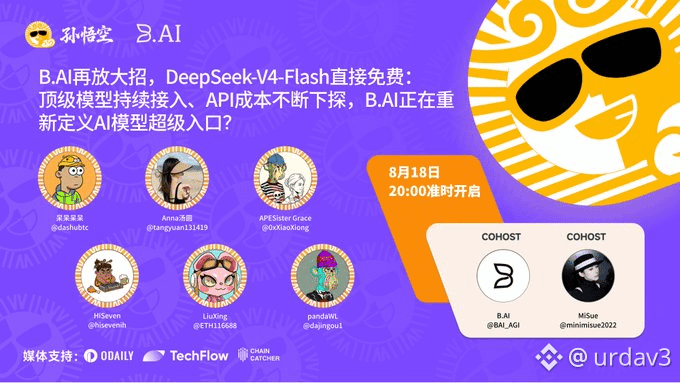
📡 Tomorrow's Space Is About the Bigger Question
That is why the upcoming Space discussion is worth paying attention to.
The conversation is larger than one model launch or one pricing adjustment.
It touches on several questions that could define the next phase of AI:
🤖 How will AI Agents reshape demand for inference?
💸 How low can model invocation costs realistically go?
🧩 Will users interact with individual models or unified AI platforms?
🌐 Can multi-model ecosystems become the new internet gateways?
🚀 And ultimately, who will build the “super entrance” of the AI era?
As models become stronger while access becomes cheaper, the balance of power may shift.
The winner may not be whoever owns the strongest model at one particular moment.
It may be whoever makes powerful AI easy enough, cheap enough, and flexible enough for everyone to use and build on.
That is a much bigger competition.
🎙️ Tune in to tomorrow night's Space and join the conversation with multiple leading voices.
The model race is evolving.
The platform race is just beginning.