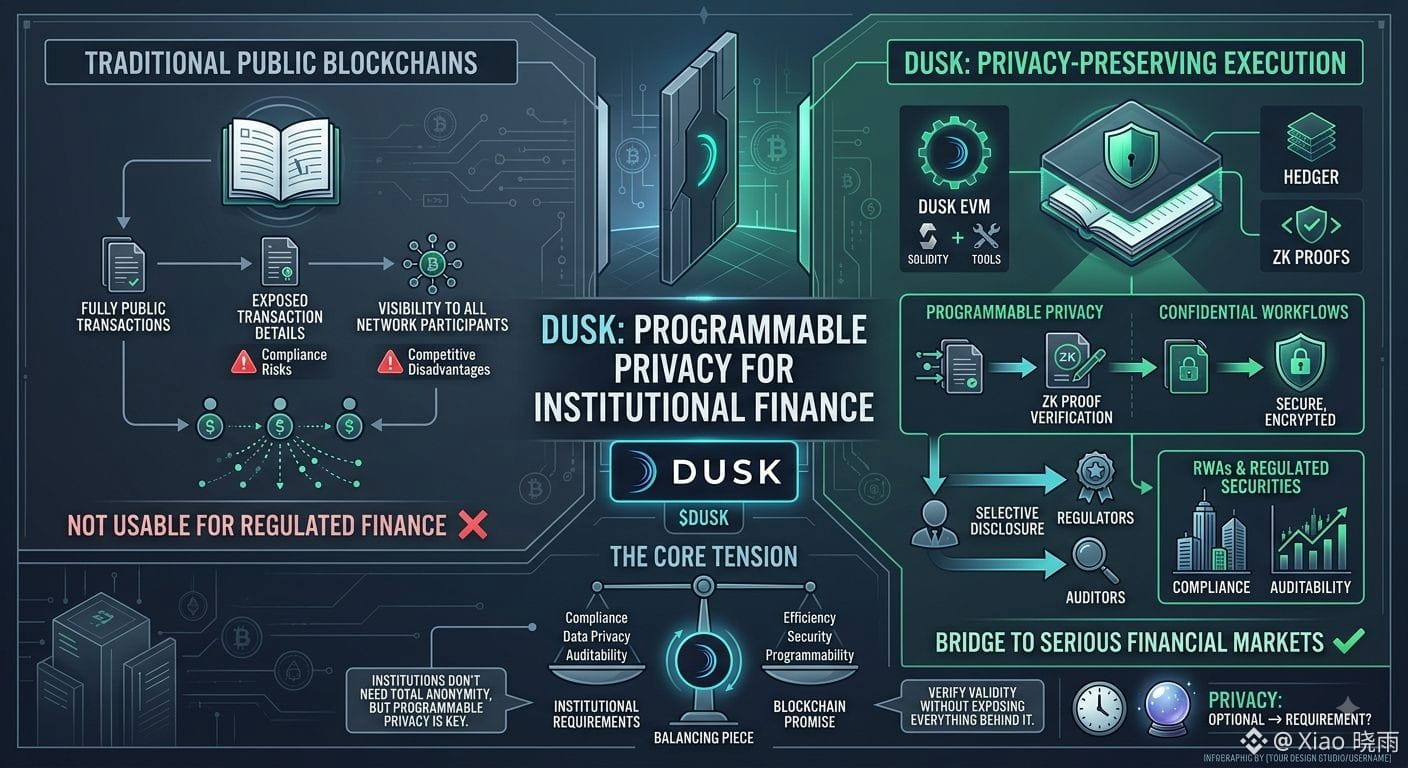
@Dusk is interesting for one reason: it’s not trying to make finance more public. It’s trying to make public blockchain rails usable for finance that needs privacy.
DuskEVM is the part I’m watching closely. EVM compatibility gives developers familiar Solidity tooling, while Dusk’s privacy architecture can support confidential workflows instead of forcing every transaction detail into the open.
Then you have Hedger, ZK proofs, and privacy-preserving execution pushing the idea further: verify that something is valid without exposing everything behind it.
That matters for RWAs and regulated securities. Institutions don’t necessarily need total anonymity. They need programmable privacy, compliance, and the ability to disclose specific information when required.
If blockchain is going to handle serious financial markets, this balance between privacy and auditability could be one of the biggest pieces.
Do you think privacy will become a requirement for institutional onchain finance, rather than just an optional feature?
#dusk $DUSK
DuskEVM is the part I’m watching closely. EVM compatibility gives developers familiar Solidity tooling, while Dusk’s privacy architecture can support confidential workflows instead of forcing every transaction detail into the open.
Then you have Hedger, ZK proofs, and privacy-preserving execution pushing the idea further: verify that something is valid without exposing everything behind it.
That matters for RWAs and regulated securities. Institutions don’t necessarily need total anonymity. They need programmable privacy, compliance, and the ability to disclose specific information when required.
If blockchain is going to handle serious financial markets, this balance between privacy and auditability could be one of the biggest pieces.
Do you think privacy will become a requirement for institutional onchain finance, rather than just an optional feature?
#dusk $DUSK