@Dusk #dusk
$DUSK Most privacy blockchains lean toward one idea: keep everything private.
Dusk takes a more flexible approach.
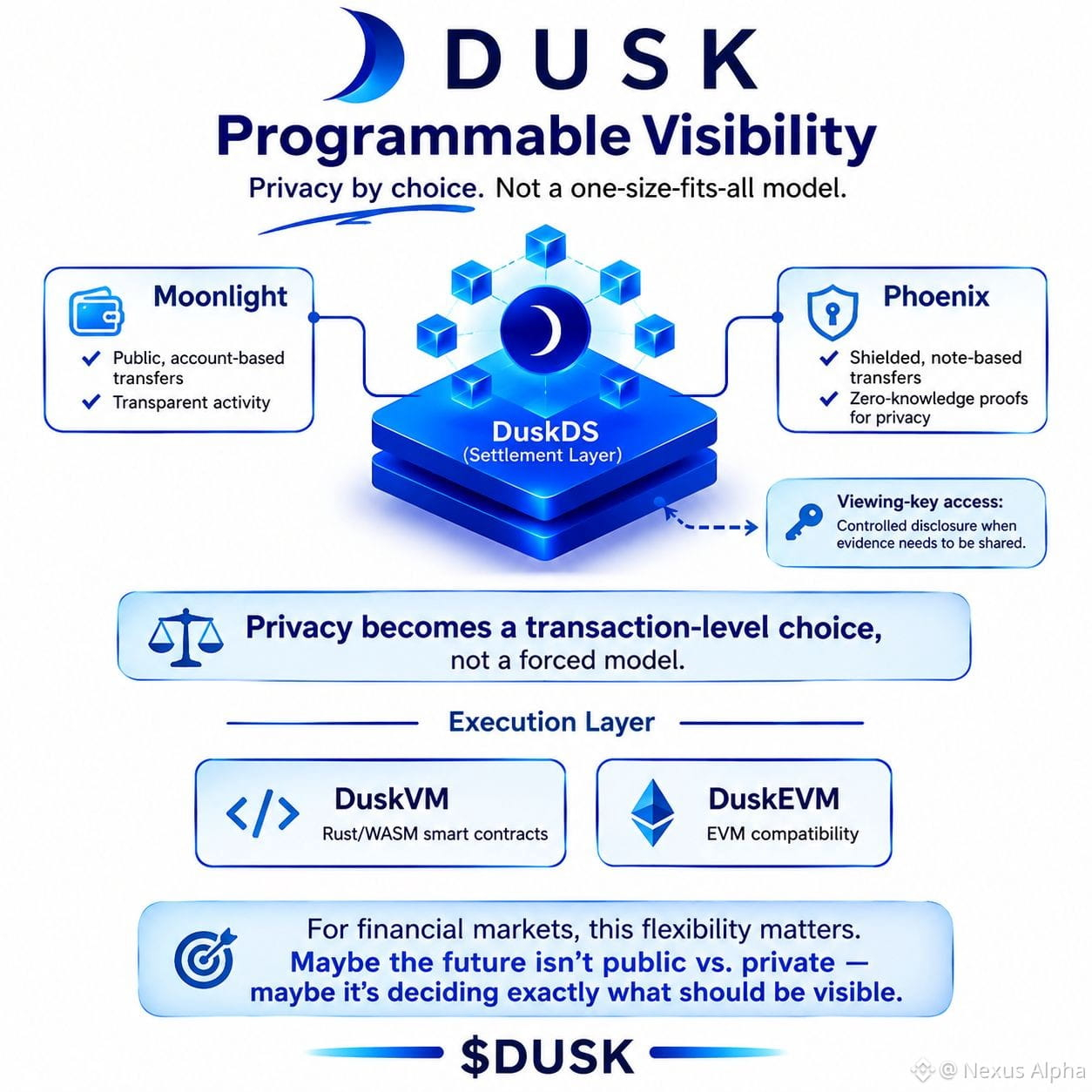
Its L1 supports two native transaction models: Moonlight for transparent, account based transfers, and Phoenix for shielded, note based transfers using zero-knowledge proofs. Both settle on DuskDS, but they expose very different information to observers.
That distinction is what stands out.
Privacy becomes a transaction-level choice, rather than forcing an entire financial workflow into one visibility model.
Need transparency? Moonlight.
Need confidential transfers? Phoenix.
Need controlled disclosure? Dusk supports viewing key based access when specific evidence needs to be shared.
Then there’s the execution layer confidential smart contracts through the XSC standard, alongside DuskVM and DuskEVM.
For financial markets that flexibility matters.
Maybe the future isn’t simply public vs private
Maybe it’s deciding exactly what should be visible and what shouldn’t.
$DUSK
$DUSK Most privacy blockchains lean toward one idea: keep everything private.
Dusk takes a more flexible approach.
Its L1 supports two native transaction models: Moonlight for transparent, account based transfers, and Phoenix for shielded, note based transfers using zero-knowledge proofs. Both settle on DuskDS, but they expose very different information to observers.
That distinction is what stands out.
Privacy becomes a transaction-level choice, rather than forcing an entire financial workflow into one visibility model.
Need transparency? Moonlight.
Need confidential transfers? Phoenix.
Need controlled disclosure? Dusk supports viewing key based access when specific evidence needs to be shared.
Then there’s the execution layer confidential smart contracts through the XSC standard, alongside DuskVM and DuskEVM.
For financial markets that flexibility matters.
Maybe the future isn’t simply public vs private
Maybe it’s deciding exactly what should be visible and what shouldn’t.
$DUSK