
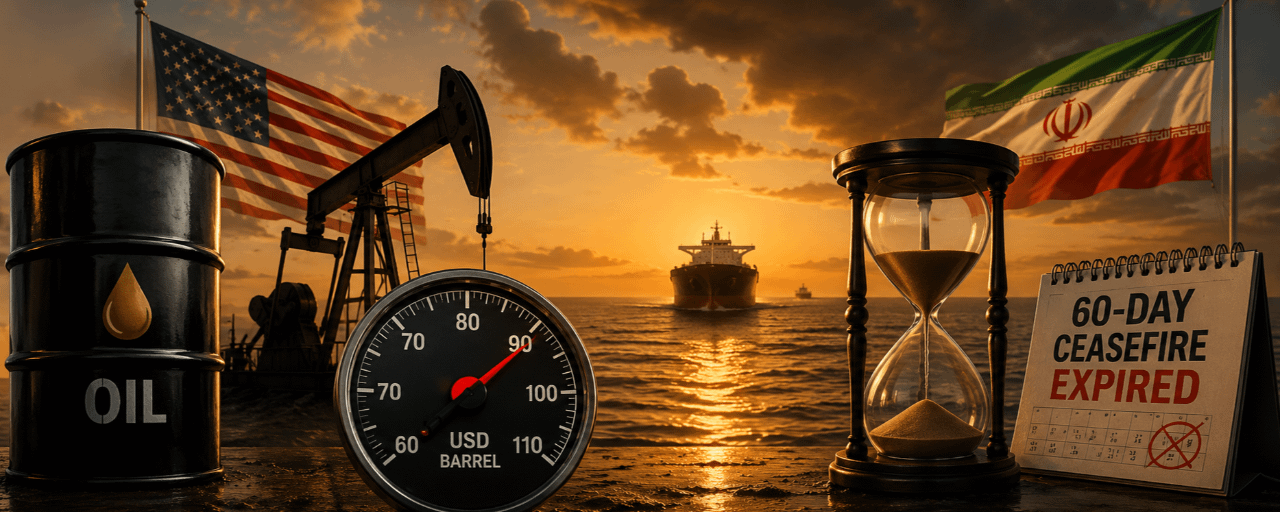
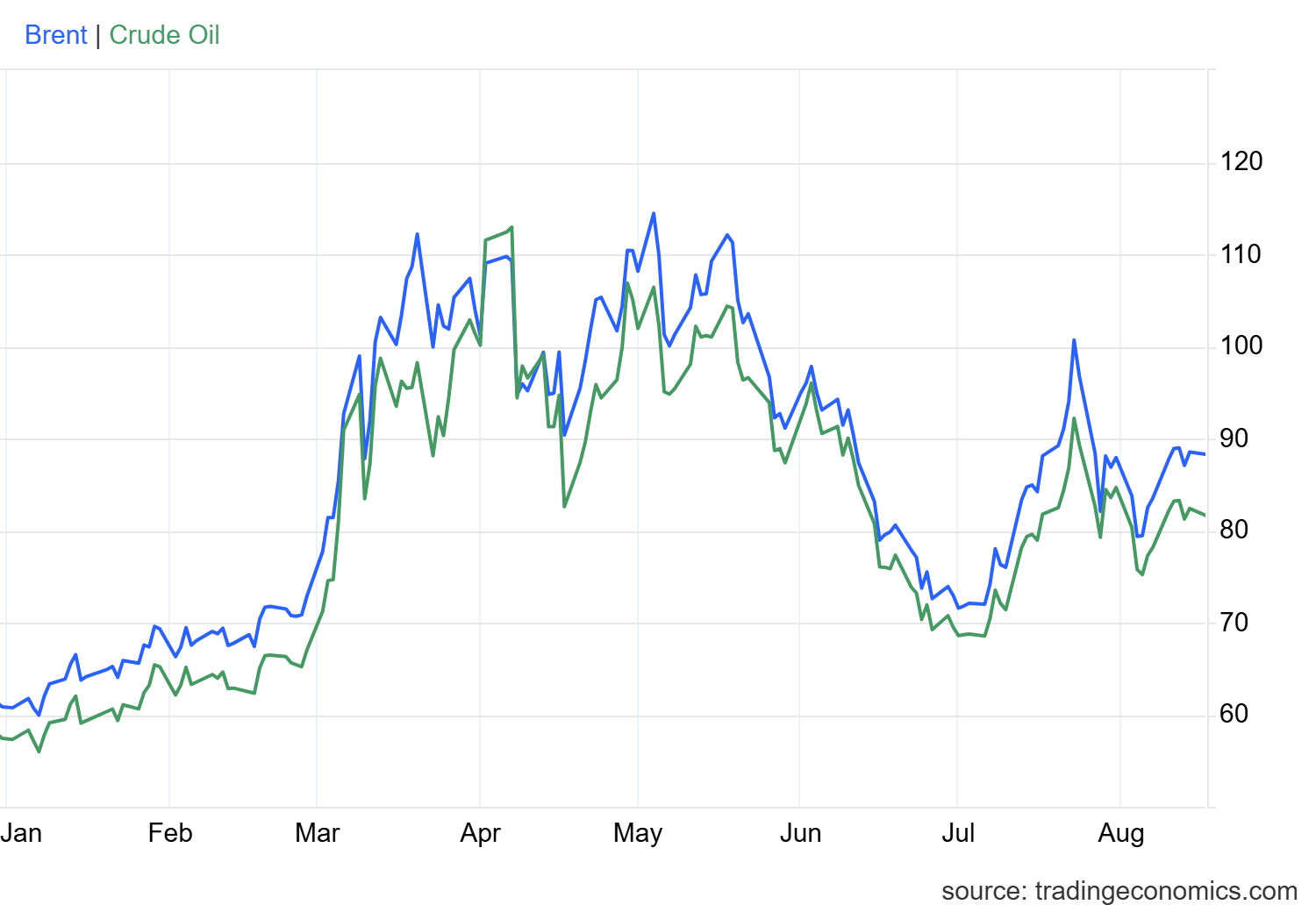
Brent crude opened little changed, just below $89 a barrel on early Monday, and West Texas Intermediate, the U.S. domestic benchmark, slipped a few cents to around $82. Neither benchmark has moved much since Friday's close. The calm is deceptive: both contracts spent last week ripping higher, Brent up roughly 6% and WTI more than 5%, and the market is now simply holding its breath at the new, elevated level rather than retreating from it.
What it's holding its breath for arrived precisely on schedule. The Memorandum of Understanding that Presidents Trump and Masoud Pezeshkian signed in Islamabad on June 17 expired at the 60-day mark on Monday, with neither government showing much interest in extending it and no route back to reopening the Strait of Hormuz in sight.
Iran isn't treating Monday's expiration as a crisis, exactly, because it doesn't accept there was a ceasefire to begin with. Foreign Minister Abbas Araghchi has spent the past week arguing that the Islamabad memorandum was meant to end the war outright, not open a 60-day countdown clock a distinction that lets Tehran sidestep the question of who blew through the deadline. He said over the weekend that Iran has not decided whether to resume talks with Washington, and that Qatar and Pakistan are only relaying messages rather than actively mediating.
A narrower, separate track continues with Oman, focused specifically on shipping routes through Hormuz. Araghchi said that channel can only move forward once a broader political settlement is reached, not before. Deputy Foreign Minister Kazem Gharibabadi was more pointed on the underlying question of control, dismissing any notion that Washington could simply claim the waterway and insisting it "will only be closed and opened under Iran's command."
A White House official described the overall posture as "static." Trump, for his part, said over the weekend that the U.S. is capable of destroying Iran outright but doesn't want to, leaning instead on the financial squeeze rather than a return to open strikes, for now.
Trump's "Wall of Steel"
The president has not softened his language even as the diplomatic track stalls. At a Friday rally in Garden City, New York, he called the U.S. naval blockade a "wall of steel," insisted no ship moves through Hormuz without American permission, and floated once again that he might simply declare the strait U.S. territory once Iran is fully defeated. He also asked Americans to accept the price at the pump that comes with it, framing a bit more pain at the gas station as the cost of keeping nuclear weapons out of Tehran's hands. AAA had the national average near $4.08 a gallon Friday, about 29% above where it sat a year ago.
Treasury Secretary Scott Bessent used a Thursday appearance on Newsmax to preview where the pressure goes next. New measures are coming this week, he said, aimed at pushing Iran's economic isolation to a level unmatched in sanctions history, layered on top of the continuing blockade of Iranian ports.
Bessent has taken to summarizing the pivot from military to financial pressure in shorthand: the campaign moved, in his words, "from Epic Fury to Economic Fury." The underlying maximum-pressure order traces back further than the war itself. Trump directed Treasury to apply it in March 2025, nearly a year before the first strikes.
None of the pressure changes one basic fact: Iran still has a buyer. China's independent "teapot" refineries, concentrated in Shandong province, have absorbed the bulk of Iran's crude exports for years despite wave after wave of U.S. sanctions naming individual plants. Treasury has argued the trade generates hundreds of millions of dollars for Iran's military. Beijing's response has not been to cut the flow off but to shield its own refiners from the penalties, formally blocking the U.S. sanctions as violations of international law.
Somewhere between the tanker strikes, an expired deadline nobody quite agrees was real, and a president musing about annexing a foreign waterway, the market has settled on the only answer it has for now: hold near $89, and wait to see whose next move breaks the standoff.
Shipping Traffic Has All But Stopped
The rally behind Monday's calm wasn't abstract. It came from a string of attacks on tankers operated by Abu Dhabi's ADNOC and a strike on a Saudi Aramco refinery, on top of a market that has effectively given up waiting for a near-term resolution.
Ship-tracking data from Kpler showed only two vessels crossing the strait on Friday: a grain carrier and an empty dry bulk ship against more than 130 daily transits before the war began. Insurers have largely pulled coverage from the route, and the tankers still willing to risk it increasingly run dark, transponders switched off.
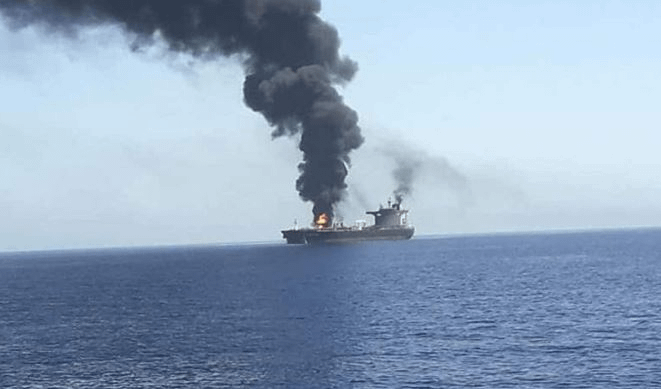
That risk turned concrete again Friday evening, when the UK Maritime Trade Operations centre reported a bulk carrier struck by an unidentified projectile that hit the hull inside the strait. The crew was reported safe; no damage assessment has been released, and the environmental impact remains unknown. It was at least the third attack on commercial shipping in the waterway within 48 hours, after the UAE accused Iran's Revolutionary Guard of hitting two ADNOC vessels on Thursday conduct Abu Dhabi's foreign ministry has since labeled outright piracy.
Washington's Own Reserve Is Running Thin
The strain has reached into Washington's emergency stockpile, too. The Strategic Petroleum Reserve fell below 300 million barrels this month, its lowest level since it was first filled in the early 1980s, after Trump ordered a 172-million-barrel release in March to soften the shock of the closed strait. Once that drawdown finishes, the SPR will sit around 243 million barrels, close to the roughly 250-to-300 million barrel range petroleum engineers consider the practical floor for keeping the reserve's underground salt caverns structurally sound.
Government auditors have already raised a flag on this. A May report from the Government Accountability Office found that repeated partial drawdowns can distort the caverns, leaving them warped in ways that shorten their working life. The Energy Department disputes any real risk of collapse, but the disagreement itself says something about how little cushion is left in the system built for exactly this kind of emergency.
Aboard the Lincoln, No End Date in Sight
The human toll of an open-ended deployment resurfaced this weekend too. Adm. Brad Cooper, the top U.S. commander overseeing the war, visited the USS Abraham Lincoln on Saturday and acknowledged mental health strain among the crew a week after a sailor attached to the ship's air wing went overboard and was recovered by a search-and-rescue helicopter. The carrier has now gone more than 260 days without a port call, and is expected to be relieved soon by the USS George Washington.
Cooper pushed back on the grimmer accounts that have circulated from crew families describing food shortages and failing plumbing, noting that the Lincoln currently has "among the lowest number of cases related to mental health" of the Navy's 11 active carriers. Extended deployment isn't for everyone, he acknowledged, and every sailor handles the strain differently, but he stopped well short of conceding the ship is in crisis.
Seoul Gets Cut Out, Too
Trump opened a fresh front entirely unrelated to oil on Sunday, ordering the Pentagon to scale back the annual Ulchi Freedom Shield exercises with South Korea just as the eleven-day drills involving roughly 18,000 South Korean troops were set to begin. His stated reason: Seoul had turned down his request to help denuclearize Iran, an unusual formulation given South Korea's limited reach into Tehran's affairs, paired with a nod to what he called his good relationship with North Korea's Kim Jong Un.
Lebanon's Worst Day in Months
The weekend brought its own violence, separate from but tangled up with the Iran standoff. Israel said Sunday it had killed Abu Hassan Alaa, a senior commander in Hezbollah's Badr Unit, in a strike a day earlier on a compound in the Deir al-Zahrani area of southern Lebanon. The Israeli military described it as retaliation for a Hezbollah drone attack that wounded three of its soldiers in the security zone. In a separate raid the same weekend, Israel said it also killed a battalion commander in Hezbollah's elite Radwan Force near the town of Ansar.
Lebanon's Health Ministry put Saturday's death toll at 11, the country's deadliest day of fighting in months. Lebanese Prime Minister Nawaf Salam called the strikes "an extremely serious matter" that threatens to unravel the fragile framework holding the wider Israel-Lebanon front together. The timing could hardly be worse: it lands in the same 48 hours as the US-Iran deadline, adding another live fuse to a region already juggling several.
A Different Cairo, A Different War
Away from the Gulf, Trump's envoys spent Sunday in Cairo working an entirely separate file. Jared Kushner and Nickolay Mladenov met with mediators from Egypt, Qatar and Turkey to push the administration's Gaza plan forward, with Hamas representatives present for part of the discussions even as Israeli strikes resumed in the enclave following a brief lull. Kushner and Mladenov are due to meet Israeli Prime Minister Benjamin Netanyahu on Monday, the same Netanyahu who dismissed the latest version of the roadmap as unacceptable barely a week earlier.