Evaluating tokenized equities based strictly on market capitalization completely ignores the hidden capital structure of the underlying business.
Traders blindly buy heavyweights like $AAPLB or $MSFTB after a market cap drop, assuming it automatically indicates a cheap valuation for these bStocks. However, ignoring the company's balance sheet debt means you are fundamentally mispricing the actual acquisition cost of the asset.
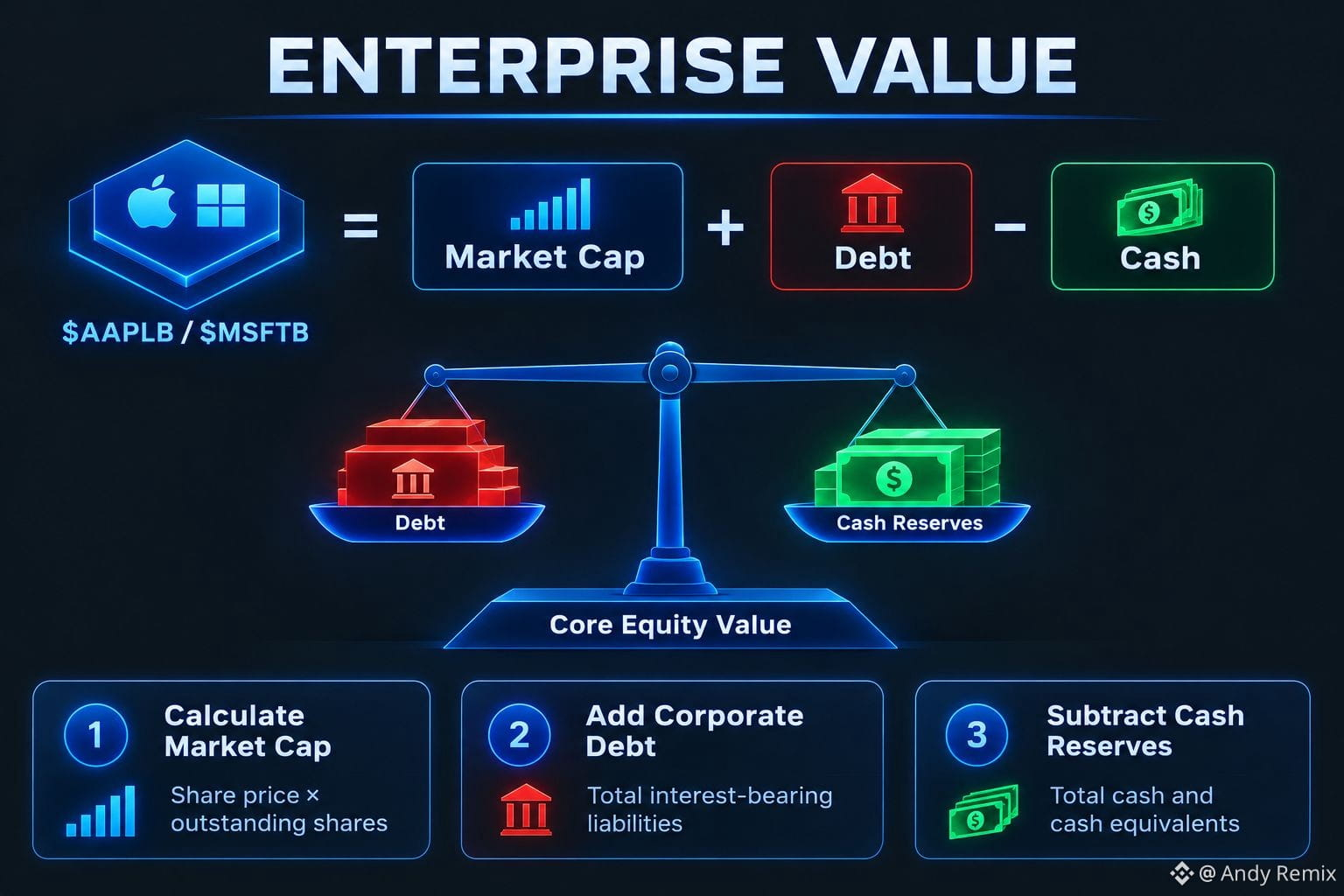
True pricing requires calculating the Enterprise Value through a strict algebraic equation:
Enterprise Value = (bStock Price * Outstanding Shares) + Corporate Debt - Cash Reserves
The optimal corporate valuation framework for spot equities:
1. Calculate the core market capitalization by multiplying the current bStocks price by the total outstanding shares.
2. Add total short-term and long-term corporate debt to assess the true financial burden inherited by the shareholders.
3. Subtract liquid cash reserves to determine the actual unencumbered valuation the market is placing on the core operations.
Market capitalization only shows the equity price tag, while Enterprise Value reveals the true underlying cost of the entire corporate structure.
Do you analyze the corporate debt load before buying bStocks or do you trade strictly based on the market cap and chart?
@BinanceCIS #bStocksCIS
Traders blindly buy heavyweights like $AAPLB or $MSFTB after a market cap drop, assuming it automatically indicates a cheap valuation for these bStocks. However, ignoring the company's balance sheet debt means you are fundamentally mispricing the actual acquisition cost of the asset.
True pricing requires calculating the Enterprise Value through a strict algebraic equation:
Enterprise Value = (bStock Price * Outstanding Shares) + Corporate Debt - Cash Reserves
The optimal corporate valuation framework for spot equities:
1. Calculate the core market capitalization by multiplying the current bStocks price by the total outstanding shares.
2. Add total short-term and long-term corporate debt to assess the true financial burden inherited by the shareholders.
3. Subtract liquid cash reserves to determine the actual unencumbered valuation the market is placing on the core operations.
Market capitalization only shows the equity price tag, while Enterprise Value reveals the true underlying cost of the entire corporate structure.
Do you analyze the corporate debt load before buying bStocks or do you trade strictly based on the market cap and chart?
@BinanceCIS #bStocksCIS