
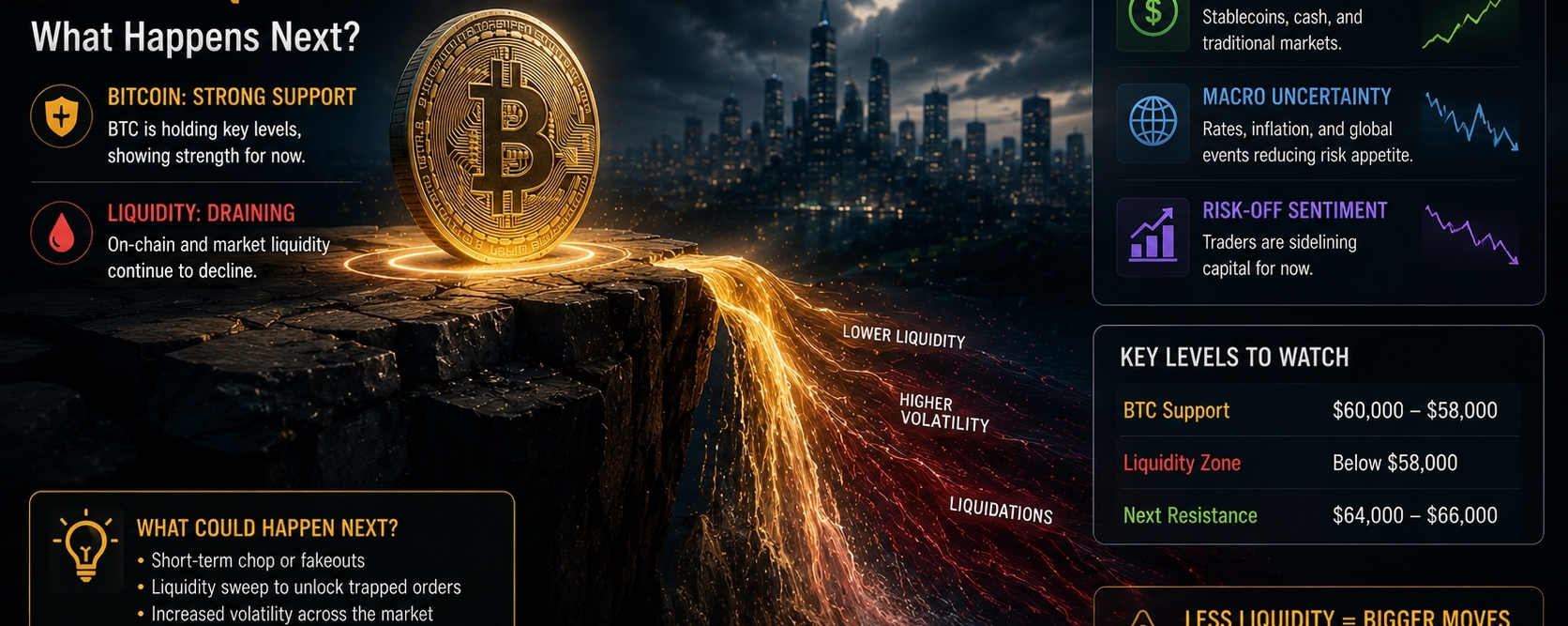

Bitcoin is doing something interesting right now.
Price has shown surprising resilience, but underneath the surface, liquidity remains weak. I think this disconnect is one of the most important signals in the crypto market because price can hold for a while without fresh capital—but eventually, liquidity usually matters.
So the bigger question isn't simply whether Bitcoin can hold support.
It is whether new money will return before buyers lose patience.
Bitcoin Is Holding Better Than Expected
Bitcoin has recently been consolidating despite a difficult macro environment and cautious investor sentiment.
CoinShares reported this week that Bitcoin trading volumes on trusted exchanges were running at only around $4 billion per day. With such thin activity, even relatively small flows can have a larger-than-normal impact on price.
I find this particularly interesting.
Bitcoin isn't experiencing the kind of aggressive demand normally associated with the beginning of a major rally, but sellers haven't completely taken control either.
That creates a fragile balance.
The Liquidity Problem Is Bigger Than Price
Liquidity tells us how much capital is actually available and willing to participate in the market.
Earlier in the year, that picture deteriorated significantly.
NYDIG reported that U.S. spot Bitcoin ETFs experienced about $4.9 billion in net outflows during Q2. At the same time, total stablecoin market capitalization declined from roughly $322 billion in late May to around $311 billion.
To me, that's an important combination.
ETF outflows suggest weaker demand through traditional investment channels, while shrinking stablecoin supply can indicate less immediately deployable dollar liquidity across crypto.
Bitcoin Needs Real Spot Demand
This is probably the signal I’m watching most closely.
A Bitcoin rally can happen without strong spot demand. Leverage, short covering and derivatives positioning can push prices higher quickly.
But those moves aren't necessarily sustainable.
NYDIG's Q2 analysis argued that leverage had been playing a larger role while spot demand remained weak. It specifically identified sustained ETF inflows and renewed stablecoin growth as important confirmation signals for a stronger Bitcoin recovery.
I would therefore be much more interested in a Bitcoin breakout accompanied by improving spot flows than a sudden leveraged pump.
Stablecoin Capital Hasn't Completely Disappeared
There is another side to the liquidity story.
Some stablecoin capital appears to be staying within the broader crypto ecosystem rather than completely exiting into traditional cash.
Earlier analysis found that roughly $273 billion in stablecoin liquidity remained in crypto even during market weakness, while some capital was moving toward areas such as DeFi yields and tokenized real-world assets rather than directly toward Bitcoin.
This could explain part of Bitcoin's unusual behavior.
Money may still be on-chain—it simply isn't rushing into BTC.
Capital Has More Places to Go Now
Previous crypto cycles were relatively simple.
New liquidity entered the market, Bitcoin attracted capital first, and eventually some of that money rotated toward Ethereum and altcoins.
I don't think we should automatically expect exactly the same pattern anymore.
Tokenized real-world assets have become a much larger part of the on-chain economy. CoinShares reported recently that tokenized funds, stocks and commodities had surpassed $40 billion in market capitalization.
That means Bitcoin is competing for liquidity with a growing number of blockchain-based financial products.
Global Liquidity Matters Too
Crypto doesn't exist in isolation.
Interest rates, bond yields, dollar conditions and broader global liquidity can influence how willing investors are to take risk.
Recent macro commentary has warned that global liquidity may be weakening, potentially creating a more difficult environment for risk assets.
Bitcoin's muted reaction to recent U.S. economic data also shows how cautious investors remain. On August 14, BTC struggled around the $63,000 area and failed to gain meaningful momentum above $64,000 despite economic data that might normally have supported risk assets.
For me, that's another reason not to assume every bounce marks the beginning of a new bull move.
What Happens If Liquidity Returns?
This is where the situation becomes interesting.
Bitcoin has managed to remain relatively resilient despite weak trading volumes and inconsistent capital flows.
If ETF demand begins improving, stablecoin supply starts expanding again and spot buyers return, Bitcoin could suddenly have something it currently lacks: fresh fuel.
Price strength combined with expanding liquidity would be a much healthier signal than price strength alone.
I would see that as evidence that investors aren't simply defending existing positions—they are putting new capital to work.
What If Liquidity Keeps Leaving?
The opposite scenario deserves equal attention.
If Bitcoin continues holding while ETF flows, stablecoin liquidity and spot demand remain weak, the market could become increasingly dependent on leverage.
That makes the structure more vulnerable.
Without fresh buyers, important support levels can eventually become harder to defend, especially if macro conditions deteriorate or another wave of selling appears.
This is why I don't want to judge the market from the Bitcoin chart alone.
I’m Watching the Money, Not Just the Candles
Right now, I see Bitcoin as resilient—but not fully confirmed.
Low trading volumes, mixed institutional flows and weaker liquidity tell me that the market still needs stronger evidence before I would call this a sustainable demand-driven recovery. CoinShares similarly cautions that thin summer trading makes short-term Bitcoin moves harder to interpret.
What would change my view?
Growing spot demand, sustained ETF inflows, expanding stablecoin liquidity and stronger trading volumes appearing together.
If those signals return while Bitcoin continues holding, the market could be quietly preparing for something much bigger.
But if liquidity keeps disappearing while price simply moves sideways, the pressure could eventually become difficult to ignore.
Bitcoin may be holding the line—but I’m watching where the money goes next. That could tell us far more than the next green or red candle.