I keep coming back to one quiet line in Dusk Network's latest work on SME financing: a tokenized security needs an authoritative ownership record.
At first, that sounds like paperwork around the interesting part. The token is visible, transfers are programmable, and ownership changes can share one controlled state. Surely the ledger has already solved the record problem.
Not necessarily.
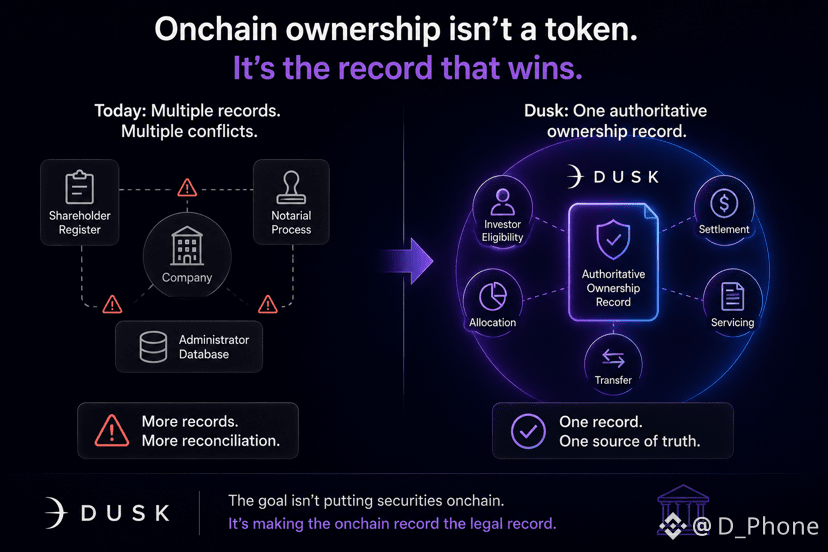
A company can place a token beside an unchanged shareholder register, administrator database, and notarial process. That creates one more record to reconcile. It does not remove reconciliation.
This is where Dusk's infrastructure has a harder job than minting an asset. The issuance workflow must connect investor eligibility, allocation, transfer, settlement, and servicing to the record that the legal structure actually recognizes. For a Dutch private company, even a digital shareholder register does not automatically replace required notarial actions.
If another register remains decisive, the token may only describe ownership instead of constituting it.
So I no longer read "onchain ownership" as a technical state alone. I read it as a claim about which state wins when two records disagree.
Dusk can coordinate a shared ownership lifecycle and reduce repeated handoffs. It cannot declare by itself that every jurisdiction, issuer, or court will treat that state as legally decisive.
The evidence I want is very specific: a live instrument whose legal documents identify the Dusk-based record, plus a real transfer that updates every required party without a second manual ledger becoming the final authority.
Until then, the important question is not whether Dusk can put SME securities onchain. It is whether Dusk can make the onchain record the place where ownership stops being duplicated.
@Dusk #dusk $DUSK $BTW $VELVET
At first, that sounds like paperwork around the interesting part. The token is visible, transfers are programmable, and ownership changes can share one controlled state. Surely the ledger has already solved the record problem.
Not necessarily.
A company can place a token beside an unchanged shareholder register, administrator database, and notarial process. That creates one more record to reconcile. It does not remove reconciliation.
This is where Dusk's infrastructure has a harder job than minting an asset. The issuance workflow must connect investor eligibility, allocation, transfer, settlement, and servicing to the record that the legal structure actually recognizes. For a Dutch private company, even a digital shareholder register does not automatically replace required notarial actions.
If another register remains decisive, the token may only describe ownership instead of constituting it.
So I no longer read "onchain ownership" as a technical state alone. I read it as a claim about which state wins when two records disagree.
Dusk can coordinate a shared ownership lifecycle and reduce repeated handoffs. It cannot declare by itself that every jurisdiction, issuer, or court will treat that state as legally decisive.
The evidence I want is very specific: a live instrument whose legal documents identify the Dusk-based record, plus a real transfer that updates every required party without a second manual ledger becoming the final authority.
Until then, the important question is not whether Dusk can put SME securities onchain. It is whether Dusk can make the onchain record the place where ownership stops being duplicated.
@Dusk #dusk $DUSK $BTW $VELVET