#dusk $DUSK @Dusk
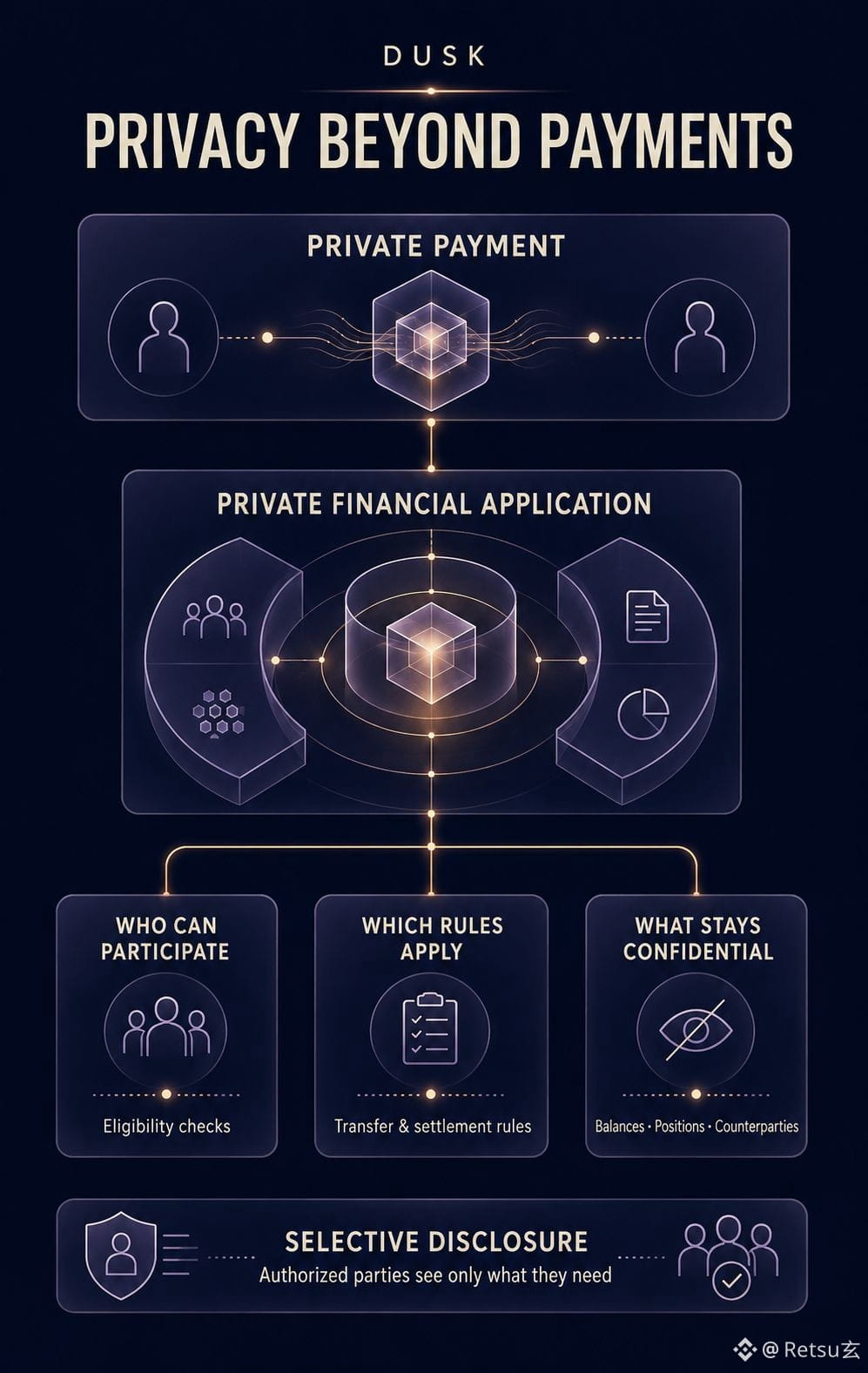
I've been around long enough to notice that crypto often treats privacy as a transfer feature: hide the sender, receiver or amount, and call the job done. That matters, but one private payment does not make a private financial system. The app around it can still expose positions, eligibility, counterparties and transaction rules.
Something about Dusk caught my attention. Phoenix offers shielded, note-based transfers, while Moonlight keeps a public account path. More interesting is what sits above the payment. Dusk's contracts and identity layer are designed so an app can check eligibility, enforce transfer or settlement conditions, and disclose selected facts to an issuer or auditor without publishing everything.
I've seen similar ideas before, and the hard part was rarely cryptography alone. It was deciding where privacy ends: who gets viewing rights, how access is governed, what metadata leaks, and whether users understand the choices. Private finance still needs liquidity, pricing, recovery and decent wallets. Confidential execution does not erase those problems.
I keep wondering whether crypto has framed privacy too narrowly. Bitcoin showed that value can move without a bank, but its open ledger also showed how much a payment trail reveals. Dusk is testing a broader idea: perhaps the useful unit of privacy is not one transaction, but the financial relationship around it. I'm still not convinced the trade-offs are solved, but that question feels worth following.
I've been around long enough to notice that crypto often treats privacy as a transfer feature: hide the sender, receiver or amount, and call the job done. That matters, but one private payment does not make a private financial system. The app around it can still expose positions, eligibility, counterparties and transaction rules.
Something about Dusk caught my attention. Phoenix offers shielded, note-based transfers, while Moonlight keeps a public account path. More interesting is what sits above the payment. Dusk's contracts and identity layer are designed so an app can check eligibility, enforce transfer or settlement conditions, and disclose selected facts to an issuer or auditor without publishing everything.
I've seen similar ideas before, and the hard part was rarely cryptography alone. It was deciding where privacy ends: who gets viewing rights, how access is governed, what metadata leaks, and whether users understand the choices. Private finance still needs liquidity, pricing, recovery and decent wallets. Confidential execution does not erase those problems.
I keep wondering whether crypto has framed privacy too narrowly. Bitcoin showed that value can move without a bank, but its open ledger also showed how much a payment trail reveals. Dusk is testing a broader idea: perhaps the useful unit of privacy is not one transaction, but the financial relationship around it. I'm still not convinced the trade-offs are solved, but that question feels worth following.