I spent enough time around smart-contract tooling to become suspicious of anything that says "less boilerplate." Usually it just means the boilerplate moved somewhere I haven't found yet.
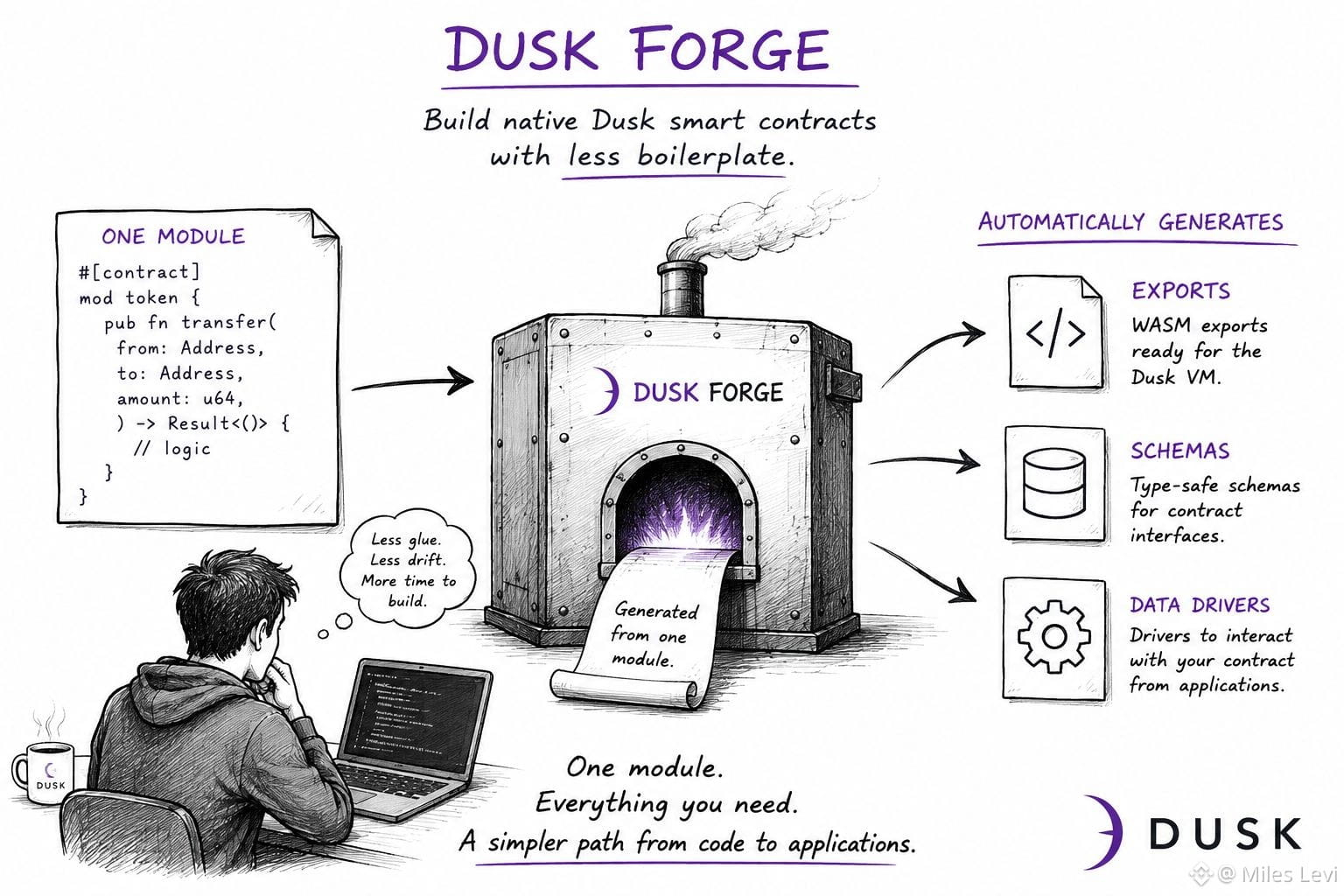
That's why Dusk Forge caught my attention. Not because it makes Rust suddenly easy, but because it attacks a specific irritation: writing a native Dusk contract usually means handling the contract itself, its WASM exports, schemas, and the data-driver layer that lets apps talk to it. Forge's #[contract] macro generates those from one module instead of making the developer maintain them separately.
On paper, that's small. In practice, small friction decides what gets built. I've seen chains with elegant execution models lose developers because the day-to-day workflow felt like punishment. The core idea was fine. The mechanics weren't.
But there's a catch. Abstraction hides complexity, it doesn't remove it. A generated schema is useful until it drifts. A data-driver is convenient until frontend, wallet, node, and contract versions stop agreeing. Dusk's own docs admit native DuskVM dev still means Dusk-specific tooling, while EVM gives you the wider Ethereum ecosystem.
So I'm not reading Forge as a breakthrough. I'm reading it as maintenance work. After enough cycles, I trust maintenance work more than breakthrough language.
Liquidity doesn't care how elegant the macro expansion looks. Users care whether the app works, whether the exit is boring.
Maybe that's the part worth watching — not whether Forge sounds easier, but whether building on Dusk gets cheaper in the invisible ways.
@Dusk #dusk $DUSK
That's why Dusk Forge caught my attention. Not because it makes Rust suddenly easy, but because it attacks a specific irritation: writing a native Dusk contract usually means handling the contract itself, its WASM exports, schemas, and the data-driver layer that lets apps talk to it. Forge's #[contract] macro generates those from one module instead of making the developer maintain them separately.
On paper, that's small. In practice, small friction decides what gets built. I've seen chains with elegant execution models lose developers because the day-to-day workflow felt like punishment. The core idea was fine. The mechanics weren't.
But there's a catch. Abstraction hides complexity, it doesn't remove it. A generated schema is useful until it drifts. A data-driver is convenient until frontend, wallet, node, and contract versions stop agreeing. Dusk's own docs admit native DuskVM dev still means Dusk-specific tooling, while EVM gives you the wider Ethereum ecosystem.
So I'm not reading Forge as a breakthrough. I'm reading it as maintenance work. After enough cycles, I trust maintenance work more than breakthrough language.
Liquidity doesn't care how elegant the macro expansion looks. Users care whether the app works, whether the exit is boring.
Maybe that's the part worth watching — not whether Forge sounds easier, but whether building on Dusk gets cheaper in the invisible ways.
@Dusk #dusk $DUSK