My cousin works at a small brokerage in Rotterdam, and last night she asked me, half-joking, "so which coin is going to steal my job." I said probably none of them. Then I mentioned Dusk and she got quiet in a way that made me go look closer.
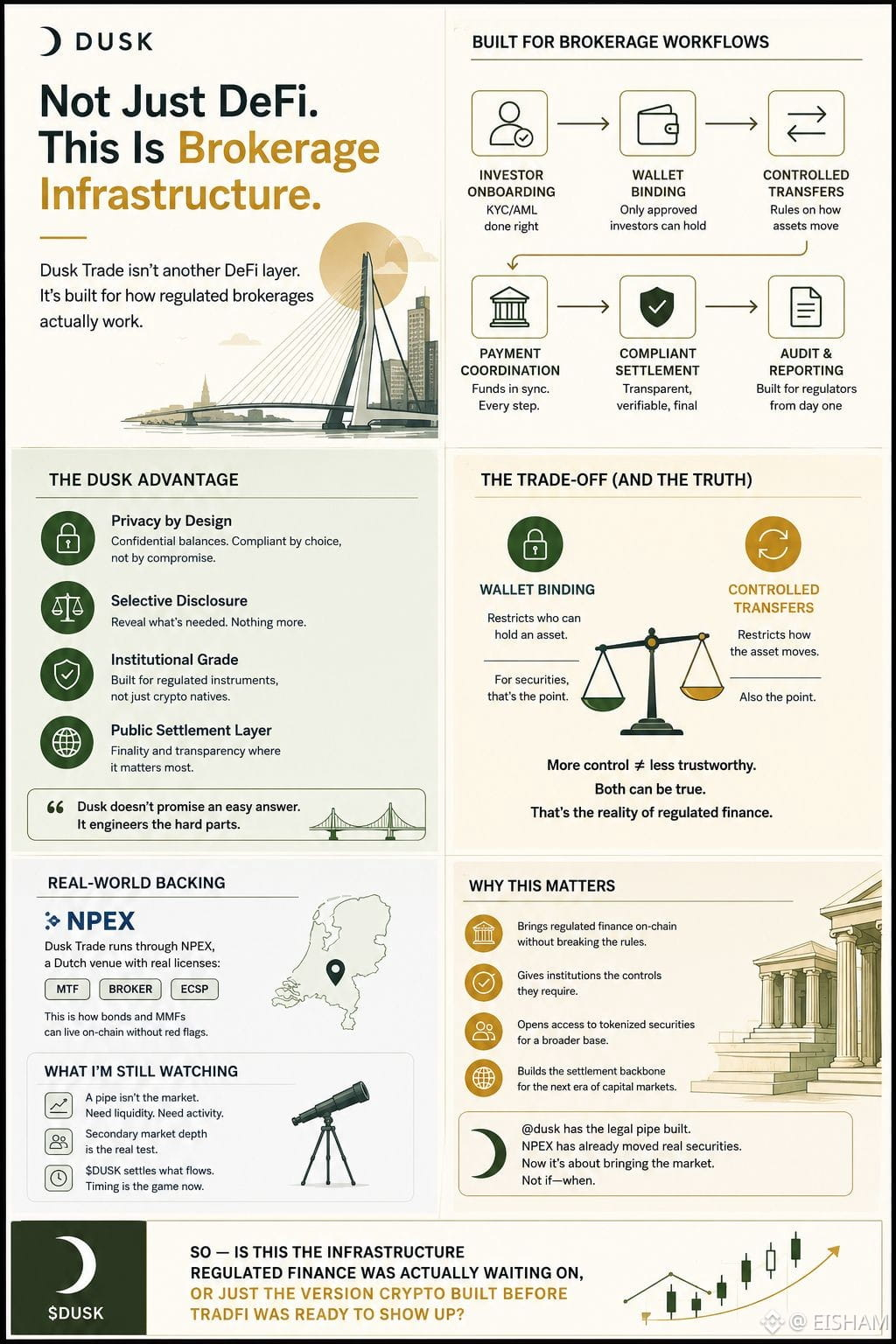
Dusk Trade is the part of the stack I hadn't really sat with before. It's not another DeFi front-end bolted onto a chain. It's built around actual brokerage workflows — investor onboarding, wallet binding, controlled transfers, payment coordination, compliant settlement. That's the language of a regulated exchange, not a token launch. And it isn't theoretical. It runs through NPEX, a Dutch venue holding actual MTF, Broker, and ECSP licenses, which is how you get bonds and MMFs onchain without a lawyer immediately objecting.
Here's what I keep circling back to though. "Wallet binding" means Dusk can restrict who's allowed to even hold an asset. "Controlled transfers" means it can restrict how that asset moves after that. For a security, that's not optional, that's the whole point. But it's also the exact thing that makes some people say this isn't really decentralized anymore. Both things are true at once and I don't think there's a clean way around it.
@Dusk has the legal pipe built. NPEX has already moved real securities through it. What I haven't seen yet is a liquid, actively traded secondary market on the other end — and a pipe nobody's using much yet is still just a pipe. $DUSK settles whatever eventually flows through it, so I guess the real question is timing, not architecture.
So — is this the infrastructure regulated finance was actually waiting on, or just the version crypto built before TradFi was ready to show up?
#dusk $DUSK
Dusk Trade is the part of the stack I hadn't really sat with before. It's not another DeFi front-end bolted onto a chain. It's built around actual brokerage workflows — investor onboarding, wallet binding, controlled transfers, payment coordination, compliant settlement. That's the language of a regulated exchange, not a token launch. And it isn't theoretical. It runs through NPEX, a Dutch venue holding actual MTF, Broker, and ECSP licenses, which is how you get bonds and MMFs onchain without a lawyer immediately objecting.
Here's what I keep circling back to though. "Wallet binding" means Dusk can restrict who's allowed to even hold an asset. "Controlled transfers" means it can restrict how that asset moves after that. For a security, that's not optional, that's the whole point. But it's also the exact thing that makes some people say this isn't really decentralized anymore. Both things are true at once and I don't think there's a clean way around it.
@Dusk has the legal pipe built. NPEX has already moved real securities through it. What I haven't seen yet is a liquid, actively traded secondary market on the other end — and a pipe nobody's using much yet is still just a pipe. $DUSK settles whatever eventually flows through it, so I guess the real question is timing, not architecture.
So — is this the infrastructure regulated finance was actually waiting on, or just the version crypto built before TradFi was ready to show up?
#dusk $DUSK