I cracked open Dusk's execution pipeline this morning—and realized most chains are just patching privacy onto an EVM foundation built for transparency. Dusk rebuilt the stack from the circuit upward.
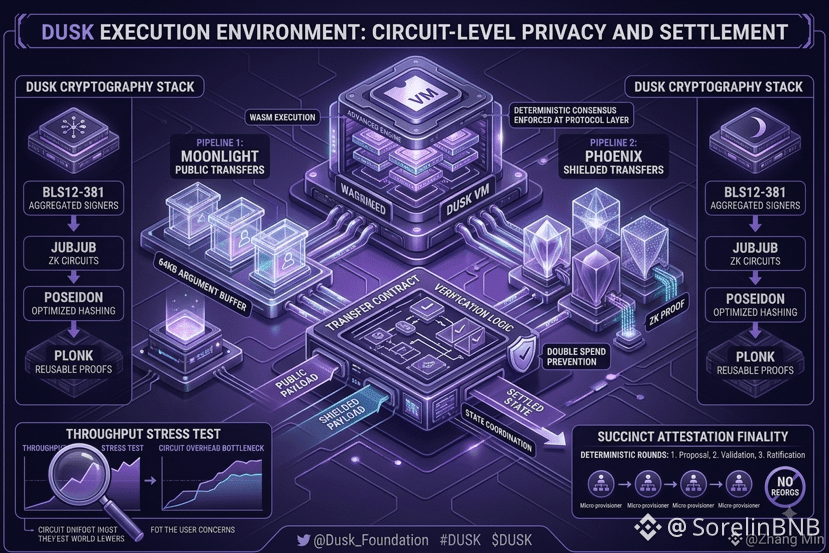
DuskVM executes WASM bytecode, not EVM. Contracts compile to WASM and pass through a 64KB argument buffer. Execution results must be identical across every node or consensus validation fails. That's deterministic execution enforced at the protocol layer, not assumed.
The settlement pipeline runs two native transaction models in parallel—Moonlight for public, account-based transfers, Phoenix for shielded, UTXO-style transfers with ZK proofs. Both settle to the same chain through the Transfer Contract, which accepts both payload types, routes them to verification logic, and prevents double spends. Protocol-level state coordination, not a UI toggle.
Cryptography stack: BLS12-381 for aggregated signatures and BLS threshold, JubJub for efficient ZK circuits, Poseidon for circuit-optimized hashing, PLONK for reusable, on-chain-verifiable proofs. All in pure Rust. Succinct Attestation finalizes through three deterministic rounds—proposal, validation, ratification—with randomly selected provisioners. No reorgs. No probabilistic finality. Average block time: ~2 seconds.
What isn't addressed: whether the WASM execution pipeline with ZK-integrated privacy maintains throughput under institutional trading volumes, or whether circuit overhead becomes the next bottleneck.
What I'm sitting with: Dusk didn't fork a chain. It built an execution environment where privacy, compliance, and settlement are the same engineering problem—solved at the circuit level before the first transaction ever settled.
@Dusk #DUSK
#dusk $DUSK $WAL $ACE
DuskVM executes WASM bytecode, not EVM. Contracts compile to WASM and pass through a 64KB argument buffer. Execution results must be identical across every node or consensus validation fails. That's deterministic execution enforced at the protocol layer, not assumed.
The settlement pipeline runs two native transaction models in parallel—Moonlight for public, account-based transfers, Phoenix for shielded, UTXO-style transfers with ZK proofs. Both settle to the same chain through the Transfer Contract, which accepts both payload types, routes them to verification logic, and prevents double spends. Protocol-level state coordination, not a UI toggle.
Cryptography stack: BLS12-381 for aggregated signatures and BLS threshold, JubJub for efficient ZK circuits, Poseidon for circuit-optimized hashing, PLONK for reusable, on-chain-verifiable proofs. All in pure Rust. Succinct Attestation finalizes through three deterministic rounds—proposal, validation, ratification—with randomly selected provisioners. No reorgs. No probabilistic finality. Average block time: ~2 seconds.
What isn't addressed: whether the WASM execution pipeline with ZK-integrated privacy maintains throughput under institutional trading volumes, or whether circuit overhead becomes the next bottleneck.
What I'm sitting with: Dusk didn't fork a chain. It built an execution environment where privacy, compliance, and settlement are the same engineering problem—solved at the circuit level before the first transaction ever settled.
@Dusk #DUSK
#dusk $DUSK $WAL $ACE