#dusk $DUSK @Dusk
Privacy Isn’t the Extra Layer on DuskEVM
At first, DuskEVM looked like a familiar route for Solidity developers standard EVM tooling, familiar contracts, and an easier path for builders entering a new ecosystem.
The deeper I looked, the more that assumption fell apart.
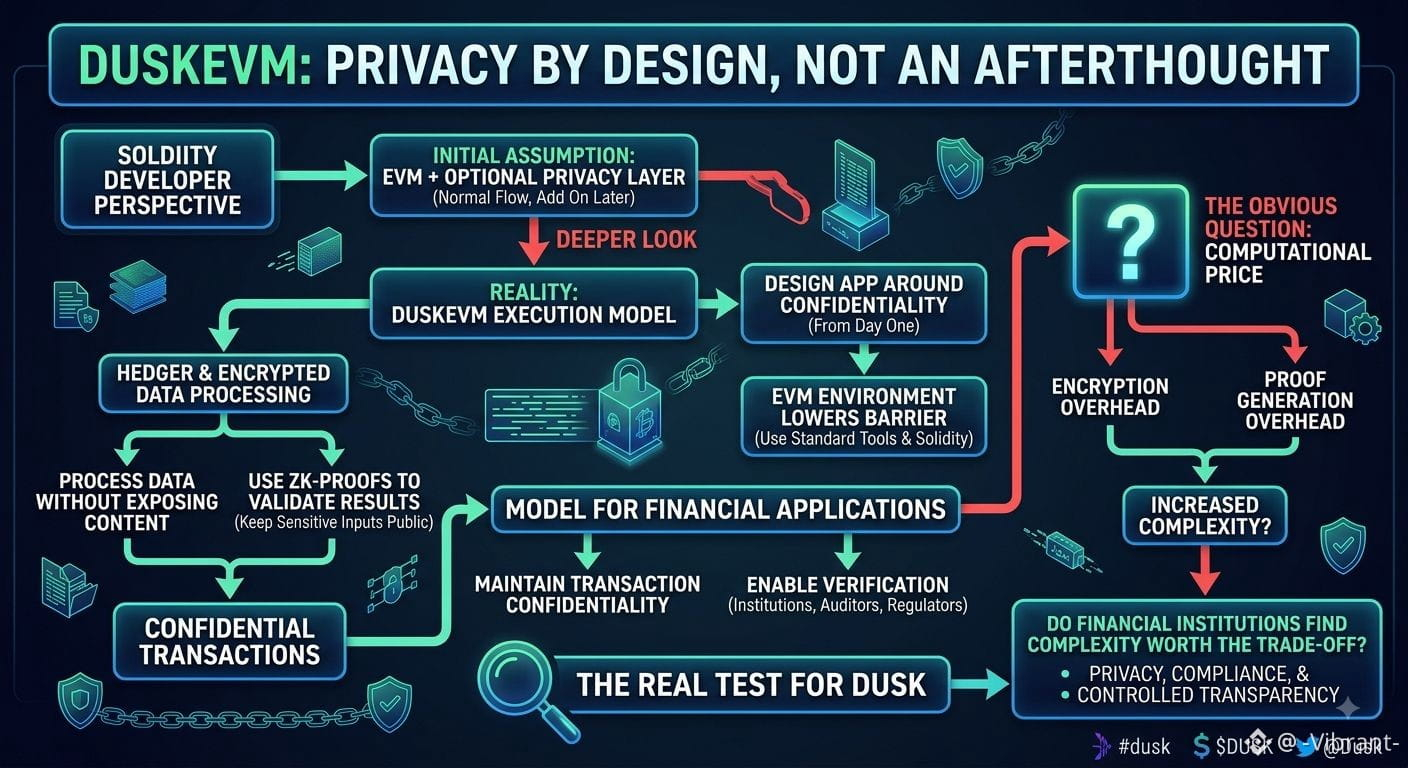
Hedger makes privacy part 0f the execution model itself. Encrypted data can be processed without exposing the underlying information, while zero knowledge proofs can validate the result without making sensitive inputs public. That creates a very different model for financial applications transactions can stay confidential while still allowing authorized institutions, auditors, or regulators to verify what matters.
That distinction is important. The idea isnt simply “build normally and add a privacy layer later.” Developers can design applications around confidentiality from day one, while the EVM environment lowers the barrier for teams already familiar with Solidity.
But there’s an obvious question privacy has a computational price. Encryption and proof generation can introduce additional overhead compared with ordinary transparent transactions.
So the real test for Dusk isnt whether confidential execution is technically possible. It’s whether financial institutions consider that extra complexity a worthwhile trade for privacy, compliance, and controlled transparency.
That’s the part Im watching most closely.
#dusk $DUSK @Dusk
Privacy Isn’t the Extra Layer on DuskEVM
At first, DuskEVM looked like a familiar route for Solidity developers standard EVM tooling, familiar contracts, and an easier path for builders entering a new ecosystem.
The deeper I looked, the more that assumption fell apart.
Hedger makes privacy part 0f the execution model itself. Encrypted data can be processed without exposing the underlying information, while zero knowledge proofs can validate the result without making sensitive inputs public. That creates a very different model for financial applications transactions can stay confidential while still allowing authorized institutions, auditors, or regulators to verify what matters.
That distinction is important. The idea isnt simply “build normally and add a privacy layer later.” Developers can design applications around confidentiality from day one, while the EVM environment lowers the barrier for teams already familiar with Solidity.
But there’s an obvious question privacy has a computational price. Encryption and proof generation can introduce additional overhead compared with ordinary transparent transactions.
So the real test for Dusk isnt whether confidential execution is technically possible. It’s whether financial institutions consider that extra complexity a worthwhile trade for privacy, compliance, and controlled transparency.
That’s the part Im watching most closely.
#dusk $DUSK @Dusk