#dusk $DUSK
I’ve noticed that the more time I spend using transparent blockchains, the more complicated the idea of “transparency” starts to feel.
The first time I waited for an Ethereum transaction to confirm, curiosity pushed me toward a block explorer. What surprised me was not the delay, but how much financial history a public address could expose. That transparency is useful for verification, yet it becomes uncomfortable when the same model is applied to institutions that may be unable or unwilling to expose every position, balance, or counterparty relationship publicly.
That is what makes @Dusk interesting to me.
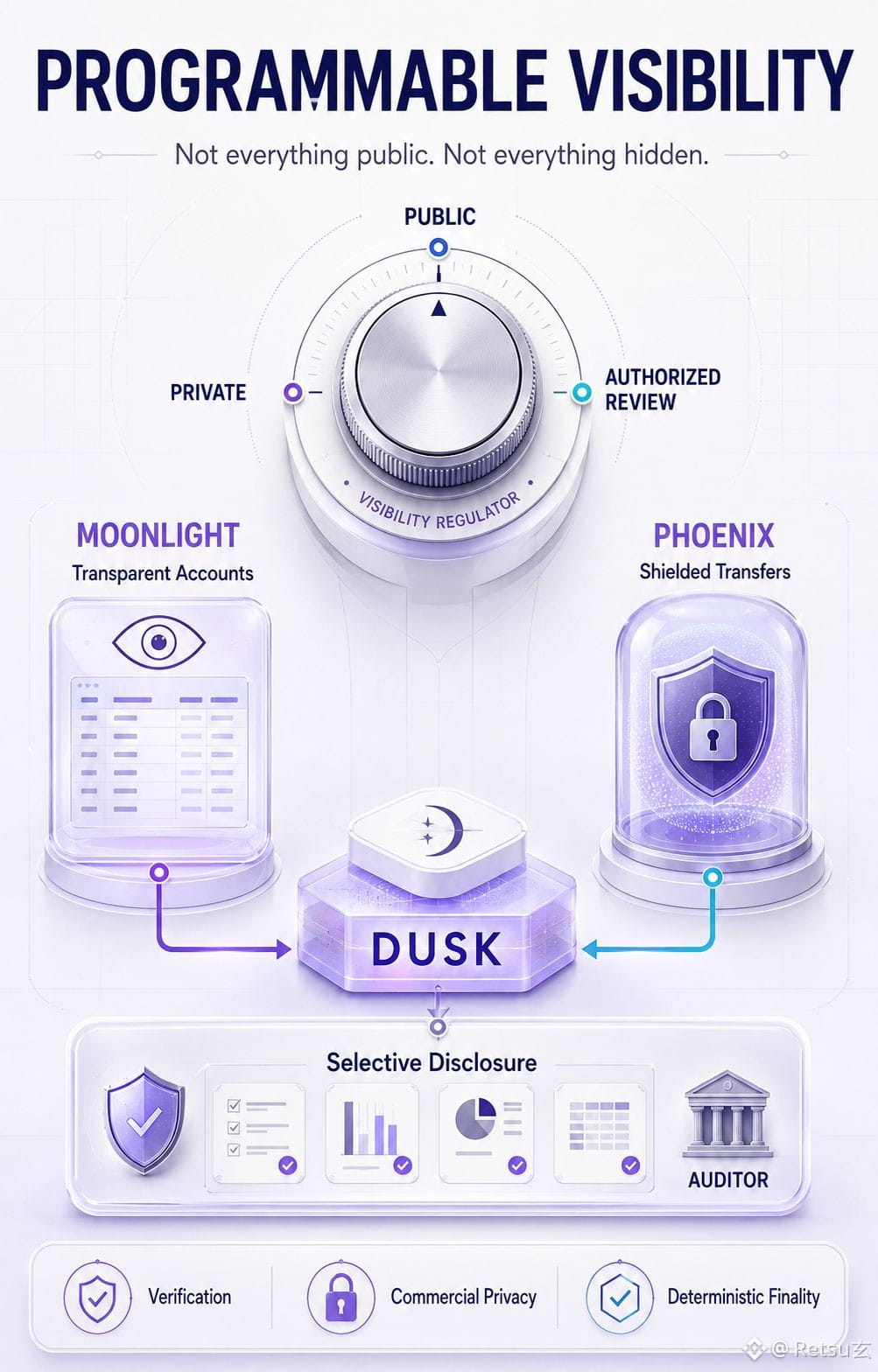
Dusk does not simply make everything private. Its architecture offers different visibility models. Moonlight is transparent and account-based, while Phoenix provides shielded UTXO transfers. In Phoenix transactions, sender, receiver, and transferred amount are hidden from the general public, while involved parties and holders of the appropriate view key can access relevant information.
The important idea, then, is not “privacy versus transparency.” It is programmable visibility.
Dusk also uses zero-knowledge proofs and selective disclosure, allowing financial workflows to keep unnecessary information confidential while providing controlled evidence when authorized parties need it. Its Succinct Attestation consensus provides deterministic finality once a block is ratified.
Ethereum is not standing still either. Privacy technologies continue to develop there, while ZK-rollups should not automatically be treated as private transaction systems because their primary role is scaling through validity proofs.
So I keep coming back to one question: if financial activity can remain shielded by default, exactly what should an auditor be allowed to access, and who should control that permission?
That boundary may matter more for institutional adoption than simply making every transaction public.
I’ve noticed that the more time I spend using transparent blockchains, the more complicated the idea of “transparency” starts to feel.
The first time I waited for an Ethereum transaction to confirm, curiosity pushed me toward a block explorer. What surprised me was not the delay, but how much financial history a public address could expose. That transparency is useful for verification, yet it becomes uncomfortable when the same model is applied to institutions that may be unable or unwilling to expose every position, balance, or counterparty relationship publicly.
That is what makes @Dusk interesting to me.
Dusk does not simply make everything private. Its architecture offers different visibility models. Moonlight is transparent and account-based, while Phoenix provides shielded UTXO transfers. In Phoenix transactions, sender, receiver, and transferred amount are hidden from the general public, while involved parties and holders of the appropriate view key can access relevant information.
The important idea, then, is not “privacy versus transparency.” It is programmable visibility.
Dusk also uses zero-knowledge proofs and selective disclosure, allowing financial workflows to keep unnecessary information confidential while providing controlled evidence when authorized parties need it. Its Succinct Attestation consensus provides deterministic finality once a block is ratified.
Ethereum is not standing still either. Privacy technologies continue to develop there, while ZK-rollups should not automatically be treated as private transaction systems because their primary role is scaling through validity proofs.
So I keep coming back to one question: if financial activity can remain shielded by default, exactly what should an auditor be allowed to access, and who should control that permission?
That boundary may matter more for institutional adoption than simply making every transaction public.