#dusk $DUSK @Dusk
I was helping my son with homework late tonight when he suddenly asked me:
“What happens if the computer crashes?”
My first instinct was simple: “Just restart it.”
But then I thought about something I’ve been reading in the Dusk whitepaper, and the question suddenly felt much bigger.
A blockchain can look impressive when everything is working perfectly. The real test, though, is what happens when things start going wrong.
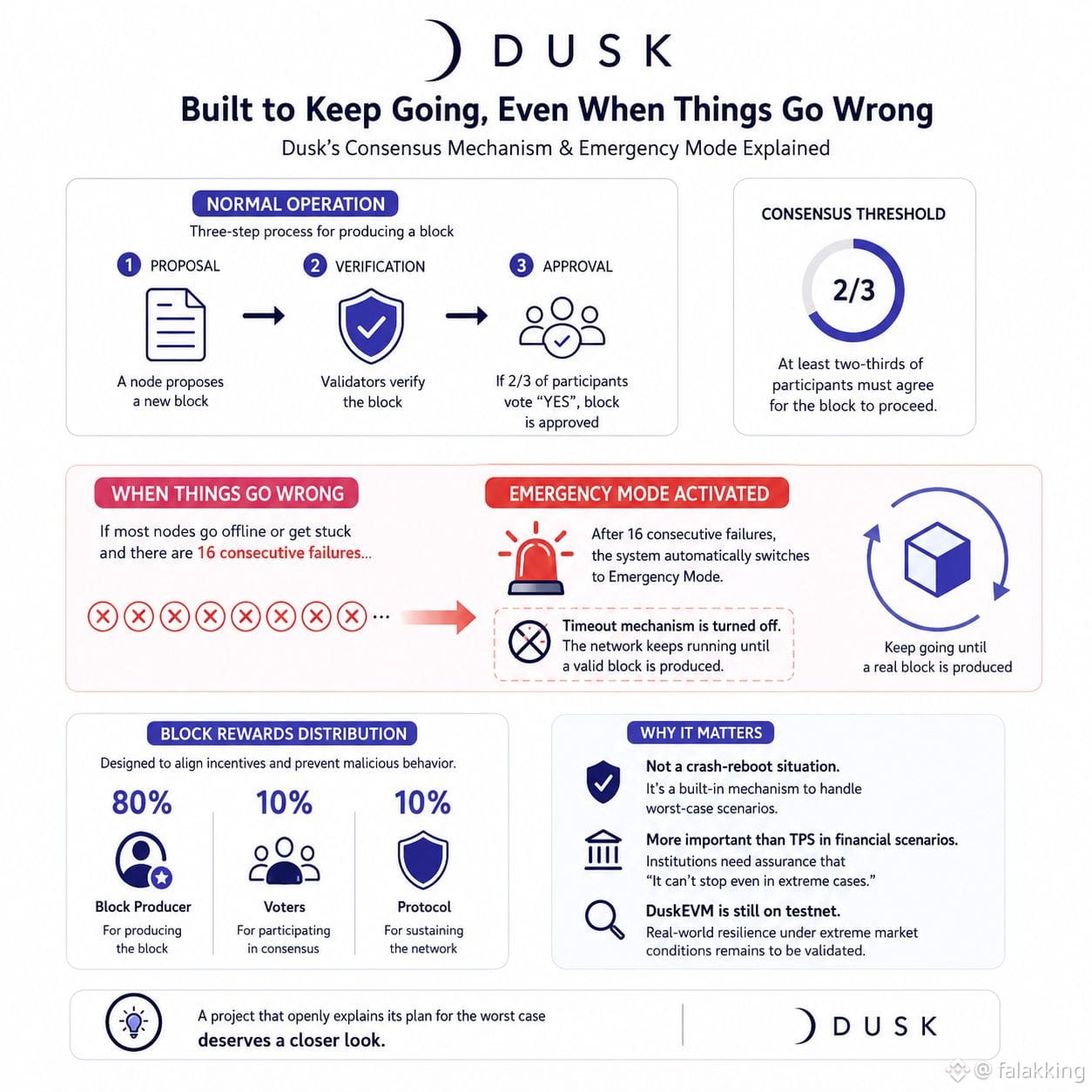
Dusk’s consensus design has a normal flow: a block is proposed, verified, and then approved. If enough participants agree—2/3—the block moves forward.
But what if the network gets stuck?
According to the design, after 16 consecutive failed attempts, the system can enter an “emergency mode.” Instead of simply stopping and waiting for someone to restart it, the timeout mechanism is disabled and the network keeps working until a valid block is produced.
That’s a very different mindset from “just reboot.”
It’s basically a contingency plan built into the consensus process.
And this is where I find Dusk interesting. For financial infrastructure, reliability during abnormal conditions may matter more than another impressive TPS number. Institutions need to know what happens when participation drops, nodes fail, or the network faces unexpected stress.
Even the reward structure shows how much attention is given to incentives: 80% goes to the block producer, 10% to voters, and 10% to the protocol.
Of course, design on paper is one thing. Proving it under real-world conditions is another.
DuskEVM is still on testnet, so I’m not ready to call any of this proven at scale.
But the deeper I look, the more I believe this is the question worth asking about any serious blockchain:
Don’t show me only how the network works when everything goes right. Show me what happens when everything goes wrong.
I was helping my son with homework late tonight when he suddenly asked me:
“What happens if the computer crashes?”
My first instinct was simple: “Just restart it.”
But then I thought about something I’ve been reading in the Dusk whitepaper, and the question suddenly felt much bigger.
A blockchain can look impressive when everything is working perfectly. The real test, though, is what happens when things start going wrong.
Dusk’s consensus design has a normal flow: a block is proposed, verified, and then approved. If enough participants agree—2/3—the block moves forward.
But what if the network gets stuck?
According to the design, after 16 consecutive failed attempts, the system can enter an “emergency mode.” Instead of simply stopping and waiting for someone to restart it, the timeout mechanism is disabled and the network keeps working until a valid block is produced.
That’s a very different mindset from “just reboot.”
It’s basically a contingency plan built into the consensus process.
And this is where I find Dusk interesting. For financial infrastructure, reliability during abnormal conditions may matter more than another impressive TPS number. Institutions need to know what happens when participation drops, nodes fail, or the network faces unexpected stress.
Even the reward structure shows how much attention is given to incentives: 80% goes to the block producer, 10% to voters, and 10% to the protocol.
Of course, design on paper is one thing. Proving it under real-world conditions is another.
DuskEVM is still on testnet, so I’m not ready to call any of this proven at scale.
But the deeper I look, the more I believe this is the question worth asking about any serious blockchain:
Don’t show me only how the network works when everything goes right. Show me what happens when everything goes wrong.